

Fiio Level 1 is a Great Looks, Power, Sonics and PEQ for 140$ Jadeaudio Review
I can tell you right now, there are four reasons to get this amp: great vintage-style real wood panel looks, the FiiO app's PEQ, big power output, and good sonic quality. That makes it one of the most complete packages in this cheap Class D market. Let's go into a little more detail.
Build Quality/Specs

Jade Audio is FiiO's newer sub-brand, and the Level 1 is its first stab at a desktop power amplifier. It lands at $139.99, built around the Texas Instruments TPA3255 chip that has quietly become the backbone of an entire tier of budget hi-fi, and it arrives with a specification sheet that leads with a genuinely eyebrow-raising number: up to 300 watts per channel. Numbers like that tend to invite skepticism, and rightly so. What's actually going on underneath is more interesting, and more honest, than the headline figure suggests, and that's worth unpacking properly before getting to how it sounds.
In the box you get the amplifier itself, the included power supply, a power cord, a quick start guide, and a warranty card. Nothing unusual there.
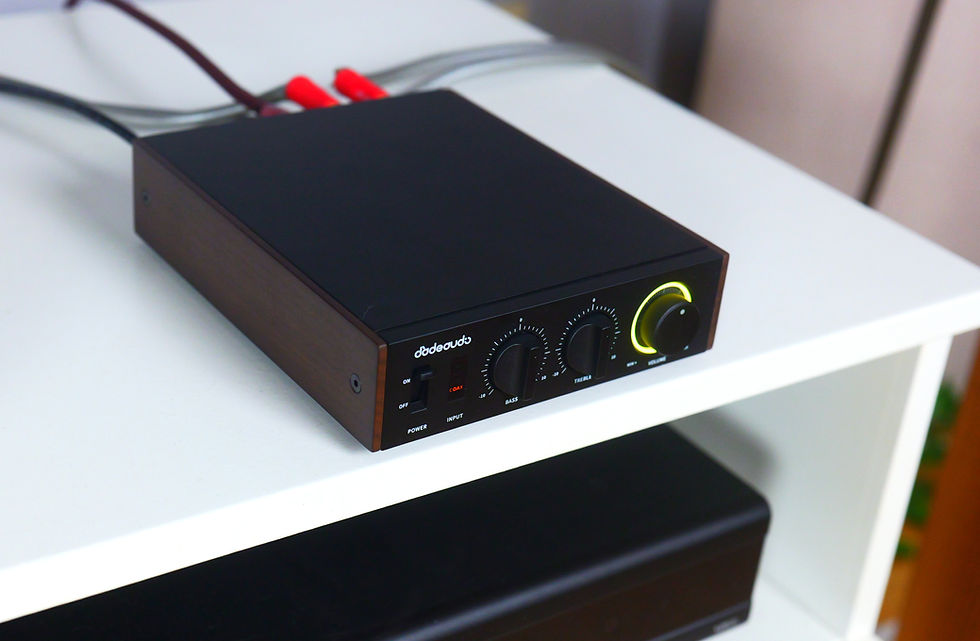
What is unusual is the chassis. It's 181 by 133 by 36 millimeters, about 676 grams, an aluminum alloy body with real wood side panels, not a wood veneer sticker, actual wood. It comes in two color combos: black with walnut panels, or silver with maple panels. For a hundred-and-forty-dollar Class D amp, this is a genuinely premium-looking object on a desk. The layout up front is simple: power and input selector on the left, bass and treble knobs, and a big machined volume knob on the right, with an RGB ring around it that changes color depending on which input is active, and which Bluetooth codec is in use if you're on wireless.
Clarifying a bit Dishonest Marketing
I have to mention a few sneaky tactics that FiiO uses here that amount to false marketing.
This is the section most reviews rush through, and it's the one you actually need to understand before you buy this amp, because Jade Audio's marketing leans hard on one number: 300 watts per channel. Let's break down what's real.
What ships in the box: a 48 volt, 5 amp, 240 watt external power supply, made by Merryking. That's a genuinely substantial included supply; most TPA3255 amps at this price ship with something smaller.
With that included supply, FiiO's own spec sheet says:
4 ohm load: 120 watts plus 120 watts, under 1% THD+N
8 ohm load: 115 watts plus 115 watts, under 1% THD+N
Best case distortion figure: under 0.0025% THD+N at 1kHz, which works out to roughly 92dB SINAD
Signal to noise ratio: 108dB or better, A-weighted
Dynamic range: 103dB or better
That is the real-world number for the amp as sold, out of the box, no extra purchases. And 120 watts into 4 ohms clean is already more than enough for the vast majority of bookshelf speakers.
Where the 300 watt figure comes from: the amplifier accepts anywhere from 24 volts up to 53 volts on its DC input, so there's room built into the platform to push harder than stock. If you feed it an optional 53 volt, 12 amp supply, FiiO quotes a peak of 300 watts plus 300 watts into 4 ohms. But check the fine print on that number: it's measured at 10% THD+N. Just to put that in perspective, 1% distortion already sits at the edge of what most ears would call clean, so 10% is well past the point where you'd actually hear the sound falling apart. It's a "the chip survives at full tilt" number, not a listening number.
Look one line further down FiiO's own sheet and you get the figure that actually matters: same 53 volt supply, capped at 1% THD+N instead, and you're looking at 240 watts plus 240 watts into 4 ohms, 135 watts plus 135 watts into 8 ohms. That's the genuine step up on offer if you go hunting for the bigger supply, real, just not the number on the box.
The catch: that 53 volt, 12 amp supply is not sold by Jade Audio or FiiO. It doesn't ship in the box, and there isn't an official accessory to buy. If you want it, you're sourcing a third-party 53V/12A supply yourself, and by the time you've bought a decent one, you've spent close to what the amplifier itself cost. So functionally, this is a "the platform can do more if you go looking" spec, not a "buy this and unlock it" spec. Worth knowing going in, because the box art and the marketing lead with 300 watts, and the number most buyers will actually live with day to day is 120 watts into 4 ohms.
Bottom line on power: as sold, this is a genuinely potent 120 watt per channel amp into 4 ohms, comfortably enough for the vast majority of bookshelf and even some floorstanding speakers. The 300 watt figure is real, but it is a best-case, third-party PSU, near-clipping number, not the out-of-box experience.
The greatest reasone to get this Amp
On the back there's an RCA line input, USB-C, coaxial, an RCA output for a preamp, and also a sub out. There's no optical, which would have been nice. But with all these inputs, there is a DAC inside. What DAC, and what quality, remains a bit of a mystery to me, as FiiO doesn't mention the DAC in any documentation. It's also worth noting it can work as a preamp, though I'm not sure why anyone would use it that way.
This, for me, is the feature that actually separates the Level 1 from a lot of the TPA3255 crowd. Through FiiO Control, on iOS and Android, you get:
A real parametric EQ, not a token two-band tone stack. Full band editing: frequency, filter type, and Q, with three custom slots plus built-in presets
Volume and channel balance control
Source selection
Front LED on/off toggle
Built-in documentation for the panel layout and indicator lights
One important behavior to know before you set this up: the PEQ and channel balance only work on the digital inputs, meaning USB-C, coaxial, and Bluetooth. If you feed the Level 1 from the analog RCA line input, say from an external preamp, the signal bypasses the internal DAC and DSP entirely and goes straight to the amplifier stage. No EQ, no balance adjustment available in the app in that mode. That's a real design tradeoff to understand if you're planning to use this purely as a power amp behind an existing preamp: you lose the app's headline feature in that configuration. Feed it digitally instead, and everything comes back.

No PFFB
The one thing this platform does not have is PFFB, Predictive Fast Feedback, a hardware-level correction some competing TPA3255 designs use to keep frequency response more consistent across different speaker impedances. Without it, frequency response can shift slightly depending on what you connect. In practice the PEQ largely compensates, since you can just measure or listen and dial it back flat if needed, but it's a genuine, checkable difference between this and some rivals.
Sonic Quality
I'd love to spend more time talking about sound, but honestly, if you've had experience with the TPA3255 chip, you already know what this is all about. I can't recommend this as a step up if you already own something like the Fosi ZA3, Ampapa D1, or Aiyima A70 or A80. You won't get more sonically from this. You'll get clear sound and signal, amplified with a nice power level. But let me explain that a bit more.
I ran the Level 1 through several pairs of bookshelf speakers over a few weeks, going back and forth between a flat setting and the FiiO Control app's PEQ dialed in per speaker.
What stands out first isn't any single frequency band, it's how composed the whole presentation stays once you push it. Nothing about this amp suggests it's working hard, even when the volume climbs well past comfortable desk levels. Transients arrive and leave cleanly, without any sense of the amplifier catching up to the music or running out of headroom before you expect it to.
Down low, the bass has real grip. Notes start and stop on cue, with no trailing bloom or one-note thickness that lingers past where it should. The front panel bass knob is a coarse tool, useful for a quick global lift if a speaker runs lean, but the PEQ is where the real correction work happens, letting you go after a specific hump or dip in the bass rather than boosting everything below a certain point.
The midband is where this amp mostly gets out of the way. Vocals and instruments land with the right sense of body and don't get pushed forward or pulled back artificially, and I didn't catch the Level 1 adding its own tonal signature here. Switch the PEQ on with a curve tuned to the speaker actually connected, and things get noticeably cleaner still, with more separation between instruments and less smearing on busier passages.
Up top, extension is solid, and I never ran into the glare or hardness that shows up on lesser Class D implementations when pushed. The treble knob works as a gentle top-end trim rather than anything drastic, handy if a particular speaker is a touch forward in your room. Even at higher volumes, nothing turned splashy or fatiguing.
On power, the on-paper numbers back up what the ears suggest: 120 watts per channel into 4 ohms and 115 into 8 ohms from the stock power supply, both under 1% distortion, comfortably more than a typical bookshelf pair will ever need. And because the TPA3255 design is inherently efficient, none of this comes with a heat penalty; the chassis stayed cool through hours-long sessions at volume.
But all in all, this is a very Class D sound, with all the peaks and benefits that come with Class D sound.

For whom this amp is for?
So why should you buy this instead of something else?
Who should actually buy this, versus something else
Rather than walking through a list of rival boxes one by one, it's more useful to ask the question the way an actual buyer would: what does your setup already have, and what are you trying to avoid buying twice?
You already own a DAC or a streamer, and just need clean power. Skip the Level 1. There are bare TPA3255 power amps in the $80 to $110 range that do nothing but amplify, no app, no Bluetooth, no DAC to duplicate what you already own, and they do that one job very well. Paying extra here for a DAC and Bluetooth section you'll never use is money down the drain.
You want hardware-level frequency stability guaranteed, not just PEQ correcting for its absence. Look toward the $150-plus PFFB-focused amps instead. They hold response steady across different speaker loads at the circuit level rather than asking you to measure and correct afterward. The tradeoff is you're back to sourcing your own DAC and streamer separately, and by the time that's done you've usually spent more in total than the Level 1 costs by itself.
Absolute measured performance is the only thing that matters to you, full stop. There's a purist tier north of €250 running dual amplifier chips in a bridged configuration with premium capacitors throughout, delivering SINAD numbers meaningfully ahead of anything else mentioned here, and running cooler doing it. It also assumes you're bringing your entire source chain and don't want or need Bluetooth, a DAC, a remote, or tone controls. It's an amplifier for someone who already has firm opinions about their system, not a starting point.
A physical remote and a screen genuinely matter to you. There's a roughly $200 integrated amp with a built-in DAC, hardware PFFB, and a small VU meter with real remote control, everything the Level 1 doesn't offer in that department. Its tone controls are broad shelf adjustments though, no per-band correction, so if surgical room correction matters more to you than a remote, that trade goes the other way.
You're running a powered subwoofer and want it integrated properly. A separate $200 option built specifically for 2.1 systems includes a genuinely adjustable high-pass filter you can dial anywhere from 30Hz to 200Hz in hardware, which the Level 1 simply doesn't offer. No PEQ or DAC on that one, so it's solving one problem very well rather than several problems adequately.
You want the single most connected box regardless of price, and don't mind a fan. Around $280 to $300 sits the most fully loaded option here: better Bluetooth codec support, a motorized remote volume knob, hardware high-pass filtering, and dual analog inputs. The catch is a cooling fan that's inaudible from across a room but noticeable if you're sitting right next to it on a quiet night.
You want streaming baked directly into the amplifier, not added as a separate box. There's a roughly $300 option built around full network streaming with its own app ecosystem, essentially a different category of product wearing an amplifier's shape.
Once you've ruled those specific needs in or out, what's left is a fairly narrow gap, and that's exactly where the Level 1 sits. It's the one option here that puts a real DAC, LDAC Bluetooth, genuinely deep parametric EQ, and a chassis that looks and feels considerably pricier than it is, all into a single $139.99 box, without asking you to also own a separate source, a separate DAC, or a separate streaming device first. That's not a claim that it beats every amp on every axis, it doesn't, it's a claim about what one box, at this specific price, is capable of covering on its own.
And that is all.
Hope you enjoyed this video.
Jadeaudio Level 1:
Pros
Genuinely premium build for the price: aluminum chassis with real wood side panels (walnut or maple), machined volume knob with RGB input indicator ring
Real parametric EQ through the FiiO Control app: full band editing with frequency, filter type and Q, three custom slots plus presets. Rare at this price and the standout feature vs the TPA3255 crowd
Strong out-of-box power: 120W + 120W into 4 ohms and 115W + 115W into 8 ohms under 1% THD+N, plenty for virtually any bookshelf pair
Substantial included 48V/5A 240W power supply, bigger than what most rivals ship with
Good measured performance: down to 0.0025% THD+N (roughly 92dB SINAD), 108dB SNR, 103dB dynamic range
Complete one-box package at $139.99: internal DAC, LDAC Bluetooth, USB-C, coaxial, RCA in, pre out and sub out
Clean, composed sound with good bass grip, neutral mids and non-fatiguing treble; runs cool even at volume
App extras: channel balance, source selection, LED toggle
Cons
Misleading 300W marketing: that figure requires a third-party 53V/12A power supply that FiiO doesn't sell, and it's measured at 10% THD+N, well past audible distortion. Real out-of-box number is 120W into 4 ohms
No PFFB, so frequency response can shift slightly with speaker impedance (the PEQ can compensate, but it's a manual fix)
PEQ and channel balance only work on digital inputs; the analog RCA input bypasses the DSP entirely, so using it as a pure power amp kills the headline feature
No optical input
The internal DAC is undocumented; unknown chip and quality
Sonically no step up over existing TPA3255 amps like the Fosi ZA3, Aiyima A70/A80 or Ampapa D1


I know the level 1 and wiim amp pretty different beasts. But soundwise i wonder how they compare? I know both use 3255 chipset. Im aware the wiim is primary sold as a streamer, however for me id be more curious about sound quality comparison. If anyone has any thoughts on them. Thank you
Fiio's own web site about PFFB implementation and main selling points about the level 1. https://www.fiio.com/LEVEL_1
It actually has PFFB albeit not the best one but still decent. The amplifier remains well composed even when pushed hard with no treble edginess or bass strugle
The DAC is limited to 96K sample rate when using USB and my understanding it cannot receive DSD basically a limited DAC but coax input can receive 192K