

FiiO's First Real Class A Amp: I Love It, And It Nearly Cooked Itself Doing It
Let me just say this upfront. I love listening to this amp. I also had to check on it mid-session because it was running hot enough to worry me a little. Both of those things are true. That's basically the whole review in one sentence.
What is this thing, actually

FiiO didn't bother with a clever model name here. They called it, literally, the FiiO CLASS A. No K-number, no cryptic three digits. Just the topology, printed on the front like a dare.
It's also not a standalone product as much as it is a piece of a bigger idea. FiiO is positioning it as the amp stage in a full "retro desktop HiFi system," meant to stack with the DP11 CD transport and the Warmer R2R tube DAC, all sharing the same chassis width and design language so the three sit on top of each other like a proper vintage separates rig.
There's a wider family around it too, other sources like the K15 and BR15 R2R, and on the output side an AIR AMP and SP5 active speaker pairing if you want to run it as a full preamp into a small desktop system rather than just headphones. That context matters, because it tells you this box was never meant to be judged in isolation.
Class A in plain English, and why the alternatives exist
So what does "Class A" actually mean, and why isn't every amp built this way if it sounds this good?
It comes down to how the output transistors handle the audio signal. In a Class A design, the output devices conduct through the entire signal cycle, all 360 degrees of it, all the time, whether you're blasting a chorus or sitting in silence between tracks. They're biased with a constant current that never switches off. That's the "always on" behavior driving both the warmth people talk about and the heat you have to deal with. Because there's no point where one device hands off to another mid-waveform, there's no crossover distortion, the specific kind of glitch that happens right at that handoff point in other designs. The tradeoff is brutal inefficiency. A Class A stage burns roughly the same power whether it's idling or maxed out, so most of what you're paying for in electricity becomes heat, not sound.
Class AB is what you'll find in the vast majority of consumer amps, including FiiO's own K17. Here, each output transistor handles roughly half the waveform, one for the positive swing, one for the negative, with a small overlap where both are lightly conducting near the crossover point specifically to smooth over that handoff and reduce the distortion Class A avoids entirely. At idle or low volume, it behaves close to Class B, drawing much less current. Push it harder and it draws more, scaling with the signal instead of staying maxed out constantly. That's why an AB amp runs noticeably cooler day to day. You're trading away Class A's zero-crossover-distortion property for something that's dramatically more power efficient and much easier to keep cool in a compact chassis.
And then there's Class D, which barely resembles either. It throws out the analog conduction model entirely. Instead of the output devices tracking the waveform directly, they switch fully on or fully off at very high frequency, using pulse width modulation to encode the signal, then a filter reconstructs something close to the original analog waveform on the way out. Efficiency here can clear 90 percent, which is why Class D amps run cool and can be tiny even at high power. The historical knock against it was switching artifacts and a less refined top end, though modern Class D implementations have closed a lot of that gap. It's just a fundamentally different approach to the same problem, switching instead of continuously conducting.
So when FiiO leans this hard into the name, they're making a specific bet. Zero crossover distortion, that continuous, unhurried conduction character, in exchange for the heat and the size you're about to read about. It's the oldest, least efficient, and arguably most honest way to build an amplifier. Everything else in this review, the transformer, the capacitor bank, the thermal protection circuits, exists because FiiO chose to build it the hard way.
The circuit, in plain English

Here's where the marketing photos actually earned their keep. FiiO published the full signal path, and it's worth walking through because it explains a lot about what you're paying for.
Signal comes in and hits a volume and tone control stage built around an NJW1194 chip, which is also where the bass and treble adjustment lives. From there it passes through a gain control stage, then an OPA1642 buffer, and only then does it reach the actual Class A amplification circuit, which FiiO breaks into four internal stages: differential input, voltage amplification, current drive, and power amplification. Wrapped around that whole output stage is a DC servo feedback loop, constantly measuring the output and correcting any DC offset back toward zero.
And this whole chain is duplicated four times over, once for the positive and negative leg of the left channel, once for the positive and negative leg of the right. That's what "fully balanced differential architecture" actually means in hardware terms, not just a balanced jack on the front panel, but four complete, independent signal paths from input to output.
FiiO's own claim is that the DC servo circuit doesn't just protect your headphones, it improves bass response and transparency, resulting in a clearer, more controlled low end. Keep that in mind, because I'm going to push back on part of it later.
Two transistor types, one union, according to FiiO
This is the part that made me raise an eyebrow. FiiO doesn't just tell you what transistors are inside, they tell you what each type supposedly sounds like.
The amp uses 16 Toshiba twin matched-pair transistors, and FiiO's own description of them is "warm and smooth, with a relaxed low end and sweet, engaging vocals." Alongside those are 8 Sanken Electric audio transistors, which FiiO describes as "precise and fast with incisive dynamics and strong control," better suited to large-scale orchestral and rock material. All of it sits on a shared heatsink with the quiescent current manually calibrated by hand for every single unit, not set once in software and left alone.
I'll be honest, audio marketing loves to assign a specific personality to individual components like this, and whether a listener can genuinely isolate "that's the Toshiba pair talking" from "that's the Sanken pair talking" in a finished mix is a fair thing to be skeptical about. But keep those two claims in mind, they're worth testing against actual music later in this review.

The power supply, and a claim I want to test
The transformer is a custom 60W toroidal unit, wound on a continuous silicon steel strip core for low losses, with fully copper enamelled windings for low resistance and fast transient response. It's got copper foil shielding around the primary and secondary windings specifically to cut electromagnetic interference, plus an outer silicon steel shield on top of that. The actual unit inside my sample is stamped EAGLERISE B27803N2, rated 60VA, with a 16V-0-16V secondary at 1.65A and an additional 8.5V tap at 0.8A.
Feeding off that is a 20,000μF bank of Nichicon audio-grade capacitors in a split, independently regulated supply for the different amplification stages. FiiO's language here is specific: they say this setup suppresses mains-frequency ripple to deliver clean DC and "a deep, black background."
That's the claim I want to push on. Because in actual listening, the noise floor on this thing isn't fully black. It's not hissy, it's not distracting, but it doesn't give you that dead-silent, pitch-black transparency the marketing promises. Whatever is happening upstream in that power supply, it isn't translating into total silence at the output, at least not on my unit.
Protection, and the irony of my overheating
FiiO lists six separate protection systems on this thing: DC output protection, power input overcurrent protection, headphone amp temperature protection, overvoltage protection, output overload detection, and transformer thermal protection. The transformer itself even has a built-in resettable thermal switch that's supposed to trigger automatically if things get too hot.
So on paper, this is a heavily protected design. Genuinely comprehensive. And yet, during one review session running over an hour and forty minutes straight, the protection actually did its job, and that's exactly the problem. The amp got hot enough that it shut itself down mid-listening. Not a glitch, not me imagining it, the device stopped playing and essentially told me to let it cool down before I could keep going. I don't know another piece of gear in my setup that's ever done that to me.
That's not a small thing to bury in a review. FiiO clearly designed for the heat problem, Class A's biggest inherent weakness, they built the safeguards for exactly this scenario. But knowing the shutdown exists and actually hitting it during a normal, if long, listening session are two very different things. This isn't a device you forget is running Class A. It reminds you, physically, the entire time it's on.

Connectivity, briefly
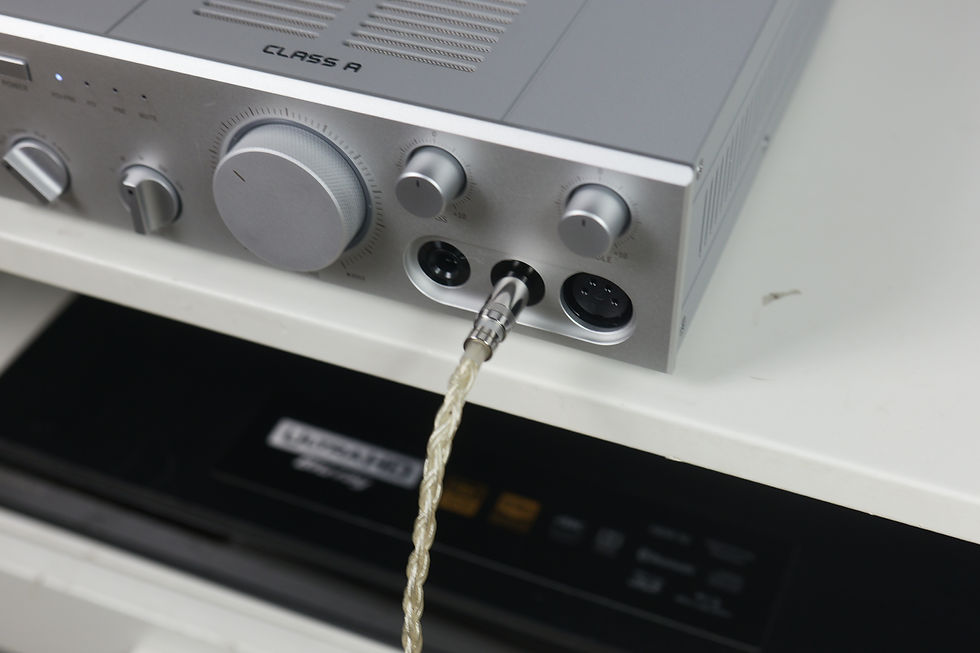
Worth having the full list in one place. Four inputs: 3.5mm single-ended, RCA single-ended, 4.4mm balanced, and XLR balanced. Two line outputs, RCA and XLR, so it functions as a real preamp into powered speakers or a downstream power amp. Three headphone outputs, 6.35mm, 4.4mm balanced, and 4-pin XLR balanced. And a 12V trigger in and out, so it can power on and off in sync with the rest of a stacked system rather than needing its own separate button press every time, which matters more than it sounds since there's no remote.
The sound, track by track, not just in the abstract
Neutral warmth. Real smoothness. That relaxed, unhurried character only a true Class A output stage seems to manage. But "lovely experience" means nothing without something specific behind it, so let's actually test the claims FiiO made earlier against real material.
Vocals and midrange first, the easy win for any Class A design.
David Bowie's Ziggy Stardust is the obvious pick, mostly because Bowie's voice on this record has been dissected on a thousand systems already, so any coloration is impossible to hide. On "Five Years" the vocal sits close and textured without ever getting sharp or sibilant, and that "relaxed low end, sweet engaging vocals" character FiiO credits to the Toshiba pairs is genuinely present. Mick Ronson's guitar on "Moonage Daydream" gets that glam rock bite without turning harsh, which is exactly the balance a lot of amps get wrong in one direction or the other.
Fusion and separation next, where the balanced architecture earns its keep. Weather Report's Mysterious Traveler is a genuinely demanding test. Between Zawinul's electric keys, Shorter's sax, and the percussion running underneath on tracks like "Nubian Sundance," there's a lot happening at once, and a lesser amp turns it into mush. Through the CLASS A, everything stays in its own lane. You can actually follow the bass line independently from the keys even when the track gets busy, and that's the fully differential, four channel architecture doing real work rather than being a spec sheet phrase.
Dynamics and headroom, where I went looking for the noise floor again. Sigur Rós' Ágætis byrjun is close to a perfect stress test for this amp specifically, because it lives at both extremes. "Svefn-g-englar" opens near silence and builds into a massive, reverb-soaked swell, and the amp handles that climb with real composure, nothing feels strained or compressed as the track opens up. But this is also exactly where the noise floor issue shows back up. In those opening near-silent seconds, there's a faint bed of noise sitting under what should be true black silence. It's subtle, it won't ruin the song or your mood, but it's the one place I felt the amp slightly overpromise. A cleaner, more neutral DAC upstream might narrow the gap, but it won't close it entirely.
Weight and aggression, the Sanken test. Sleep Token's Even in Arcadia swings between whispered, almost fragile vocal passages and full weight, syncopated heavy sections, sometimes within the same track. This is where I went looking for FiiO's claim about the Sanken transistors delivering "incisive dynamics and strong control." Honestly, it holds up. This amp is built for rock and metal, it works phenomenally there, with a similar push to what good R2R gear does, except Class A pulls it off even better. The sudden drops into the heavier sections stay controlled instead of smearing into a wall of noise, and the low end has real punch without ever feeling loose or bloated.
Pulling it together. The Toshiba pairs being responsible for that warm, relaxed low end and vocal character, that tracks with Bowie. The Sanken pairs bringing precise, controlled dynamics on complex or heavy material, that tracks with Sleep Token and the busier Weather Report passages. Whether you could genuinely isolate one transistor type from the other blind is still a fair thing to doubt. But as a finished circuit, what FiiO describes on paper and what actually comes out of the headphones do line up more than I expected going in.

The IEM surprise nobody warned me about
Here's something I didn't expect going in. This amp might actually be better paired with in-ear monitors than with full-size headphones, which isn't how Class A amps usually get talked about.
A lot of IEMs, planars especially, run bright by default. It's a common complaint, and it's usually the reason people end up chasing EQ just to make long sessions bearable. Through the CLASS A, that brightness gets tamed without the IEMs losing what makes them theirs. Whatever I plugged in, it felt more complete, more musical, more fun to sit with for an hour than it had any right to be. I can't think of another amp I've used with IEMs where I genuinely didn't want to take them off.
If your honest complaint about your current setup is that your headphones sound thin, your IEMs are a little too sharp, or your music just lacks weight, this is built for exactly that problem.
The tradeoff, and I want to be upfront about it, is transparency. This isn't the amp for someone chasing the absolute last word in detail retrieval. Whatever source you feed it, the fine detail sits a little further back, a little more recessed than it would through a cleaner, more neutral amp. Once you accept that and stop expecting razor sharp resolution, what's left is a genuinely fun, emotionally engaging way to listen. But if detail retrieval is your priority above everything else, know that going in.

Size: bigger than it should be, smaller than it has any right to be
For a box that's just a headphone amp and preamp, no DAC, no screen, no streaming, it's pretty chunky. Heavy, too. Real desk space for something that only does amplification.
And yet. Stack it up against basically any other Class A headphone amp on the market and it looks almost compact. Most Class A designs need way more chassis and much bigger heatsinks just to deal with the heat this topology throws off. Given the transformer, the capacitor bank, and 24 discrete output transistors packed in here, FiiO clearly worked to keep the footprint as tight as they reasonably could, which is genuinely hard to pull off with this topology.
Why is FiiO even doing this
FiiO built its name on tiny, cheap, portable amps, before evolving into something bigger. Class A is the opposite of that earlier philosophy entirely. It's inefficient by design, it runs hot, it costs more to build and hand-calibrate, and it's a harder sell to an audience that grew up on FiiO's efficient little dongles.
So why bet on it now? Knowing now that this sits inside a whole "retro desktop HiFi system" alongside a CD transport and an R2R tube DAC, this isn't a one-off experiment. It's a deliberate push into warmer, more vintage-flavored, more analog-coded sound as a real product line, not just a single box testing the waters. And that warmer voicing cuts both ways, it's also far more forgiving of a poorly mastered track or a low bitrate file than a clinically neutral amp would be, which matters more than audiophiles like to admit given how much of what people actually listen to day to day isn't pristine.
And honestly? Calling it "CLASS A" instead of giving it a proper model number still feels telling. It reads less like "here's our new flagship" and more like "let's see if people actually want this direction."
Verdict: A Small Technological Miracle That Isn't For Everyone
Here's where I land on it.
This amp is, in a very real sense, a small miracle of stubbornness. FiiO took the least efficient, hardest to cool, most expensive to hand build amplifier topology that exists, and put it in a box smaller than it has any right to be, at a price of $380 that makes no sense for what's actually inside. Sixteen matched Toshiba pairs. Eight Sanken transistors. A custom toroidal transformer. A capacitor bank most integrated amps twice the price don't bother with. All of it hand calibrated, one unit at a time.
And it is obviously imperfect. It runs hot enough to shut itself down on a long session. The noise floor isn't the pitch black silence the marketing promises. It's chunkier than a headphone only amp should be. None of that is a small footnote, and I'm not going to pretend otherwise just because I like it.
But here's the thing. I do like it. More than that, I genuinely enjoyed my time with this amp in a way that's rare enough to write down plainly.
It's a very specific sound, coming from a very specific device. Definitely not for everyone. But you should try it anyway, I recommend it. This isn't gear for everyone. If you want a clean, efficient, cool running amp that disappears into the background, this isn't it, and it was never trying to be. But if you want to feel like you're listening through something built by people who still believe in doing things the hard way, especially if IEMs or bright headphones have been fighting you this whole time, this is unlike almost anything else at this price.
And honestly? Flaws and all, I'd take a seat next to this thing again tomorrow.
Pros
Genuine Class A character: real warmth, smoothness, and that relaxed, unhurried conduction only this topology delivers, no crossover distortion anywhere in the signal
Serious build quality for the money: 16 hand-matched Toshiba transistor pairs, 8 Sanken transistors, a custom 60W toroidal transformer, and a 20,000μF capacitor bank, all at $380
Fully balanced, fully differential architecture, four independent signal paths rather than just a balanced jack bolted onto a single-ended circuit
Exceptional with IEMs and bright headphones specifically, tames harshness and adds weight without flattening what makes them good
Doubles as a genuine preamp, RCA and XLR line outs mean it can anchor a small desktop speaker system, not just drive headphones
Five gain levels plus ±10dB independent bass and treble, real flexibility across very different headphone sensitivities
Remarkably compact given the topology, most true Class A designs need significantly more chassis to manage the heat
More forgiving of imperfect source material, a poorly mastered track or a low bitrate file doesn't get punished the way it would on a clinically neutral amp
Cons
Runs hot enough to trigger its own thermal shutdown on long listening sessions, this isn't occasional warmth, it's a real limitation on how long you can sit with it
Noise floor isn't the pitch black silence FiiO's marketing promises, a faint bed of noise is audible under quiet passages if you're listening for it
Detail retrieval takes a back seat, treble and fine resolution sit a little recessed compared to a more neutral, transparent amp
No remote, you're reliant on the 12V trigger for system-wide power sync instead
Chunky and heavy for a box that's only a headphone amp and preamp, no DAC, no screen, no streaming
A genuinely polarizing, specific sound signature, not built for anyone chasing reference-level neutrality or marathon sessions without a break


Comments