

Find me a Better Amp in this price range, I`ll wait - Advance Paris A10 Apex Review
For more great review, and to understand some context of this review see my review of Musical Fidelity M5si:
https://www.hifidaydreaming.com/post/even-9-years-old-musical-fidelity-m5si-is-still-unbeatable-in-it-s-price-range-vs-arcam-radia-a25 It got me on first sight. Instantly. No hesitation, no reviewer's caution, none of the professional distance I am supposed to maintain.
I saw the A10 Apex and I wanted it, and I am not going to pretend otherwise just to sound rigorous.
Big black fascia. Two large analogue VU meters, needles moving with proper weight. And between them a small illuminated window with two valves glowing softly behind it. It is the single best-looking integrated amplifier I have come across at anywhere near this money, and standing in front of one, the build backs the looks up completely. It feels like an object that was designed rather than assembled.
But this was not my first meeting with the brand.
Full specifications for Advance Paris A10 Apex:
X-i75 opened my eyes
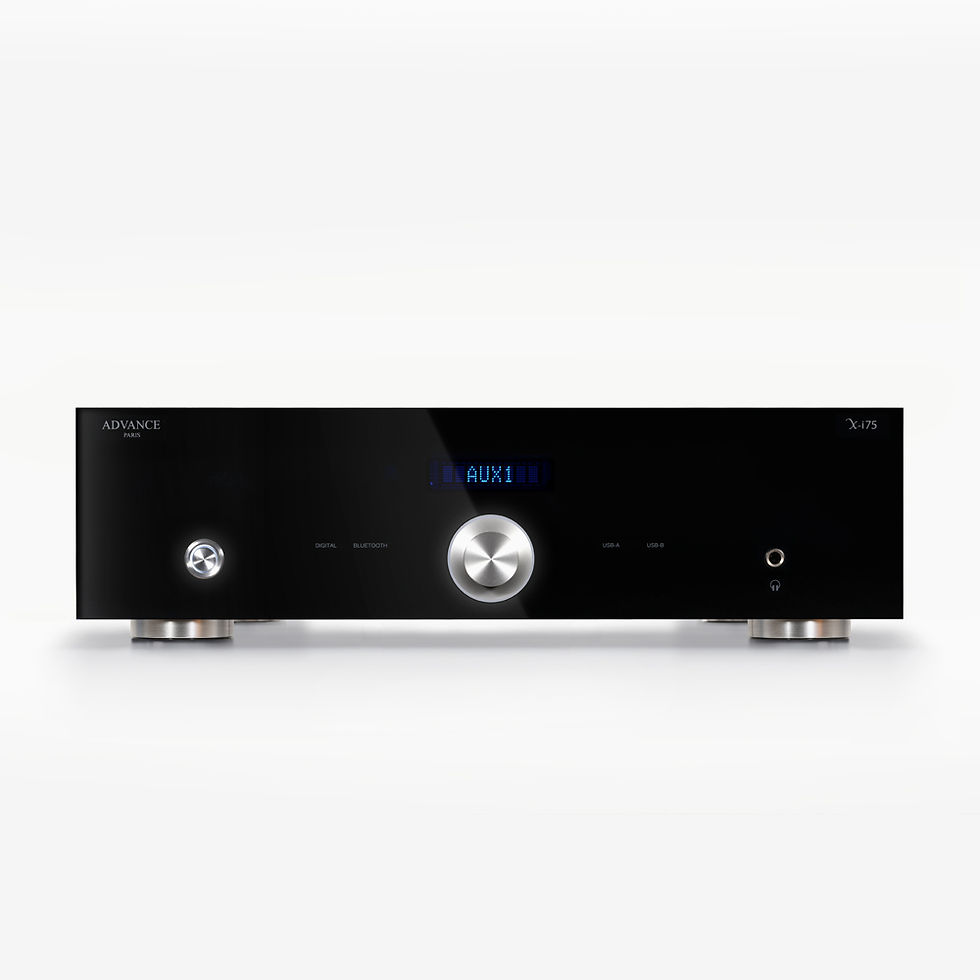
My introduction to Advance Paris was the X-i75, and if you want to understand why I take this company seriously, that is where it starts. Sub-£1,000. 75 watts into 8 ohms, 110 into 4. Class A/B with a Hi Bias mode that runs the first few watts in Class A. Toroidal transformer, built-in MM phono stage, a proper spread of analogue and digital inputs, a headphone jack, a subwoofer output, a real remote. A VU meter on the front, because of course there is.
It is one of the genuinely great budget amplifiers, and it is great in a very specific way: it does not feel like a compromised version of something better. It feels like a complete idea executed at a price. That is rare under a grand, where most manufacturers are busy deleting features and hoping you do not notice.
So when I say the A10 Apex sold me on looks, understand that I already trusted what was behind the looks.
The question was whether an amplifier this theatrical could also be a serious piece of engineering, or whether the valves and the meters and the glow were the product and the sound was an afterthought.
Three weeks later, I have an answer, and it is more interesting than I expected.
Full Specification for Advance Paris X-i75:
First, some brand history, because context matters
Advance Paris has an origin story that is more complicated than the marketing suggests, and I would rather you hear it from me than find out later and feel misled.
The company started life in 1995 as Advance Acoustic, born out of a decision made in Toulouse to build a new French hi-fi name. It began with loudspeakers, five of them, developed in France. Electronics came later: the company started working on them in 2002, and the first integrated amplifier landed in 2004. That amp set the visual and technical template that is still visible in the product you see here. VU meters, valves, big heavy amplifiers. It has been the brand's DNA for twenty years.
The Advance Paris name itself only appeared in 2013, and the company went international in 2005, now selling into more than forty countries from offices roughly twenty kilometres outside Paris.
Design and development happen in France. Assembly happens in factories elsewhere under the company's own engineering supervision, which is the same arrangement that roughly ninety percent of this industry uses while being coy about it. I mention it not as a criticism but because I think you deserve the full picture when someone puts "Paris" in the brand name and charges accordingly.
The APEX range is the 30th anniversary line, launched from late 2025. Four products: the A8 Apex, the A10 Apex, the flagship A12 Apex, and the ACD Apex CD player. All of them get the 30th Edition treatment, which means a black finish and white VU meters. The Apex tier sits above the long-running Classic range, and the upgrades are the usual internal story: lower-noise power supply design, ESS Technology voltage regulation, better passive components throughout.
The A10 Apex is the middle child. It is also, I think, the smartest buy in the entire range, and I will spend a good chunk of this review explaining why.
The looks: yes, it is showing off, and yes, it works

I opened by admitting the looks got me, so let me now do the harder thing and explain why, in terms that are not just "it glows and I liked it."
I am aware that best-looking amplifier at this price is a subjective claim dressed as a fact. I do not care. Stand this next to almost anything else at two and a half thousand euros and the competition looks like server equipment. But the reason it works is not the glow. It is that every individual element has been thought about properly, and that is a much less common thing than it sounds.
The front panel is dominated by two large analogue VU meters, and I want to talk about them properly, because "has VU meters" has become a lazy box-tick in this hobby. There is a difference between meters that are decorative and meters that are good, and the difference comes down to three things: ballistics, legibility, and lighting.
The ballistics here are genuinely lovely. The needles have weight to them. They swing with the music rather than twitching at it, and they settle rather than snapping. Watching them track a dense mix is one of those small pleasures that has nothing to do with fidelity and everything to do with why we do this at all. Cheap meters look nervous. These look confident.
Legibility is where the 30th Edition changes earn their keep. The Classic version of this amp ran blue-tinted meters. The Apex switched to white on black with a revised typeface, and the improvement is disproportionate to how small the change sounds when you type it out. White scale, black face, clean numerals. You can read them from across a room in daylight, which is more than I can say for a lot of dimly backlit designs.
And then there is the tube window.
This is the part everyone photographs. A small illuminated aperture in the fascia, with the two preamp valves visible behind it, lit in a warm amber-red glow. On the Classic, with blue meters flanking it, the effect was a bit of a colour clash. Two different light temperatures fighting each other across the front panel. On the Apex, with the meters gone white and the volume knob and power button switched from brushed metal to black, the whole face resolves into a single coherent object. The valve window stops being a competing element and becomes the element. The thing your eye goes to.
Is it necessary? No. Is it a bit theatrical? Absolutely. Would I want it any other way?
Not a chance.
Here is the thing about theatre in hi-fi. We spend a fortune on objects that sit in our living rooms doing nothing visible for hours at a time. An amplifier that gives you something to look at, that changes when the music changes, that glows softly at ten at night when you are three drinks into a listening session, is providing real value. Not sonic value. Emotional value. And anyone who tells you emotional value does not count has never actually enjoyed this hobby.
On build: it is a big unit. 430mm wide, 175mm tall, 351mm deep, 12.9kg. That height matters more than the width, because 175mm eats shelves. Measure before you buy. The casework is solid, the panel gaps are tight, the knobs turn with proper damped resistance rather than plasticky slop. Is it the single most tank-like chassis at the price? Probably not, and I would not claim it is. But it is comfortably in the "this feels like a serious object" category, and the finish quality on the black anodising is very good.
The remote deserves a mention too, which is a sentence I almost never write. It is a proper metal handset with direct input selection. On an amplifier with thirteen inputs, that is not a luxury, it is a requirement. Cycling through thirteen sources with a next-input button is a punishment. Advance Paris understood this. Several manufacturers charging four times as much still have not.
The architecture: why this thing is actually rare
Right. Let us talk about what is under the lid, because this is where the A10 Apex stops being a pretty face.
The A10 Apex is a hybrid. The preamplifier stage runs two ECC81 (12AT7) twin-triode valves. The power amplifier stage is solid state, Class A/B, fed by a 380VA toroidal transformer, rated at 130W per channel into 8 ohms and 198W into 4 ohms.
Now, "hybrid amplifiers are rare" is a claim I see thrown around a lot, and I want to be precise rather than dramatic about it.
Hybrids are not extinct. Vincent has built its whole identity on them, and the SV-237MKII sits at almost exactly this price with a tube preamp stage and a solid-state output section. Pathos does hybrids. Unison Research does hybrids. Rogue Audio does hybrids. So no, the A10 Apex is not the last of its kind.
But here is what actually is rare.
Almost every hybrid on the market treats the topology as the entire product. You get tubes and transistors and a volume knob and, if you are lucky, a couple of digital inputs bolted on as an afterthought. The Vincent, for example, gives you three line inputs, no phono stage at all, and a Burr-Brown PCM5102 handling two digital inputs. It is a purist device with a tube stage in it.
The A10 Apex is the only amplifier I can think of that takes hybrid topology and then wraps it in a genuinely modern, fully-loaded, do-everything feature set. HDMI eARC. An ESS9018 DAC. A phono stage with adjustable capacitance. Dual subwoofer outputs. XLR input. Home theatre bypass. Zone A/B speaker outputs. Trigger in and out.
That combination, valves plus a full 2026 connectivity suite, is close to unique. Everyone else picks a lane. Advance Paris refused.
What the valves actually do here
A quick technical grounding, because there is a lot of nonsense written about hybrid designs.
The ECC81 is a twin triode. In this amp it lives in the low-voltage preamp section, which is exactly where a valve is happiest. Used inside its designed envelope, the ECC81 is a genuinely well-behaved, low-noise part with very forgiving overload characteristics. This is not a case of shoving a tube somewhere for the aesthetic and hoping. It is a sensible engineering choice for the job.
Two things you should know before you buy:
The valves cannot be bypassed. They are a permanent part of the signal path. There is no switch, no defeat mode, no "solid-state only" setting. If you fundamentally do not want valves in your system, this amplifier is not for you and no amount of my enthusiasm should change that.
There is a warm-up period. Roughly thirty seconds from power-on before the amp is ready. It is a small thing and you stop noticing it within a week, but it is worth knowing if you are the sort of person who expects instant-on from every box in the rack.
There is also a High-Bias switch on the rear panel. Flick it and the amplifier runs double Class A bias, which extends how far into the volume range you stay in Class A operation before the output stage transitions to Class B. It runs hotter. It also, to my ears, does something meaningful at low and moderate listening levels, which I will get to.
So how does the architecture shape the sound?
This is the question that actually matters, and I want to answer it honestly rather than reaching for the usual "warmth of tubes, control of transistors" marketing sentence.
Here is what a valve preamp stage genuinely contributes in a design like this. Triodes distort in a specific way, weighted towards low-order harmonics, predominantly second-order.
Second-harmonic distortion is musically consonant. It is an octave. Your ear does not read it as an error, it reads it as fullness, as body, as a slightly thicker rendering of tone. That is the physical mechanism behind "tube warmth." It is not mysticism, it is harmonic structure.
What you get from that, practically, is a midrange with more density and a treble with softer edges on transient attack. Voices sit forward with more chest and less throat. Cymbals have body around the strike rather than just the strike.
What the solid-state output stage contributes is everything the valve stage cannot: damping factor, current delivery, and bass grip. A 380VA toroidal driving a Class A/B output section is going to control a woofer in a way that no realistically-priced valve output stage ever will. Bass stays tight. Impedance dips do not turn into wobbly, ill-defined low end.
The design intent, then, is to place the tonal character upstream where it costs you nothing in control, and put the muscle downstream where it costs you nothing in character.
Does it fully work?
Mostly, yes. But it is a trade, not a free lunch, and the trade is this: you are buying a sonic signature. This amplifier has an opinion. It is not neutral and it does not want to be. If your definition of a great amplifier is "a straight wire with gain," go and buy something else and be happy. If you want an amplifier that does something specific and does it deliberately, keep reading.
Sound quality
I ran the A10 Apex for a fortnight before taking any of this seriously, partly because valves and partly because I did not trust my own enthusiasm. When an amplifier has already won you over on looks, your ears will happily go along with it for a week or two out of sheer politeness. You have to wait that out.
The short version: muscular, smooth, warm, and cleaner than warm-and-smooth usually manages to be.
The longer version needs music.
Sault, "Wildfires"
I started here because it is a track that punishes vague bass. That bassline is enormous, round, and mixed forward, and a lot of amplifiers turn it into a warm smear that swallows everything sitting on top of it.
The A10 Apex does not. The low end has real shape to it, a defined leading edge and a proper stop, and crucially the bass and the vocal occupy separate physical spaces rather than melting into one another. Cleo Sol's voice comes through with that slightly breathy intimacy intact, and the handclaps and percussion behind it stay distinct and dry.
What the tubes are doing here is audible in the vocal, not the bass. There is a fullness in her lower register, a body to the sound, that I associate directly with a valve preamp stage.
Whether that is "accurate" is a separate argument. It is lovely, and it is consistent.
The High-Bias switch on this track is a genuine improvement at moderate volume. Things loosen slightly, the vocal gains a little air, and the whole thing relaxes without going soft.
Colin Stetson, "To See More Light" from New History Warfare Vol. 3: To See More Light
I use Stetson for one specific reason: circular breathing on a bass saxophone produces continuous tone with an enormous amount of mechanical noise layered into it. Key clatter. Breath. The physical sound of a very large piece of brass being worked hard by a human being.
This is a stress test for exactly the thing I was worried about with a valve stage. Would the warmth round off all that texture and turn a violent, physical performance into something polite?
No. And this genuinely surprised me.
The mechanical detail survives. You hear the keys. You hear the breath cycling. What the A10 Apex does is present all of it without the metallic hardness that some more forensic amplifiers impose on this recording, and the result is that you can play it much louder for much longer. The low fundamental of the bass sax has serious weight and stays articulated rather than turning into a drone.
This is the amp's core trick, and it is worth naming clearly: it removes glare without removing information.
Talk Talk, "After the Flood" from Laughing Stock
If you want to test how an amplifier handles silence, dynamic range, and the space between notes, this is the record.
Laughing Stock is a masterclass in restraint, built from long stretches of near-nothing punctuated by sudden arrivals. The A10 Apex handles the quiet passages with a low noise floor, which matters enormously here, and it handles the arrivals with proper scale. The organ drone that sits under this track has weight and body without becoming a wall. Mark Hollis's voice, which is fragile and half-buried by design, retains its texture.
Where I would push back on my own enthusiasm: the very last degree of transparency, the sense of hearing through the recording into the room, is not quite at the level of the best pure solid-state designs I have heard around this money. There is a slight veiling, a warmth, that sits between you and the absolute back of the soundstage. It is small. But on a record this delicate, it is there.
That is the trade. You knew there would be one.
Anna Meredith, "Sawbones" from FIBS
Now for something that hits.
"Sawbones" is aggressive, synthetic, dense, and relentlessly dynamic. It is the kind of production that exposes an amplifier that lacks grip: everything congeals in the loud sections and the rhythm falls apart.
The A10 Apex does not congeal. The 130 watts and that toroidal are doing exactly their job. Transients land hard, the low-end synth work has proper physical impact in the room, and the track keeps its shape through the busiest passages.
This is where the "muscular" description comes from. It is not a delicate amplifier that happens to be loud. It is a genuinely powerful amplifier that also happens to be smooth, and there is a real difference between those two things.
Cassandra Wilson, "Last Train to Clarksville" from New Moon Daughter
Because if you have a valve stage, you owe it to yourself to play something that will exploit it.
Wilson's voice is one of the great tests of midrange reproduction, all chest and smoke and low-register weight. On the A10 Apex it is close to ideal. The tone is dense, the vocal is placed convincingly in space, and the slightly bloomy character of the recording is presented as intended rather than sanitised.
The acoustic guitar and upright bass behind her have body and decay. The steel-string attack is present without being sharp.
Is this "accurate"? Honestly, I do not know, and on this record I do not care. This is what the amplifier is for.
Mdou Moctar, "Afrique Victime"
A late addition because I wanted something with genuinely aggressive guitar tone, and because that closing solo is one of the most gloriously unhinged pieces of playing on record this decade.
Electric guitar with this much overdrive is where a warm amplifier can go badly wrong, turning fire into mush. It does not happen here. The guitar keeps its bite and its edge, the rhythm section stays propulsive and separate, and the whole thing builds properly rather than compressing into noise as it intensifies.
There is a slight softening of the very top-end grain compared to something more analytical. On this record, that softening reads as a feature. You can play it loud enough to annoy the neighbours and your ears do not file a complaint.
Summing up the sound
Bass: powerful, well-shaped, properly controlled. Not the very last word in absolute definition, but there is no shortage of grip and no bloat.
Midrange: the star. Dense, textured, forward without being aggressive, with real tonal body on voices and acoustic instruments.
Treble: smooth and extended, with the hard edge taken off transient attack. Detail is present. Glare is not.
Soundstage: wide and well-layered, with good instrument separation. Depth is good rather than exceptional, which ties back to that slight warmth I mentioned.
Dynamics: genuinely strong. This amplifier has headroom and uses it.
The one-line version: it is warm and smooth without being slow or soft, and it is cleaner than "warm and smooth" usually implies.
Features and connectivity

This is the section where the A10 Apex stops competing and starts embarrassing people.
Most manufacturers have spent a decade quietly deleting inputs. Advance Paris looked at that trend and decided to do the opposite.
Analogue inputs
5x RCA line level
1x XLR balanced line input
1x MM phono input with ground, and adjustable capacitance
AMP-IN for home theatre bypass
That XLR input at this price is unusual. The adjustable capacitance on the phono stage is genuinely rare on a built-in MM input and useful if you are running a cartridge that cares about loading. Most integrated amps give you a fixed value and wish you luck.
Digital inputs
3x optical, 24-bit/192kHz PCM
1x coaxial, 24-bit/192kHz PCM
1x USB-B for computer, 24-bit/192kHz PCM plus DSD64 and DSD128
1x HDMI eARC with CEC, so the TV turns the amp on and the TV remote controls volume
A-BTC port for the optional Bluetooth module
Three optical inputs is not a typo. Someone at Advance Paris has actually looked at how people use these amps: TV, games console, CD transport, older streamer. Conversion is handled by an ESS9018 DAC.
Outputs
2x subwoofer outputs, configurable mono or stereo
PRE-OUT (RCA)
REC-OUT, fixed level, for a recorder
Zone A and Zone B speaker terminals, taking bare wire, spades or bananas
6.35mm headphone jack
Dual subwoofer outputs with a mono/stereo setting is an unusually thoughtful touch. So is the headphone output, which sounds obvious until you notice how many rivals at this money have dropped it entirely.
Functions
Loudness, bass, treble and balance controls. Adjustable auto-standby from 5 to 60 minutes. Trigger in and trigger out on 12V jacks. Firmware updates via USB stick on a dedicated port. Mains voltage selectable, 115V or 230V.
What is missing
No onboard streaming. No Roon endpoint, no AirPlay, no network anything.
No built-in Bluetooth. You need the optional A-BTC module, which does aptX AD and low-latency, and which will also transmit out to Bluetooth headphones. Handy, but it is an extra purchase.
The Classic-era HDMI audio input is gone. The A10 Classic had a second HDMI input alongside eARC. The Apex dropped it. Niche, but if you were using it, know that it is not coming back.
I am relaxed about the streaming omission and I think you should be too. Streaming is the single fastest-obsolescing part of any hi-fi system. Every other connection on this amplifier will still be relevant in fifteen years. Keeping the network layer external means you replace a £300 box in 2032 instead of a £2,500 one.
Specifications
Advance Paris A10 Apex | |
Type | Hybrid integrated amplifier with DAC |
Preamp | 2x ECC81 / 12AT7 valves, not bypassable |
Power amp | Class A/B, High-Bias switchable |
Power, 8Ω | 130W (THD+N 1%, 1kHz) / 120W (20Hz–20kHz, THD+N under 0.07%) |
Power, 4Ω | 198W (THD+N 1%, 1kHz) / 183W (20Hz–20kHz, THD+N under 0.07%) |
Frequency response | 20Hz–80kHz (+/-1dB, 31W into 8Ω) |
THD+N | 0.045% (1kHz, 90W, 8Ω) |
Signal-to-noise ratio | 106dB (1kHz, 90W, 8Ω) |
Transformer | Toroidal, 380VA |
DAC | ESS9018 |
Analogue inputs | 5x RCA, 1x XLR, 1x MM phono, AMP-IN |
Digital inputs | 3x optical, 1x coaxial, 1x USB-B, HDMI eARC |
Analogue outputs | PRE-OUT, REC-OUT, 2x SUB-OUT |
Headphones | 6.35mm |
Speaker outputs | Zone A + Zone B |
Dimensions (WxHxD) | 430 x 175 x 351mm |
Weight | 12.9kg |
Price | €2,490 / £2,450 / $3,499 |
A note on the power figures, because they matter. The 130W rating is quoted at 1% THD at 1kHz. The full-bandwidth figure at low distortion is 120W into 8 ohms. Advance Paris also quotes its distortion spec at 90W, which tells you where the amplifier is genuinely comfortable and where it is being pushed. This is normal and Advance Paris is being more transparent than most by publishing both numbers, but read specs properly and you will never be disappointed by them.
Synergy: what to plug into it
The A10 Apex has a strong tonal character. That is a feature, but it means partnering matters more than it does with a neutral amplifier.
Speakers that work brilliantly. Anything slightly bright or forward in the treble. Focal, KEF, Monitor Audio, Klipsch. This amplifier is a tremendous partner for speakers that other amps make sound tiring. It takes the edge off without dulling the detail, and 130 watts is plenty of grip for a metal-dome tweeter design.
Speakers to be careful with. Anything already voiced warm and thick. Wharfedale's classic-styled range, some of the softer-balanced Sonus faber models, older warm-sounding British designs. Warmth on warmth is how you end up with a system that sounds pleasant for ten minutes and boring for ten years. Not a hard no, but audition it.
Speakers I would actively seek out for it. Something like a DALI Rubikore 2 is close to ideal, honest and open in the treble with enough resolution to show what the valve stage is doing, and easy enough to drive that the A10 Apex never breaks a sweat. A Focal Aria or Kanta standmount is the other obvious direction if you want the amp doing its "civilising a bright speaker" trick at full strength.
Sources. Do not overthink the DAC. The ESS9018 stage is competent and perfectly usable, but the amplifier's own character dominates anyway. If you want a step up, feed it something clean and detailed rather than something else that is warm. A Bluesound Node into the coaxial or optical is a genuinely excellent, cost-appropriate match, and BluOS is the best software in this part of the market by a comfortable distance.
Turntables. The onboard MM stage is good, low noise, with usable detail, and the adjustable capacitance is a real asset. It is a proper phono stage rather than a token gesture. Would a dedicated external unit at around €500 beat it? Probably, on dynamics. But you have plenty of spare inputs when you decide to find out.
High-Bias. Leave it on if your room and your speakers allow. It runs hotter, so give the amp ventilation, but the improvement at normal listening levels is real.
Competitors
Let me deal with the obvious ones quickly before the fight that actually matters.

Vincent SV-237MKII is the closest thing to a direct topological rival, hybrid tube preamp into solid-state power, around the same money, 150W into 8 ohms. It is a fine amplifier. But it gives you three line inputs, no phono stage whatsoever, and two digital inputs on a Burr-Brown PCM5102. As a feature proposition it is not in the same conversation.
Which brings us to the one that actually matters.
Full Specification of Vincent SV-237MKII:
Head to head: Advance Paris A10 Apex vs Musical Fidelity M5xi

This is the real fight, and it is a good one, because these two amplifiers disagree about almost everything.
The M5xi launched in 2026 as a genuine ground-up reworking of the M5 formula rather than a badge change. The topology traces back to Musical Fidelity's TITAN power amplifier, configured as two independent monoblock power amps with a separate preamp stage, using a low-distortion Darlington output configuration. The transformer and power supply board sit encapsulated in a metal enclosure to keep electromagnetic interference away from everything else, which matters particularly because the phono stage runs at very high gain.
Here is where they stand against each other.
Advance Paris A10 Apex | Musical Fidelity M5xi | |
Topology | Hybrid: ECC81 valve preamp, Class A/B solid-state output | All solid state, dual monoblock + separate preamp |
Power, 8Ω | 130W (1% THD, 1kHz) | 160W (1% THD, 1kHz), 140W full bandwidth |
Power, 4Ω | 198W | 240W (1% THD, 1kHz), 210W full bandwidth |
Peak power | Not quoted | 190W / 320W |
Damping factor | Not quoted | 47 (8Ω) |
Analogue inputs | 5x RCA, XLR, MM phono, AMP-IN | 4x RCA (one switchable to HT bypass), MM/MC phono |
Digital inputs | 3x optical, coax, USB-B, HDMI eARC | 1x optical, 1x coax, USB-C, HDMI eARC |
Phono | MM only, adjustable capacitance | MM and MC, fixed 220pF |
Sub outputs | 2, mono or stereo | None |
Headphone out | Yes, 6.35mm | No |
Tone controls | Bass, treble, balance, loudness | None |
Zone B speakers | Yes | Second pair for bi-wiring |
VU meters | Yes | No |
Extras | High-Bias switch, triggers, firmware via USB | USB-A 5V/2A streamer power out, RS232, stepped attenuator |
Volume control | Conventional | Burr-Brown stepped attenuator |
Weight | 12.9kg | 15kg |
Price | €2,490 / £2,450 / $3,499 | €2,290 / £2,099 / around $2,700–2,800 |
Connectivity: not close
The A10 Apex wins this comprehensively and it is not really an argument. Thirteen inputs against nine. An XLR input the M5xi simply does not have. Three optical inputs against one. Two subwoofer outputs against none. A headphone jack against no headphone jack at all.
If you have a TV, a games console, a CD player, a turntable, a streamer and a legacy source or two, the A10 Apex takes all of it and asks for more. The M5xi will have you buying a switch box.
The one connectivity point where Musical Fidelity wins is phono. The M5xi does MM and MC. The A10 Apex is MM only. If you run a moving coil cartridge, that is a real, concrete, costs-you-money difference, and it is the single strongest practical argument for the M5xi.
The M5xi also has a genuinely clever feature I want to give credit for: an isolated 5V/2A USB-A power output, on its own transformer winding and linear supply, specifically for powering a streamer. That is thoughtful engineering aimed at a real problem, and nobody else is doing it.
Power: Musical Fidelity, clearly
160W against 130W into 8 ohms. 240W against 198W into 4 ohms. Peak figures of 190W and 320W. A quoted damping factor of 47 and two pairs of output devices per channel.
The M5xi is the more powerful amplifier and it is engineered around that fact. Dual monoblock architecture, TITAN-derived topology, the whole design philosophy pointing at authority and control. If you own difficult speakers, big floorstanders, a large room, or anything with a nasty impedance curve, the M5xi has more in reserve.
Looks: Advance Paris, by a mile
The M5xi is a slab of milled aluminium with a volume knob and some small buttons. It is beautifully made, understated, minimalist in the way British hi-fi has been minimalist for forty years. It looks like a serious tool.
That is a legitimate aesthetic and some people will strongly prefer it. If you want your hi-fi to disappear into the room, buy the Musical Fidelity.
But if you want an object with presence, something that glows and moves and gives you something to look at while you listen, there is no contest. The A10 Apex is a piece of furniture. The M5xi is an appliance.
Sound: same family, different personalities
Both of these amplifiers are muscular. That is the shared trait and it is worth stating up front, because they are not delicate or polite designs. Both grab a speaker and drive it.
The M5xi is the more forceful of the two. It leads with authority. Bass is tighter and more clenched, transients hit with a harder leading edge, and there is a directness to the presentation that comes from having more power and a solid-state signal path with nothing in it to soften anything. It is a clean, fast, propulsive amplifier. On dense rock and electronic material it grips like a vice.
The A10 Apex is smoother and warmer. The midrange has more density and body, the treble is less insistent, and the whole presentation is a touch more rounded. Where the M5xi hits you with the leading edge of a note, the A10 Apex gives you the leading edge and the body behind it.
Here is the important part, and it is the part I did not expect: being warmer has not made the A10 Apex murky. It is decently clean. Detail retrieval is good, the noise floor is low, and instrument separation holds up under complex material. It is warm the way a good analogue recording is warm, not the way a cheap amplifier is warm. There is a real difference and it took me a while to trust it.
Put simply:
The M5xi is for outright power. Maximum grip, maximum authority, maximum control. If your speakers are hard to drive and you want the amplifier to dominate them, this is your answer.
The A10 Apex is for versatility plus a specialist sonic signature. It does more things, connects to more things, and it has a deliberate character that it applies to all of them. You are buying a voice, not just a wattage figure.
Value: this is genuinely tight
The M5xi is cheaper. €2,290 against €2,490. £2,099 against £2,450. Around $2,700 to $2,800 against $3,499 in the US, where the gap widens considerably.
So on a pure euros-per-watt basis, Musical Fidelity wins. More power, less money.
But that framing misses the point.
Work out what you would spend to bring the M5xi up to the A10 Apex's functional level. An external DAC with more digital inputs, because one optical is not enough for a modern setup. A subwoofer crossover solution, or an active sub with high-level inputs. A headphone amplifier, because there is no headphone output. A source switch if you have more than five analogue sources.
You are now well past the A10 Apex's price, with four boxes and a cable nightmare.
Conversely, work out what you would spend to bring the A10 Apex to the M5xi's phono capability: a decent MC stage or a step-up transformer, call it a few hundred. That is a smaller gap.
My read: the M5xi is better value if you are a two-source purist with hard-to-drive speakers and a moving coil cartridge. The A10 Apex is better value for absolutely everyone else. In Europe the price gap is small enough that the connectivity alone justifies it. In the US, where the A10 Apex carries a much bigger premium, the argument is closer and I would think harder.
My take? I prefer the Advance Paris A10 Apex, and by a decent margin. It is a much more versatile tool, it looks better, and it sounds great. The M5xi has more power and sounds every bit as good, so it is the better choice for more demanding speakers. But as a whole box, the A10 Apex wins.
Full Specification for Musical Fidelity M5xi:
Who should buy this?
Buy the A10 Apex if:
You want one box that does absolutely everything, and you have a lot of sources
You have a TV in the system and want proper stereo sound from it
Your speakers are slightly bright or forward and you want them civilised
You want your hi-fi to be an object you enjoy looking at
You want a deliberate sonic character rather than neutrality
You run a moving magnet cartridge
Do not buy it if:
You want a strictly neutral, transparent amplifier
You run a moving coil cartridge and do not want a second box
You need onboard streaming
You have very difficult speakers or a very large room
Your shelf is under 175mm tall (check this before you order, seriously)
You fundamentally do not want valves in your signal path
Verdict

I came into this fully expecting to have to write the awkward paragraph. The one where you admit you fell for an amplifier on looks and then have to gently explain that the sound does not quite justify the object. Instead I have spent three weeks hunting for something to complain about.
The complaints exist. It is not the last word in transparency, and on very delicate material there is a slight warmth that sits between you and the deepest layers of a recording. The MM-only phono stage is a real limitation for moving coil users. It is physically large in a way that will genuinely cause problems for some racks. And in the US market it carries a price premium over the Musical Fidelity M5xi that makes the value argument much closer than it is in Europe.
But those are the complaints of someone who was actively looking for them.
What Advance Paris has built here is an amplifier that does something almost nobody else is attempting. It takes a hybrid architecture, which is rare enough on its own, and instead of treating that topology as the entire product it wraps it in the most comprehensive connectivity suite in its class and finishes it with the best industrial design at the price. It sounds muscular and smooth and warm, and it manages to be all three without becoming soft or murky, which is a harder engineering problem than it sounds.
And it is the same instinct that made the X-i75 such a good budget amplifier, just scaled up and given a bigger budget. Give people everything, make it look like something, do not treat the affordable customer as someone who deserves less. Whatever else you say about this company, it is consistent about that.
The Musical Fidelity M5xi is a superb amplifier and if you want raw power and minimalist looks, buy it happily. But the A10 Apex is doing something more interesting, and it does more things, and it makes me want to sit down and listen in a way that a well-engineered black box does not.
And leave the lights off for the first hour, so you can watch the valves glow. Pros
Best-looking amplifier at the price, and the build backs it up
VU meters with proper ballistics and genuinely good legibility on the white-on-black 30th Edition face
Tube window and the toned-down Apex cosmetics finally resolve into one coherent front panel
Thirteen inputs, including an XLR input and three optical, which nothing else at this money offers
MM phono stage with adjustable capacitance, rare on a built-in stage and actually useful
Dual subwoofer outputs, configurable mono or stereo
HDMI eARC with CEC, plus AMP-IN for home theatre bypass
Headphone output still present when rivals have dropped it
Excellent metal remote with direct input selection
Muscular, smooth and warm without going murky or soft
Midrange density and tonal body are the standout
Takes the edge off bright speakers without dulling detail
High-Bias switch makes a real difference at low and moderate levels
Tone controls, adjustable standby, triggers, USB firmware updates
Analogue connections that will still be relevant in fifteen years
Cons
Valves cannot be bypassed, so this is not for anyone who does not want them in the signal path
Roughly thirty seconds of warm-up before it is ready
MM phono only, no MC support
No onboard streaming
No built-in Bluetooth, the A-BTC module is an extra purchase
The A10 Classic's second HDMI audio input is gone
Physically large, and 175mm tall will not fit some racks
Not the last word in transparency, with a slight warmth on very delicate material
Less power than the M5xi, so harder loads and big rooms favour the rival
Price premium over the M5xi is much steeper in the US than in Europe


This is a $3500 USD in the USA. Depressing...