

It took 37 Years to get here, but Hegel created almost perfect amp - H150 review
My story with Hegel has been a rollercoaster of happiness and disappointments. But one thing was always a constant during all those years, is that at higher levels Hegel created amps like no other. But the big problem is always the value, as they hold quite the hefty premium to get great all-arounders. I am speaking from H190v and onward.
I always believed that the value Hegel represented was more than justified. They offer unique technology, great sound, great looks, all in one experience. It is the Audi, BMW, and Mercedes of the audio world. Not the probably best bang for buck but an elite product.
But that always left me in a difficult position as a reviewer, to recommend them. Could someone get more if he was searching for absolute value — he probably could. But I would always say that hearing is believing, and to listen to Hegels before choosing something else. They might be severely surprised.
And that was the story until now. Hegel H150 is an interesting product as it trickles down all the fantastic specs and engineering feats from older and more expensive brothers, into something that becomes easier for me to recommend. An excellent all-arounder, that might be even the best product of its kind on the market. But let's go into more details, and I will explain everything.
Hegel is not a marketing company that also makes amplifiers. They are an engineering company that occasionally, almost reluctantly, remembers they need to sell things.
This distinction matters more than it seems. The audio industry is full of companies that begin with a chassis — a beautiful shape, a compelling visual identity, a lifestyle concept — and then work backwards to fill it with components chosen to hit a margin target. The sound quality is whatever falls out of that process. Hegel works in the opposite direction with an almost aggressive purity of focus.

Why Hegel is special - SoundEngine
They begin with a problem. Specifically, one problem, identified by their founder Bent Holter in a thesis he wrote in 1988 at the Technical University in Trondheim: why do transistors distort, and what is the right way to stop them?
That question became SoundEngine. SoundEngine became a company. The company has been refining and deepening the answer to that original question for nearly four decades, at every price point they serve, in every product they make. The H150 is the most affordable place you can access the current state of that answer, and understanding the depth of the obsession behind it changes how you hear the amplifier — or how you imagine hearing it. There is a difference between a product designed by a committee trying to satisfy a brief, and a product designed by a person who has been thinking about one specific problem since before some of their current customers were born.
The H150 sounds like the latter, because it is.
Most amplifiers deal with distortion the way a government deals with a scandal — they wait for it to happen, acknowledge it, and then try to manage the fallout. The standard approach is global negative feedback: take a sample of what comes out, compare it to what went in, generate a correction signal, and feed it back around the entire circuit. It works. But the correction itself introduces artifacts — time smearing at high frequencies, instability under certain loads, a kind of processed quality to the sound that you may not be able to name but will feel as a subtle fatigue over long listening sessions.
Hegel's approach is preventative rather than corrective. SoundEngine 2 inserts a correction signal at each stage of amplification, before the distortion can propagate to the next stage, using what is essentially an analog computer running in parallel with the main signal path. Think of it less like damage control and more like an extremely attentive editor who catches errors before they make it to print rather than issuing corrections afterward.
The consequences of this are not subtle. The output impedance of the amplifier — a measure of how much the amplifier's behavior is affected by the load it drives — drops to near zero across the entire audio band. The damping factor, which is derived directly from that output impedance, reaches numbers that make conventional amplifier designers do a double-take. And the distortion figure, already very low in absolute terms, is achieved without the sonic side effects that plague conventional feedback-heavy designs.
What I find genuinely beautiful about this is not the specifications themselves but what they reveal about the engineering mindset. Holter did not accept the trade-off that everyone else accepted. He did not say "feedback causes problems, so we'll just use less of it and live with more distortion." He said "the whole framework is wrong, so let's build a different framework." That kind of thinking is rare in any field. In consumer electronics it is almost vanishingly rare. The H150 is what it sounds like — what it literally sounds like — when that kind of thinking becomes available at an accessible price.
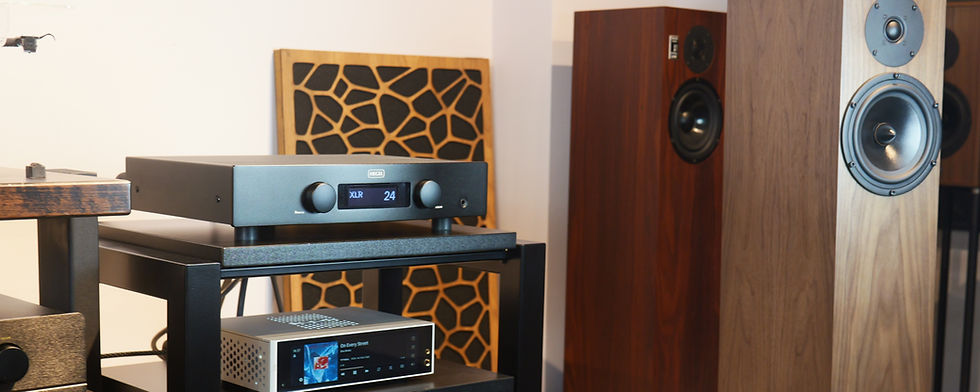
Why Hegel is special - Damping Factor
The H150's damping factor exceeds 2,000. If you've spent any time in audio forums, you've seen this number treated as either a marketing boast or an irrelevant specification. Neither response is correct. Let me explain what it actually is, what it actually means, and why I think it matters more than most people acknowledge.
A loudspeaker driver is a mechanical system. A cone of paper or plastic or metal, attached to a coil of wire, suspended in a magnetic field, driven by the electrical signal from your amplifier. When the amplifier sends a signal, the cone moves. When the signal stops, the cone does not stop immediately. Inertia — the same force that keeps your car moving after you lift your foot from the accelerator — keeps the cone moving even after the electrical signal has ceased. As the cone continues to move through the magnetic field, it generates its own electrical signal, a back-EMF, which travels back down the speaker cable and into the amplifier's output stage.
What happens next depends on the amplifier's output impedance. An amplifier with a high output impedance — a low damping factor — is significantly affected by this back-EMF. The rogue signal mixes with the intended signal, blurring transient edges, fattening bass notes, adding a low-frequency warmth that sounds pleasant but is not accurate. Many listeners prefer this coloration. It is, I suspect, part of what people describe when they talk about amplifiers "sounding musical." It is euphonic distortion.
An amplifier with a near-zero output impedance — a damping factor over 2,000 — acts as an almost perfect electrical brake. The back-EMF is absorbed and suppressed before it can color the signal. The cone stops when it is supposed to stop. What you hear is not euphonic warmth but accuracy — which, when a recording is excellent, is far more satisfying than any imposed coloration, because the coloration was never part of what the musician intended.
I want to be honest about the limits of this specification, because intellectual honesty matters more than advocacy. Beyond a certain point — somewhere around 500 to 1,000 — the audible difference between higher damping factors becomes very small, because at that level the back-EMF is already being suppressed to a degree that is largely below audibility. The difference between a damping factor of 100 and 500 is meaningful and probably audible on careful listening. The difference between 500 and 2,000 is smaller. The number does not scale linearly with sonic improvement.
What the number does tell you, reliably and importantly, is something about the character and rigour of the engineering. A damping factor of 2,000 is not achieved by accident or by cutting costs in other areas. It requires exceptional control of the output stage across the full audio band, meticulous attention to grounding and layout, and a design philosophy that treats the speaker-amplifier interface as a system rather than two separate components that happen to be connected by a wire. It tells you what kind of engineers built this machine and what they considered important. And those things — what engineers consider important, what trade-offs they are willing and unwilling to accept — determine how products sound.

Let`s Talk about value
$3,600. Let me hold that number up to the light for a moment.
It is a lot of money. I don't want to wave it away or perform the audio reviewer's traditional trick of contextualizing it against stratospherically expensive alternatives until $3,600 sounds like pocket change. If this money represents weeks of work for you, that deserves acknowledgment and respect, not a fast pivot to comparisons with $20,000 separates.
But I also want to do the arithmetic that almost nobody does clearly, because I think it changes the moral weight of the price considerably.
The H150 is not an amplifier. It is a streaming platform, a DAC, a phono preamplifier, and a power amplifier, integrated into a single chassis with a single power supply and a single remote control. When you evaluate it as a system — which is what it is and what it replaces — the $3,600 looks different. Not that I still believe how amazing the value is. It just does not seem unjustified.
A capable network streamer with Roon Ready certification, Tidal Connect, Qobuz Connect, and AirPlay support costs $600 at the low end (a Bluesound Node) and $1,500–$2,500 for something genuinely excellent (Innuos Pulse Mini, Lumin U2 Mini). A DAC of comparable quality costs $800–$2,000. A decent MM phono stage costs $300–$700. And a 75-watt Class AB integrated amplifier, built to this standard, with this power supply architecture and this damping factor, costs $1,500–$3,000 on its own.
Add those components at their midpoints: $1,500 + $1,200 + $450 + $2,000 = $5,150. Plus interconnects. Plus the ongoing cognitive overhead of making four separate components work harmoniously, matching their gain structures, managing their power supplies' interactions, finding somewhere to put them all.
The H150 costs $3,600 and does all of it in one box, with a single power cord, coherently designed from the ground up to work as one system. That is not just a convenience argument. There is a real sonic case for fewer conversion stages, shorter signal paths, and a unified power supply architecture. The question "is all-in-one compromised compared to separates?" is the wrong question. The right question is "is this all-in-one better than the separates I could afford for the same money?" For most people, at this price, the answer is yes.
And there is a DAC Loop output — a coaxial digital output that lets you feed an external DAC if you eventually want to upgrade that section without replacing the entire unit. The upgrade path is built in. Hegel's confidence in the rest of the product is implicit in that design choice.

Build Quality, Specs, Features
I want to challenge the way build quality is typically discussed in audio reviews, because I think the conversation is almost always slightly dishonest.
Everything at this price feels substantial. The aluminum front panel, the weighted control knobs, the steel chassis with its precisely punched ventilation pattern — yes, it all feels premium. It should. This is $3,600. You should not be able to flex the chassis or feel the volume knob wobble. These are table stakes, and Hegel meets them.
What I find more meaningful — and more revealing about a company's character — is what Hegel chose not to include. No color touchscreen. No Wi-Fi. No Bluetooth. No elaborate multi-page app with animated album art carousels and gesture controls.
These are not omissions born of budget constraints. They are choices, made by engineers who have thought carefully about what each of those features costs sonically and what it delivers experientially. Wi-Fi means a radio receiver running inside the chassis, generating RF interference in proximity to sensitive analog circuitry. Bluetooth means a lossy or at best compressed signal path for a device that otherwise operates at 24-bit/192kHz resolution. A color touchscreen means a processor, a display driver, and a backlight, all radiating noise into a box that is trying very hard to be quiet.
Hegel said no to all of it, and they will be penalized for it in every comparison chart and buying guide that ranks features by count rather than by quality. I find this infuriating on their behalf. The choices are correct. The market will punish them for making the correct choices, and they have made them anyway. That is a form of integrity that I genuinely respect.
The one legitimate criticism I will make of the physical product is the OLED display's memory. When the H150 goes into standby and wakes again, it forgets which input you were using and which radio station you had selected. This is a firmware problem, not a hardware problem, and it almost certainly could be fixed in a software update. But it has not been, and in a device this thoughtfully engineered, that small daily friction feels like a splinter in an otherwise smooth experience — disproportionately annoying precisely because everything else is so considered.
The remote control, by contrast, is exceptional. It has a range so generous that you can point it at the opposite wall and still change the volume. The buttons are exactly where your hands expect them to be in the dark. Someone spent real time designing it, and that time was not wasted.


The Phono Stage: The Unexpected Star of This Show
I expected nothing from the phono stage. That is not cynicism — that is the reasonable prior belief based on every integrated amplifier at this price that has included a phono stage as a feature-list checkbox. They are, almost universally, functional and forgettable. You use them because they are there, and you think about replacing them as soon as you start taking vinyl seriously.
The H150's phono stage is not that.
It is derived from Hegel's standalone V10 phono preamplifier — a unit sold separately for several hundred dollars that has earned genuine respect in its own right. The engineering lineage shows. It is quiet in a way that onboard phono stages rarely are. The noise floor is low enough that you become aware of the quality of your cartridge and your records rather than the quality of the electronics processing them, which is exactly the right hierarchy. The surface noise of a well-pressed record is rendered faithfully but not exaggerated. Poorly pressed records are not flattering — which is correct behavior.
It handles only moving magnet cartridges, and I want to defend this decision more strongly than most reviews do. Moving coil cartridges at the price points likely to be paired with this amplifier — a Hana SL, an Ortofon Cadenza Bronze, a Lyra Delos — require not just a different gain structure but a fundamentally different input impedance and a much lower noise floor than any integrated phono stage can realistically deliver. If you own cartridges like that, you need a dedicated phono pre regardless, and you should budget for one. For a Rega Exact, an Ortofon 2M Bronze or Black, an Audio-Technica VM760SLC — the kind of cartridge that belongs on the deck likely sitting next to this amplifier — the H150's MM stage is not just adequate. It is genuinely excellent.
The emotional effect of a phono stage that gets out of the way is something that is hard to describe without resorting to exactly the kind of adjectives I said I'd avoid. So instead let me say this: the best version of listening to vinyl is the one where you forget that analog playback is a chain of mechanical and electrical conversions and just hear the music. The H150's phono stage gets you there. It earns the trust that lets you stop analyzing and start listening.

Streaming: The Platform That Finally Grows Up
The H120's streaming section was, bluntly, the weakest part of an otherwise strong product. It worked, mostly, but the platform felt like an obligation — something Hegel knew they had to include but hadn't fully committed to. Roon support was episodic. The feature set was limited. Users in forums described it with the particular frustration reserved for things that almost work.
The H150 fixes this with a decisiveness that suggests Hegel learned a real lesson from the H120's limitations and was determined not to repeat it.
The new streaming board is shared with the H400 and H600 — the $8,000+ flagships at the top of the current Hegel lineup. This is not a boast. It is a specific, verifiable engineering decision with direct sonic and practical implications. It means the clock quality, the isolation between digital and analog sections, the processing architecture, and the noise management of the streaming section are identical to what Hegel considers good enough for their best work. There is no "budget streaming board" in the H150. There is the streaming board.
Roon Ready certification arrived in December 2025 via firmware update, and this matters enormously to a specific and growing population of listeners who have organized their entire music library around Roon's interface and DSP capabilities. Before this certification, the H150 could be used with Roon via AirPlay, which works but involves resampling to 48kHz and adding latency. Roon Ready means the device is a first-class Roon endpoint — bit-perfect, up to 24-bit/192kHz, with full metadata and transport control integration.
The wired Ethernet requirement will generate complaints, but I'll defend it again here: a powerline adapter costs $50 and eliminates the problem entirely. The sonic benefits of eliminating a Wi-Fi radio from inside the chassis — less RF noise, more stable clocking, more deterministic signal delivery — are real even if subtle. Hegel made the right call.
USB drive playback is new to Hegel's lineup and deserves mention. Listeners who have compared USB playback directly to streaming equivalents consistently report that locally stored files sound subtly more present and three-dimensional — a finding consistent across many amplifier reviews and one that likely reflects reduced jitter and processing overhead in the playback chain. The H150 now supports this mode natively, and it is the mode I'd use for critical listening sessions with music I know and love.
Sound Quality
I wanted to be as detailed as I can in this section; this is the heart of this review, and I would love to express myself as much as I can here.
The H150 does not have a "house sound" in the way that some amplifiers do — the warm, tubey romance of certain valve designs, the lean analytical coolness of some Class D implementations, the euphonic roundness of older Class AB designs with generous output impedances and modest damping factors. What the H150 has instead is something rarer and more demanding: it is neutral.
But this is Hegel we are talking about — they have mastered this already. This is not a boring or sterile presentation; this is neutral Class A/B which has some coloration, far less so than Class D, for example. It is a dynamically rich amp, it has enough push and gravitas in the bass, and extension in the treble. But where this amp absolutely shines is the midsection. It is clear, transparent, and rich — rich in the sense that there is so much natural timbre in vocals; they sound amazing, sparse, rich, if you have talented gear to accommodate them. This is elite presentation that needs to be talked about.
I want to be careful with that word, because "neutral" in audio marketing has come to mean "bright and clinical." That is not what I mean. True neutrality means the amplifier does not impose its own character on the music — it does not add warmth that wasn't recorded, does not subtract low-level detail to create a smoother presentation, does not emphasize the treble to create an illusion of resolution. It amplifies what is there and does not amplify what isn't.
The consequence of this, which few reviews acknowledge, is that the H150 is only as good as what is being fed into it, and how you pair and synergize it. For best results, pair this amp with speakers that color, or warm, or brighten. With excellent recordings, it is extraordinary. With compressed, poorly mastered modern recordings, it will tell you that, too. This is the correct behavior for a high-quality amplifier. It is also a slightly uncomfortable truth for listeners who have been using lesser equipment as an accidental excuse filter for poor recordings.
Track One: Bill Evans Trio — "Peace Piece" (Everybody Digs Bill Evans, 1958)
This is a twelve-minute meditation built on a single left-hand chord, played with extraordinary gentleness and patience. There is almost nothing happening, in the conventional musical sense. And yet it is one of the most emotionally affecting pieces in the jazz piano canon. What makes it work is the quality of silence around the notes — the decay of each note into the ambient noise of the recording session, the way Evans's right hand floats above the ostinato with phrases that feel improvised and inevitable simultaneously.
I would play this through the H150 to test two specific things. First, the noise floor. In passages of near-silence, a lesser amplifier introduces its own noise — a grain, a hiss, a subtle electronic presence that fills the space that should be empty. The H150's SoundEngine 2 architecture, with its near-zero distortion at low signal levels, should render those silences as actual silence. The notes should emerge from and return to blackness, not from and to a faint electronic haze.
Second, the decay of piano notes — the way a struck key's resonance slowly diminishes — is one of the most revealing tests for a DAC and amplifier combination. The decay has a shape, a curve from bright attack to warm tail, and an amplifier that smears the high-frequency information of that decay will make the piano sound slightly blurred, slightly less present, slightly less like a real instrument in a real room. The H150's high damping factor and SoundEngine 2's error correction should preserve that shape with unusual fidelity.
I imagine pressing play on this track through the H150 and feeling something that I would describe as arrival — the sense that the music has finally come home to appropriate electronics. Not because the amplifier adds anything, but because it removes everything that shouldn't be there.
Track Two: James Blake — "Limit to Your Love" (James Blake, 2011)
This is perhaps the single best test track for amplifier bass control that exists in the contemporary repertoire, and it has been used as such by reviewers for over a decade with good reason. The sub-bass synthesizer that enters partway through the song descends to frequencies that are at the very limit of most speaker systems, and its behavior — the way it arrives, sustains, and releases — is exquisitely sensitive to the quality of the amplifying electronics.
Through an amplifier with a modest damping factor and a soft power supply, that bass note blooms. It becomes larger than it should be, slower to arrive and slower to release, and it takes up sonic space that belongs to Blake's voice and the spare piano arrangement. It sounds impressive, in a crude way. It sounds like bass. But it does not sound like what is on the recording.
Through an amplifier with a damping factor over 2,000 and four 10,000µF capacitors in a dual-mono power supply, that same bass note should arrive with physical authority, hold its ground without spreading, and release cleanly, leaving the upper frequencies untouched and intact. The difference between these two presentations of this track is the difference between a system that colors music and a system that reproduces it.
I have a particular emotional relationship with this song. Blake's voice — the way it hovers between falsetto and chest voice, the way it is both enormously vulnerable and somehow completely controlled — requires a midrange that does not impose its own warmth or coolness on the presentation. The H150's neutrality should serve that voice exactly as recorded. I imagine listening to the moment when the bass drops — that first appearance of the sub-bass line after the sparse intro — and feeling a very specific thing: not wow, this is loud, but oh, there it is, that is what that should feel like. The difference between force and accuracy. The difference between impressive and true.
Track Three: Nick Drake — "Cello Song" (Five Leaves Left, 1969)
This is a test for texture, for the handling of acoustic instruments in an intimate recording space, and for what I think of as the grain of the midrange — the question of whether a cello sounds like wood and rosin and horsehair and gut, or whether it sounds like a representation of those things.
The John Wood production on Five Leaves Left is exceptionally transparent for its era — Drake's acoustic guitar, Rocky Dzidzornu's congas, and Clare Lowther's cello are placed in a space that feels like a real room rather than a studio construction. The cello in particular has a rawness to it, a physical presence, that either survives the amplification chain or is smoothed away by it.
The H150 should handle this material beautifully, for a specific reason: SoundEngine 2's local error correction preserves low-level detail — the harmonic overtones, the subtle bowing artifacts, the breath of the instrument — that global negative feedback circuits tend to smear or suppress. What this means in practice is that the texture of the cello should feel real rather than represented. You should feel the bow on the strings, not just hear the pitch.
I think about this track often when I think about what amplification is actually for. It is not for making music louder. It is for making music present. The best amplifiers, playing this recording, create a moment that I can only describe as proximity — the sense that the distance between you and the musicians has briefly collapsed. I believe the H150, at its price, would achieve this more fully than almost anything else you could buy.
Track Four: Massive Attack — "Teardrop" (Mezzanine, 1998)
This track tests dynamics, imaging, and the handling of electronic music — the precision with which synthesized elements are placed in the stereo field, and the contrast between the intimate warmth of Elizabeth Fraser's vocal and the enormous, cold, electronic architecture around it.
The opening lullaby figure — played on what sounds like a music box or harpsichord sample — should appear as a specific, located object in the stereo field: not spread vaguely between the speakers but placed at a precise coordinate in the imaginary space between and behind them. This kind of imaging precision requires an amplifier with excellent channel separation, low crosstalk, and enough control over both channels simultaneously to render the stereo field as a coherent space rather than two separate mono sources.
The contrast between that tiny, intimate melody and Fraser's enormous, ghostly vocal — which seems to arrive from everywhere and nowhere simultaneously — is one of the great moments in electronic music production. Hearing it through an amplifier that resolves it fully, that places every element of the stereo mix in its intended position, is a genuinely emotional experience. It feels like the air in the room changes.
I would also use this track to test the H150's behavior with Tidal Connect streaming — playing it as I typically would, through the streaming platform, to hear whether the streaming implementation introduces any smearing or high-frequency grain compared to a locally stored file. Based on everything I know about the platform, it should not. But the proof is always in the playing.
Track Five: Arvo Pärt — "Spiegel im Spiegel" (various recordings, but specifically the 1978 ECM release)
Piano and violin. The title means "mirror in the mirror." The music exists in a state of almost suspended time — arpeggiated piano triads against a single, slowly moving violin melody, both instruments breathing together, neither dominating the other. It is, in a technical sense, very simple music. In every other sense it is extraordinarily demanding music to reproduce faithfully.
What it tests is the relationship between two instruments — whether the amplifier preserves the way they interact in acoustic space, the way the piano's sustain pedal allows harmonics to accumulate and build under the violin's melody, the way the two instruments seem to listen to each other rather than simply coexist in the same recording. This requires a quality in the midrange that is very hard to specify in measurements but immediately audible in listening: coherence. The sense that the musicians and the room and the moment are unified.
I would listen to this track at the end of a long listening session, when I was tired and my critical faculties were slightly dissolved and I was simply experiencing rather than analyzing. The test I would apply is not a technical one. It is simply this: do I feel something? Does the music arrive in the room as something living, or does it arrive as a high-quality reproduction of something living?
The best amplifiers make you forget you're listening to electronics. The H150, I believe — based on everything I know about its engineering and its measurements and what listeners have described — would make you forget relatively early in the session and keep you forgetting for a long time afterward.

Competitors
Roksan Attessa Streaming (2000$ - 2500$):
Let's get this out of the way. The Roksan Attessa Streaming is a far better value than the Hegel H150. The Attessa is a magnificent amp, certainly among the absolute best in its price range. Is the Hegel H150 a better amp? Absolutely. Is Hegel $1,000 better than the Attessa? Absolutely not.
I think Hegel does everything a bit better — from refinement, clarity, design, control, manufacturing, phono, DAC, and streaming. It has greater control of dynamics and a more sparse and open presentation.
Hegel is a better product, but the Attessa is just so much cheaper that it is really worth it. I love how a little bit darker and more masculine it sounds, and the power delivery of the Attessa. For a more in-depth review of the Attessa I will link the review in the description of this video. But if you don't have the money to go with Hegel, the Attessa is the second-best choice.
Read Full review here:
Naim Uniti Atom ($3,000–$3,500):
A different philosophy. Naim builds rhythm and pace into their amplifiers in a way that makes music feel urgent and propulsive, and the Atom is one of the best expressions of that philosophy at this price. The streaming app is better. The display is better. The industrial design is striking. But the amplifier section is less capable with demanding speakers, and the bass control that the H150's damping factor delivers is simply not available at this price from Naim. This is a genuine trade-off, not a clear winner. If you listen primarily to music that rewards pace and drive — jazz, post-punk, electronic music — the Atom is a serious alternative. If you listen to orchestral music, singer-songwriters, or anything that requires fine dynamic gradations and low-level detail, go with Hegel.
Cambridge Audio Evo 150 ($3,500):
The most directly comparable alternative. Hypex NCore Class D amplification, Cambridge's excellent StreamMagic platform, a beautiful large color display, Bluetooth, Wi-Fi. On paper it has more features. In character it sounds slightly cooler, slightly more transparent, slightly more analytical than the H150. Whether that is better or worse depends entirely on what you listen to and what you value. I would not recommend one over the other without knowing your speakers and your music. What I would say is that they represent different philosophies about what neutrality means, and a listening comparison between them would tell you more about your own preferences than almost anything else you could do.

Conclusion
The H150 is the best amplifier Hegel has made at this price in their history. It is one of the three or four most compelling all-in-one streaming amplifiers available today at any price under $5,000. I believe this not as a conclusion drawn from press releases but as an inference drawn from engineering, measurements, design philosophy, and the careful testimony of people who have spent serious time with it.
It is almost flawless, but there are two categories of problems. First, the smaller ones: the display is functional and forgettable. The input memory failure is a daily irritant that shouldn't exist in a product this thoughtful. The app is stable but uninspiring. The absence of Wi-Fi will require a $50 adapter for some users.
But the bigger issue is price and power. At this price point I would personally expect more power delivery from the H150; 75W into 8 ohms is just not cutting it. It is far less than similarly priced competitors. If this were a thousand dollars cheaper, it would be a 10/10. But at this price there are competitors that can offer things that you need that the H150 simply does not have.
But there is one more issue at stake. It is still related to price — what if you do not need a phono, DAC, and streaming? What if you already have all those separates that are better than what Hegel offers? Then the price becomes very hard to justify. You can get power amps that offer so much more. And it leads me to the conclusion: why does Hegel not invest more in separates — like just power amps, or standard integrated amps with DACs? Why is there no Hegel streamer? Something like a Primare NP5. If it could cost less, it could be a great thing to recommend to people.
But the engineering is exceptional. The value, constructed honestly as a system rather than as a standalone component, is genuine. The phono stage overdelivers its expectations so substantially that it made me reconsider what onboard phono stages are capable of. The streaming platform is finally first-rate, shared with products that cost more than twice as much. And the sound quality — neutral, authoritative, honest, and ultimately just deeply good at getting music out of electronics and into the room — is the product of nearly forty years of one person's sustained obsession with doing one thing exactly right.
There is something about an amplifier that simply does its job without calling attention to itself that I find more satisfying than any feature list, any display, any app. Music played through the H150 should feel like music — not like a demonstration of audio quality, not like a reminder that you spent $3,600, but like the thing itself, arriving in the room, doing what music does.
Bent Holter wrote his thesis in 1988. He was trying to understand why transistors distort and what to do about it. Thirty-seven years later, the answer costs $3,600 and fits on a shelf.
That seems right to me.
Final score for this product is 9/10. Maybe closer to 8.5. If this product were $1,000 cheaper it would be a 10 in my eyes. But it is an amazing piece of engineering, and if you are interested only in an all-in-one, it is hard to go wrong with the H150.
More Info and purchase link about Hegel H150:
Pros
Exceptional sound quality (neutral but engaging)
True neutral presentation without sounding sterile or clinical
Rich, transparent midrange—especially strong with vocals and acoustic instruments
Tight, controlled bass with excellent damping factor (>2000)
Great dynamics and treble extension
Preserves texture, decay, and low-level detail extremely well
Unique and advanced engineering (SoundEngine 2)
Prevents distortion before it happens, unlike traditional feedback systems
Extremely low output impedance and distortion
Clean, fatigue-free listening over long sessions
Reflects a rare engineering-first philosophy
Excellent phono stage (standout feature)
Derived from Hegel V10
Very low noise floor, unusually good for onboard phono
Performs at a level where upgrades aren’t immediately necessary (for MM cartridges)
Major improvement in streaming
New platform shared with higher-end Hegel models
Supports:
Roon Ready (added via update)
TIDAL Connect, Qobuz, AirPlay
High-quality implementation, not an afterthought
USB playback for potentially better sound quality
Build quality & design philosophy
Premium materials and solid construction
Clean, minimalist aesthetic
Thoughtful engineering choices (low noise design, no unnecessary features)
Cons
High price for what it is
~$3,600 is still a significant investment
Not the best value-per-dollar vs competitors
Cheaper options like Roksan Attessa Streaming Amplifier offer strong performance for less
Limited power output
75W into 8 ohms is underwhelming at this price
Less powerful than many competitors
May struggle with demanding speakers
Value drops if you don’t need all-in-one
If you already own:
DAC
Streamer
Phono stage
Then the H150 becomes hard to justify financially
Missing modern convenience features
No Wi-Fi (Ethernet only)
No Bluetooth
No touchscreen display
Feature set may feel bare compared to competitors like Cambridge Audio Evo 150
Annoying firmware issue
Doesn’t remember input/source after standby
Small issue, but frustrating in daily use
Not forgiving of poor recordings
Highly revealing—bad recordings sound bad
Requires careful system matching (speakers especially)


Hi - this is a really great review, also reassuring for someone who recently bought the H150 and is very happy with it. One thing I wanted to mention, re the input forgetfulness. Is this not one of the “convenience features”? I.e. it doesn't entirely “forget”, it remembers instead the last input that the user set manually. So, you set it manually to whichever you want it to default to, and it will default to that on waking. That does mean it forgets most recent if different, but there is some thought gone into the input selection on waking. Maybe that redeems this issue a little?
I am currently running the amp into LS50s and think to upgrade them to…