

Moondrop Starfield III Review
Intro: The Blue One Grew Up

Every hobby has a gateway drug. For a huge chunk of the IEM world, it was a small, glittery blue earphone called the Starfield.
The original sold for $109, ran a single 10mm dynamic driver with a carbon nanotube diaphragm, and looked like someone had poured a night sky into a jar. It was never the most detailed IEM at its price. It didn't need to be. It was tuned with taste, it was easy to recommend, and it was pretty enough that people bought it before they even heard it.
Then came the Starfield 2 in September 2023. Lithium-magnesium dome, still one driver, still a fixed 3.5mm cable. A careful sequel. The kind that keeps the cast and changes the haircut.
The Starfield 3 is not that.
Two dynamic drivers. An electronic crossover. A 3D-printed acoustic structure. Swappable 3.5mm, 4.4mm and USB-C plugs, with a DSP sound card hiding inside the USB-C one. All for $149.99.
On paper, Moondrop rebuilt the entire thing and kept only the paint job.
And that's exactly what made me suspicious. Because "we added more stuff" is the oldest trick in the budget IEM playbook, and more drivers have ruined more good tunings than I can count.
So the question for this review is simple: did Moondrop improve the Starfield, or did they just make it busier?
Specs: More Drivers, Fewer Ohms
Here's the Starfield 3 next to the model it replaces. Put them side by side and they barely look like the same product line.
Spec | Starfield 3 | Starfield 2 |
Drivers | 10mm wood-dome woofer + 7.8mm DLC-dome tweeter (2DD) | 10mm lithium-magnesium dome (1DD) |
Crossover | Electronic crossover + 3D-printed acoustic structure | None |
Impedance | 7.7Ω | 15Ω |
Sensitivity | 119dB/Vrms | 122dB/Vrms |
Frequency response | 12Hz to 44kHz | 12Hz to 24kHz |
Cable | High-purity OCC copper, nylon braided | Silver-plated Litz |
Connector | 0.78mm 2-pin | 0.78mm 2-pin |
Plugs | Swappable 3.5mm / 4.4mm / USB-C with DSP (about 60mW) | Fixed 3.5mm |
EQ | 32-band parametric EQ via the USB-C plug | None |
Shell frame | Anodized aluminum frame and base | Zinc alloy |
Price: $149.99. Moondrop quotes total harmonic distortion at 0.2% or lower at 1kHz. Its marketing goes further and claims under 0.1% across the whole range, but its own distortion plot shows the deepest bass creeping a few tenths of a percent higher. That's normal for a dynamic driver doing heavy lifting, and still far below anything you'd hear. I just like it when the graph and the slogan agree.
The driver story. The woofer is a 10mm unit with a wood-dome composite diaphragm and what Moondrop calls an inner-and-outer equal-volume dual-magnet circuit, built for long excursion. The tweeter is a 7.8mm dynamic with a diamond-like carbon dome. Notice what Moondrop didn't do: they skipped the cheap 2-in-1 coaxial trick and gave each driver its own job, its own position and a proper crossover.
That's the grown-up way to build a two-way. The internal acoustic tubes and filters are 3D-printed through a long-term partnership with HeyGears, a DLP 3D printing specialist, which is what lets Moondrop mass-produce structures this complex without every unit sounding slightly different.
The number that actually matters. Forget the 44kHz top end. Unless you're a bat, it's a spec sheet decoration.
The real story is 7.7Ω. That's very low, and combined with 119dB/Vrms sensitivity it means two things. First, the Starfield 3 is ridiculously easy to drive. Second, it's a hiss magnet with noisy sources, and it's sensitive to source output impedance. The old rule of eighths says you want an output impedance under about 1Ω here, or the tuning starts drifting away from what Moondrop intended.
The USB-C plug sidesteps all of that, because it's designed for this exact load. More on that later.

Build Quality: Still the Prettiest Kid in Class
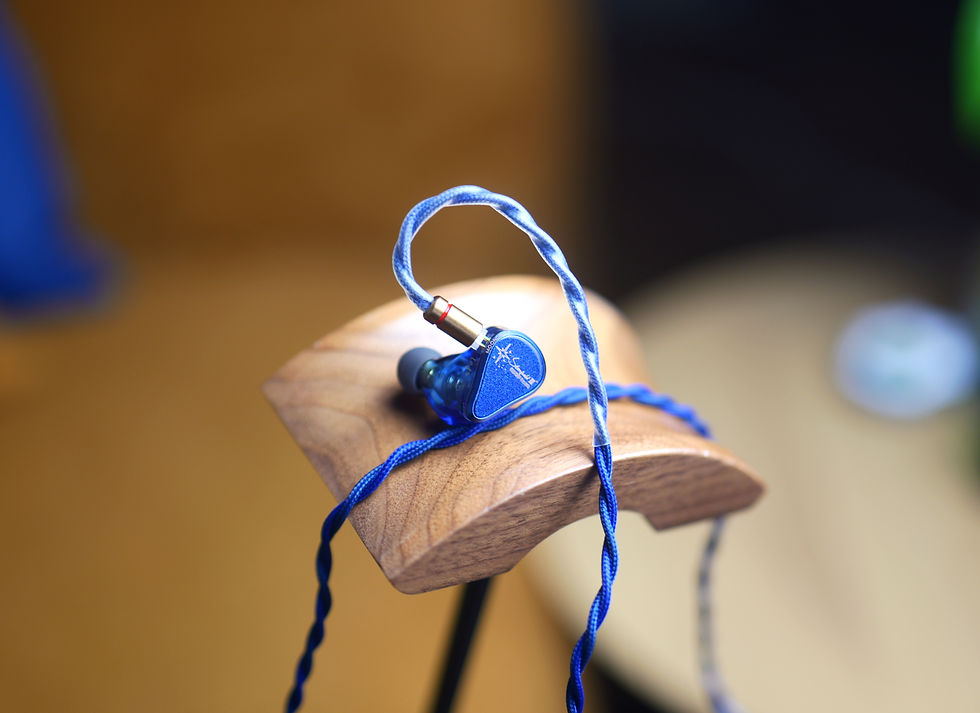
Let's get the obvious out of the way. This is one of the most beautiful IEMs I've had on my desk. Not "beautiful for $150". Beautiful, full stop.
A night sky you can wear. The shell is a deep blue with a fine glitter running through it, and in the right light it genuinely looks like a clear night far away from any city lights: dark, deep and scattered with tiny points of light. The iridescent paint shifts as you tilt it, so it never looks quite the same twice.
Then Moondrop brings in the gold. Gold-printed star motifs on the faceplate and golden accents that turn "pretty" into "prestigious". Midnight blue and gold is an old trick, used on everything from watch dials to luxury packaging, because it reads as quality instantly. Here it's done with restraint. And those little stars? They're the detail that makes you smile every single time you open the case.
Left and right aren't twins. Look closer and you'll notice the two faceplates carry different artwork. One wears a gold star with the Starfield III script. The other has a gold starburst radiating out from a single star, like a sunrise seen from orbit. Tilt them, and the paint slides between starry blue and a deep violet-purple. Even the "Left" and "Right" markings on the shells are written in gold script. Somebody at Moondrop clearly had a lot of fun with this, and it shows.
The gold doesn't stop at the faceplates either. The 2-pin connectors, the knurled plug collars and the plugs themselves are all finished in matching gold tones against a navy-blue cable. It's rare for a $150 IEM to feel art-directed from the shell to the jack. This one does.
You will tilt them under a lamp like a jeweler inspecting a diamond. Nobody needs to do that. Everybody does it anyway. I'm not saying how many times I did it while writing this section.
The paint finally got a bodyguard. The big change is the new anodized aluminum frame and base that wraps around the painted surface. Painted IEMs and house keys in the same pocket have never been friends, and Moondrop clearly knows it. The frame is there to take the knocks so the paint doesn't have to.
The body behind it is a translucent blue shell, made from hypoallergenic medical-grade resin, with a much more ear-shaped contour than before, closer to a proper custom-style monitor than the flatter Starfield 2. The nozzle is metal and on the shorter side, so your tip choice will matter more than usual. Moondrop says the new ergonomics were refined for long sessions, and the shape certainly suggests it: more contact with the concha, less of that "balanced on the edge of your ear" feeling.
The cable stops being an afterthought. You get a nylon-braided, high-purity OCC copper cable with 0.78mm 2-pin connectors. It's soft, it doesn't tangle like a set of Christmas lights, and it feels like it belongs on a $150 product, which the old silver-plated cable never quite did.
The plugs are swappable and lock in place with a screw-on collar. The USB-C one is angled at 90 degrees, so it doesn't stick out of your phone like a lightsaber:
3.5mm single-ended for everything with a headphone jack.
4.4mm balanced for your DAP or dongle.
USB-C with a built-in sound card rated at about 60mW and a DSP inside.
That USB-C plug is the sneaky star of the box. Through the MOONDROP Link app you get a 32-band parametric EQ with filter type, frequency, gain and Q. The settings are stored in the plug itself, so your tuning follows you from phone to laptop. There are community presets if you don't want to touch a Q value in your life, and Moondrop's Sound Target ID system is meant to carry your personal profile to future Moondrop products.
Tuning works through both the app and a web platform, and there's a built-in community where people share their EQ profiles and download each other's. The app can even auto-fit a curve to a target for you. And here's the part that made me laugh: the preview shows official presets for Overwatch 2, Rainbow Six and Arena Breakout. On a Starfield. Somewhere, an original Starfield owner just spilled their tea.
In the box: the IEMs, the cable, three plugs, three pairs of silicone tips and a leather-style zip case that's a clear step up from before. Three pairs of tips is the bare minimum, though. With that short nozzle, budget a few minutes (and maybe a few euros) for tip rolling. And yes, Moondrop's product page features an anime girl gazing at the night sky. This is Moondrop. There is always an anime girl.

Sonic Quality: Two Drivers Pretending to Be One
I expected a tweeter showing off. That's what usually happens when a brand adds a dedicated treble driver to a beloved single-DD tuning: the highs get louder, everybody calls it "detail", and three weeks later you're turning the volume down to survive cymbals.
That's not what happened here.
The graph doesn't lie. Moondrop prints the frequency response right on the back of the box, measured in its own lab on a B&K 5128 head and torso simulator. The blue line is the Starfield 3. The grey line is the target: Moondrop's PopAvg-DF (JM-1) curve with a -0.8dB per octave tilt and a +5dB bass boost.
And honestly? The two lines are almost the same line.
Here's how to read it. The bass is a clean shelf sitting roughly 7dB above the lower midrange, and it stays flat all the way down to 20Hz, so the sub-bass doesn't fade away the way it does on so many cheap single dynamics. The lowest part of the curve sits between about 200Hz and 600Hz, which keeps the lower mids clean rather than thick and warm. From 1kHz the curve climbs to an ear-gain peak around 3kHz, roughly 11 to 12dB above the mids. That's where voices get their presence. After about 5kHz it steps down gradually, with a few small ripples between 8kHz and 13kHz that hug the target, and then it rolls off above 15kHz.
In plain words: neutral, clean lower mids, present vocals, a treble that's extended but deliberately unexcited.
One warning before you start comparing graphs online. 5128 measurements look different from the older 711-style graphs you'll find almost everywhere. Compare shapes, not absolute numbers.
The crossover: the best compliment is silence. The highest praise I can give this two-way design is that I stopped thinking about it within ten minutes. There's no seam, no moment where the tweeter clocks in and the woofer clocks out. It just sounds like one very good dynamic driver that happens to breathe a bit easier at the top.
Bass: present, not pushy. Quantity is moderate, exactly what that +5dB shelf promises. The low end reaches deep and has real texture, but it doesn't slam. Kick drums land with a soft mallet rather than a fist. For acoustic music, jazz and anything with a real double bass, that restraint sounds natural and tidy. For EDM, hip-hop and anything that's supposed to move your fringe? You'll want more, and that's exactly what the USB-C plug's EQ is for.
Mids: the reason you buy a Moondrop. This is the home turf. Voices sit in a natural, slightly intimate position with good body and a smooth decay at the end of each phrase. Female vocals and falsetto have more room to open up than on the Starfield 2, which is where that tweeter quietly earns its salary. Voices never feel pushed at you. They feel placed.
Treble: smoother, not sharper. The top end extends further and with more ease than before, but it never gets edgy. Sibilance stays under control. If you love treble with bite, crunch and a bit of danger, this will feel too well-mannered. If you've ever had to quit a listening session because your ears hurt, you'll understand why Moondrop tuned it this way.
Stage and imaging. Width is good for an IEM, depth is reasonable rather than spectacular, and the extra air up top helps the stage feel less boxed-in than the Starfield 2. Imaging is clean and stable. It's not a holographic miracle at $150, and I'd be suspicious of anyone who tells you otherwise.
Three albums, three tests. Graphs tell you the shape. Records tell you whether you care.
Talk Talk, Spirit of Eden. An album that's half music, half silence. Quiet passages are where cheap IEMs fall apart, either hissing into the gaps or flattening the dynamics. The Starfield 3 lets the trumpet and harmonica float against a properly black background, and when the band finally erupts, the jump in scale feels real. This is where those clean lower mids earn their keep: nothing smears, nothing crowds Mark Hollis' voice.
Nick Cave, Ghosteen. Synth pads, piano and Cave's voice fighting gravity. That 3kHz peak brings the voice right in front of you without pushing it into your face, and the airy backing vocals open into space instead of getting clipped at the top. It's a deeply emotional record, and this IEM has the good manners not to interrupt it.
Daft Punk, Random Access Memories. The bass test, and the honest one. The production is immaculate, the bass lines are played by real humans, and the Starfield 3 renders them with lovely texture and timing. But Giorgio by Moroder wants more weight than this tuning gives. If you live on records like this, open the USB-C plug's EQ and add a couple of dB below 100Hz. Problem solved, warranty intact.
Which plug should you use? Here's the practical bit. Because of that 7.7Ω impedance, the source matters more than usual. The USB-C plug is matched to the load by design and is the most consistent way to hear the intended tuning. With a dongle or DAP on 4.4mm, the Starfield 3 can stretch out further, as long as the source has low output impedance and a clean noise floor. Plug it into something hissy and you'll hear the hiss before the music starts.
The Competition: Who Else Wants Your $150?
The funny thing about the Starfield 3's biggest rivals? Two of them are also made by Moondrop.
IEM | Price (approx.) | Pick it if | Skip it if |
Moondrop Starfield 2 | Often discounted now | You want the Starfield sound for less and only use 3.5mm | You want 4.4mm, USB-C or EQ |
Moondrop Aria 2 | $99.99 | You want a warmer, fuller low end for less money | You want the plugs and DSP in one box |
Simgot EA500LM | Under $100 | You like a brighter, more detail-forward sound and tuning nozzles | You're treble-sensitive |
The Starfield 2 problem. Moondrop's own predecessor is the trickiest rival. The core character is related, and once retailers start clearing stock, the price gap can get big. If you already own a Starfield 2 and love it, the 3 is a refinement, not a reason to sell a kidney. If you're buying fresh, the 3 is the one to get unless the 2 is going for silly money.
The Aria 2 math. On paper, an Aria 2 plus a decent USB dongle lands around the same total as a Starfield 3. But then you're carrying two things, you don't get 4.4mm, and you don't get a 32-band EQ living inside your plug. The Starfield 3 is basically the bundle, pre-assembled, with nicer paint.
The Simgot route. The EA500LM is the choice for people who think Moondrop is too polite. More sparkle, more edge, more "look at all this detail". It's a legitimately different philosophy rather than a better or worse one. Your ears, and your tolerance for treble, decide this one.


Outro: The Sequel That Actually Changed the Script
So, did Moondrop improve the Starfield or just make it busier?
Improved it. Clearly.
The second driver isn't there for the box. It's there to give the top end more room without wrecking the smooth, vocal-first character people loved in the first place. Add the protective aluminum frame, a proper cable, three plugs and a DSP you can actually use, and the Starfield 3 is a far more complete product than the IEM it replaces.
It's not perfect. The bass is polite to the point of shyness. The mobile app snubs iPhone owners, so the web tuner is your workaround. And that 7.7Ω load will snitch on every noisy source you own.
But at $149.99, this is one of the easiest recommendations in its class for anyone who listens to voices, acoustic instruments and long albums, and wants one IEM that works as well with a phone as with a proper player.
And honestly? I came in expecting a busier Starfield. I left with a better one.
Buy it if: you love mids and vocals, you listen for hours, you want 3.5mm, 4.4mm and USB-C in one box, and you're on Android (or don't mind tuning from a computer).
Skip it if: you're a basshead, you want treble with teeth, or you already own a Starfield 2 and are perfectly happy.
It's still the prettiest IEM in the room. Now it finally sounds like it knows that.
You can Learn more and Buy them here:


Comments