

Why I Think Kaiboer Is About to Dominate the Streamer Market - Kaiboer DMP-K8 Plus Review
And why the whole K8 family matters'
So when Kaiboer sent me the DAC-K5 a while back, I went in expecting exactly that.
I was wrong. And I don't say that lightly.
The K5 turned out to be a genuinely good streaming DAC, close enough to the Eversolo DMP-A6 Gen 2 in sound that I had to double-check the price tag. That review earned Kaiboer a permanent spot on my radar. What I didn't expect was how fast they'd move from "promising newcomer" to "company with an actual lineup."
Because that's what's happened. Kaiboer isn't new, not really. They've been making cables and UHD players since 2007, quietly, in the background, the way a lot of Chinese audio brands do before they decide to swing for the fences. What's new is the swing. And the DMP-K8 family is that swing.
The Family, Not Just the Product
Here's the thing about reviewing a single product in isolation: it tells you what a company can build once. It doesn't tell you whether they understand their own market. A lineup does.
Kaiboer's DMP-K8 series comes in three flavors, and the spacing between them is the actual story here. Once you line them up side by side, it's not a simple "more money, more chips" ladder. It's smarter than that.
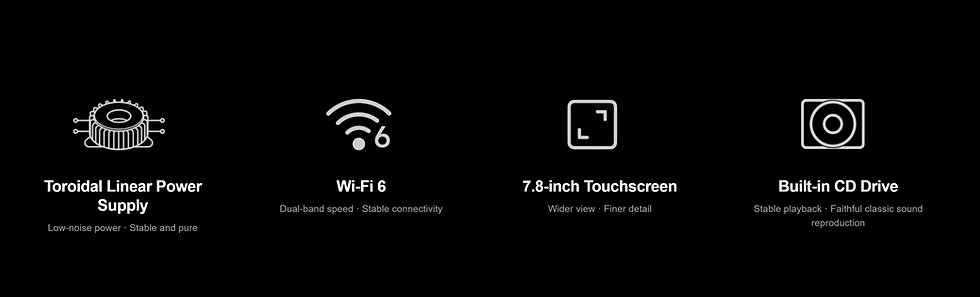
DMP-K8 is the entry point at $800, and it's more capable than "entry point" usually implies at that price. Toroidal linear power supply, the same 7.8-inch touchscreen as its siblings, built-in CD drive with lossless ripping to WAV or FLAC, dual SSD expansion (a hidden M.2 slot plus a drawer-style 2.5-inch SATA bay), NFS/SMB and WebDAV support for NAS and cloud libraries, 64-step hardware volume control, and Kaiboer's own AI lyrics and song-encyclopedia features baked into PureOS. What it doesn't have, confirmed directly by Kaiboer, is a DAC at all. This is a transport and library hub, not a converter. If you're feeding it into your own DAC or an amp with digital inputs, that's not a limitation, it's the point. If you were expecting an analog output built around ESS silicon like its siblings, look at the Plus instead.
And here's where I'll push back a little, because I don't think this whole family sits equally well with me. $800 for a device that explicitly has no DAC is a harder sell than the rest of this lineup makes it look. You're paying real money for a well-built transport, a nice screen, a CD ripper, genuinely useful storage and network features, sure, but at the end of the day it's still just a transport. Spend $200 more and the Plus hands you four DAC chips, the same screen, the same chassis language, and an actual analog output section. That's not a small gap to wave away with "well, you already own a DAC." A lot of people shopping in this exact bracket don't already have one sitting around, and for them, I'm honestly not convinced the K8 is the smart buy in this family. It's the one tier here I'm not fully sold on.

DMP-K8 Plus is where the arms race starts, at $1,000. Four ES9039Q2M DAC chips (not two, four) built on the RK3568 platform, dual femtosecond clocks, 8GB of DDR4, an XMOS XU316 USB interface, and its own toroidal linear power supply. SNR is rated at 130. This is the unit I've got on the bench, and on paper it's already punching above what you'd expect at this price tier.

DMP-K8 Pro is where Kaiboer stops being polite, but not in the way you'd guess, at $1,400. It actually drops to two DAC chips, not four. The catch is which two: dual ES9039PRO, the genuine flagship ESS part, not the Q2M variant in the Plus. Same dual femtosecond clocks, same 8GB DDR4, same XMOS XU316, but the power supply description shifts to "toroidal + linear," which reads like a second, dedicated linear stage layered on top rather than a single shared supply. SNR climbs to 140. Add a breathing-light volume knob and (per Kaiboer, still listed as forthcoming rather than confirmed) Roon Ready, and you've got a spec sheet that reads like something well above its price.
That's three genuinely different design decisions, not three points on one scale. No DAC at all, then four mid-tier DACs, then two flagship DACs. Kaiboer isn't just adding chips as you spend more, it's changing what problem each tier is solving. The K8 says "bring your own DAC." The Plus says "here's a DAC, and a generous one." The Pro says "here's the DAC, done properly." That's a rare thing to see done deliberately instead of by accident.
Here's the comparison I can't stop making. Eversolo's actual flagship, the DMP-A10, runs on the same idea as the K8 Pro: an all-in-one streamer, DAC, and preamp built around a top-tier DAC solution, dual clocking, big local storage, a large touchscreen, the works. It's a genuinely excellent piece of equipment, and it should be, because Eversolo is asking $3,680 to $3,999 for it.
The K8 Pro is $1,400.
Do the math and that's two-and-a-half to nearly three times the price for the Eversolo. Now, I want to be fair here, because the A10 isn't just a K8 Pro with a fancier logo. It adds things the Kaiboer doesn't claim: room correction with a bundled measurement microphone, a relay-switched R-2R volume stage instead of a conventional digital pot, and a broader analog input section built around real ADC capture. Those are genuine engineering additions, and they're part of what you're paying for.
But strip that away and look at the core: both units are built around genuine flagship ESS DAC silicon, both run dual precision clocks, both offer up to roughly 8TB of onboard storage, both put a large touchscreen front and center as the whole interaction model. Kaiboer built the same category of device, with the same category of core parts, for well under half the money. That's not a company undercutting on price by cutting corners on the parts that actually matter. That's a company that looked at what the segment leader charges and decided the margin didn't need to be that fat. Unheard of is the right word for it.
Zoom out for a second, because this is the actual headline, not a footnote to it. This isn't just the K8 Pro quietly matching one Eversolo flagship for a fraction of the price. Line up Kaiboer's entire three-tier family against Eversolo's entire streaming lineup and the pattern repeats at every single level. The K5 already went toe-to-toe with the $859 DMP-A6 Gen 2 in sound. The K8 Plus, at $1,000, sits right in the gap between that same A6 Gen 2 and the $1,299 A6 Master Edition Gen 2, running a genuinely rare quad-DAC architecture neither of those touches. And the K8 Pro, at $1,400, undercuts the $1,980 DMP-A8 Gen 2 by nearly $600 while running flagship ESS silicon, and undercuts the $3,680-plus DMP-A10 by two-and-a-half to three times over.
That's not one lucky product. That's a company that came out of nowhere, cables and UHD players a few years ago, and built three genuinely developed devices that undercut the strongest rival in this entire category at every price point that rival competes in. I don't say this often, and I mean it: this is a serious new contender, one with the range and the coherence to overthrow everyone in the streamer space, not just nibble at the bottom of the market.
Why does this matter more than any single review? Because a company that builds a coherent three-tier ladder, where each step up buys you something real and legible (better DACs, better clocking, better power delivery, not just a bigger badge) is a company that has actually sat down and thought about who its customers are. That's rarer than good specs.

What the K8 Plus Actually Is
Let's get concrete, because I don't want this to read like a press release with my byline on it.
The K8 Plus is an all-in-one: streamer, DAC, preamp, and CD player, built-in drive this time, no external unit needed. Four ES9039Q2M chips means each channel effectively gets its own dedicated conversion path, which is the kind of architecture decision that usually shows up two price brackets higher. Behind them sits an XMOS XU316 handling USB duties and dual femtosecond clocks keeping timing tight. You get 768kHz/32-bit PCM and native DSD512, which is more format headroom than almost anyone will ever need, but it's nice that it's there.

Very Rare DAC Configuration
How rare is quad, actually? Rarer than you'd think. I went looking for other devices running four ES9039Q2M chips, expecting to find a handful. I found one. One. TRASAM, a much smaller and far less established brand than Kaiboer, builds an Android streamer called the MP10 around the same quad-Q2M layout, right down to the 8GB of DDR4 and the WiFi 6. That's it. That's the entire list.
Everyone else stops at two, or one. Topping, a brand with a genuinely excellent engineering reputation, tops out at dual ES9039Q2M in the DX5 II. Matrix Audio, a name that's been in this game since before most of these newer Chinese brands existed, runs a single Q2M in the Mini-i 4. Kaiboer's own K5 runs dual. Going to four isn't a spec-sheet typo or a marketing flourish, it's a decision almost nobody else in this price bracket, or several brackets above it, has actually made.
Quick technical detour, because "four chips" gets thrown around without anyone explaining what it means. It's not four separate channels or four times the resolution. It's two ES9039Q2M chips assigned to each stereo channel, running in parallel rather than one chip doing the whole job. The technique is sometimes called parallel or differential DAC architecture, and the logic behind it is sound: random noise generated by each individual converter is uncorrelated, so when the two outputs are combined, that noise partially cancels itself out while the actual music signal, identical in both, reinforces. Done properly, that can push the noise floor down by a few dB compared to a single chip handling the channel alone. This isn't a marketing invention, it's a real, decades-old engineering trick.
Whether it plays out that cleanly here is a separate question. Topping's DX5 II runs one Q2M chip per channel, no parallel doubling, and is officially rated at 133dB SNR. The K8 Plus, running double that chip count, is officially rated at 130dB. So chip count clearly isn't the only variable that decides the final number, power supply design, the analog output stage, and board layout matter just as much, arguably more. Four chips is a genuine architectural choice. It's not an automatic win on the spec sheet, and as the Sound section below gets into, that's where the real answer to whether it matters actually lives.
Now, the honest caveat, because I'd rather tell you this myself than have a comment section tell me: more chips doesn't automatically mean better sound. A single well-implemented Q2M is already operating close to the limits of what's audible, and whether four in parallel buys you anything your ears can actually register, versus just a prettier number on a spec sheet, isn't something a datasheet can settle. Rare is a fact. Whether rare translates to better is what the Sound section below actually tests.

My favourite thing
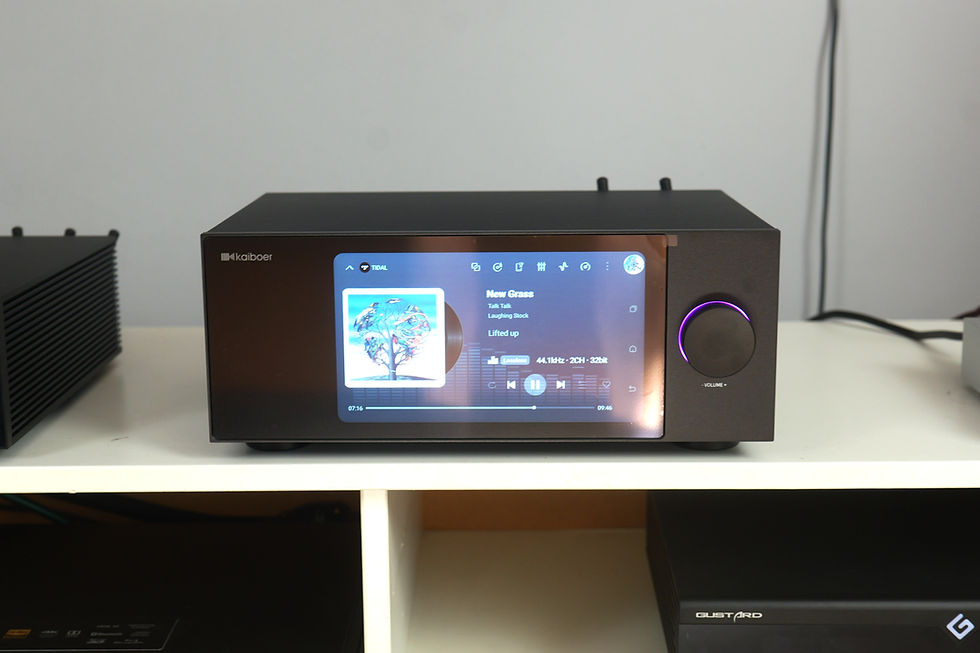
The screen is the same 7.8-inch full HD touch panel across the whole family, and it's genuinely one of the better implementations I've used at this price. Album art, real-time spectrum, VU meters, all rendered without the laggy, half-finished feel a lot of budget streamers still have. It also does phone screen mirroring, keeping your handset and the front panel in sync in real time, which sounds like a gimmick until you're queuing up a playlist from the couch instead of walking over to the unit. PureOS, Kaiboer's own Android-based interface, is clearly the product of actual internal development rather than a licensed skin bolted onto stock firmware. The app has matured noticeably since the K5.
Can we talk about the lyrics for a second? Most streamers in this class run a wide, roughly 16:9 panel, the same shape as a small TV turned on its side. Kaiboer didn't do that. The K8 Plus's screen sits noticeably closer to 4:3, taller than it is wide, and once you see synced lyrics scrolling on it, you understand why that choice matters. A wide panel gives you maybe two or three lines before you're scrolling. This one gives you real vertical room, lyrics feel like they're actually being read to you rather than ticker-taped across the bottom of the display. It's a small decision that most competitors clearly never even considered, and it's one of my favorite things about living with this unit day to day.

Software and Build Quality
Also, worth admitting up front: the software still needs polishing. Every Chinese hi-fi brand's software needs polishing, that's table stakes at this point, not a knock unique to Kaiboer. What's more interesting is what they chose to fix. This is a new company building its interface with the benefit of watching WiiM, Eversolo, FiiO, and Fosi Audio all make their mistakes first, and playing product archaeologist on PureOS for a while is genuinely fun. Information sits where you'd actually look for it, album art where you want it, metadata where you want it, without the clutter some of those older platforms have accumulated over successive firmware updates.
One small touch I genuinely enjoyed: open Tidal's own app on the unit itself (not cast to it, run locally, since there's no Connect protocol here) and play something in MQA, and the player actually shows you the unfolding happening, visually, in real time. I'll be upfront about where I stand on MQA itself, whether unfolding does anything meaningfully audible is a genuinely contested question in this hobby, and I'm not pretending that debate is settled here. But putting the process on screen instead of hiding it behind an acronym in a settings menu is a nice bit of transparency most competitors don't bother with. The same instinct shows up in the remote, more on that shortly, where the layout reads like someone actually used a WiiM remote, an Eversolo remote, a FiiO remote, made a list of everything mildly annoying about each one, and designed their own accordingly.
Wi-Fi 6 is on board, a 10-band EQ is included rather than a token 3-band toy, and Apple Music is integrated natively rather than screen-cast from a phone, a detail that matters more than it sounds like it should if Apple Music is your library. Cloud storage comes in through WebDAV and OAuth sign-in, and the player can discover SMB shares on your network without you fighting a settings menu to do it. CD ripping works the way it should: point it at a disc, let it do its thing, move on with your life.
Build quality? Fine. Not bad, not the flex some of the marketing wants it to be. The aluminum itself is genuinely good, this isn't thin, flexy sheet metal putting on an act. What it isn't is seamless. Pick it up, turn it over, and you can tell this chassis is built from multiple pieces joined together rather than the single, unified feel companies like Eversolo or LAiV have gotten very good at pulling off. It's not a bad build. It's just not a build that's going to make either of those two nervous.

Biggest Surprise
Now let's talk about the remote, because nobody talks about the remote. Pick it up and your first impression won't be flattering. It's plastic, light, the kind of thing you could imagine coming free in the box of something half the price. And honestly? If build quality alone was the scorecard, my own reference unit, the Eversolo DMP-A8 Gen 2, wins this comparison without even trying. That remote is genuinely gorgeous, weighted and machined in a way that makes you want to hold it.
But pick up the K8 Plus's remote and actually use it, and the story flips completely. Home button. Back button. A proper directional pad to move through menus the way you'd expect from something built this decade. And then the part that actually shames FiiO, Eversolo, and WiiM alike: a genuine mouse mode, a small cursor you drive around the screen exactly like a laptop trackpad, letting you point and click through PureOS instead of mashing arrow keys sixteen times to reach a submenu. I haven't used another remote in this category that does this. Not FiiO. Not WiiM. Not even my beautifully-built Eversolo. And that's before you get into the rest of what it does, because there's more here I haven't even gotten to yet.
Build quality is a five-minute impression. Layout and functionality are what you live with for years. Kaiboer clearly optimized for the second thing, and once you've navigated a dense menu with a cursor instead of a D-pad, going back feels like a downgrade, no matter how nice the remote in your other hand feels.


CD Drive Review
About that CD drive, because we need to talk about it. This isn't a transport engineered for the K8 Plus. It's a repurposed optical drive, the same basic mechanism you'd find inside a PC or laptop, dropped into the chassis rather than designed around it. The tray feels a little loose in a way that makes you second-guess yourself every time you load a disc, I find myself handling it more carefully than I should have to, half-expecting the mechanism to complain. The optics inside aren't anything special either.
Its saving grace is what it's attached to. Feed it into that same DAC section and the CD player rides on the coattails of genuinely good conversion hardware, so it never sounds bad. But it also never sounds better. On my own reference piece, the Eversolo DMP-A8 Gen 2 Master Edition, there's a real, audible step up when you play a physical disc versus streaming the same album, the CD path does something the streaming path doesn't quite match. Here, there's no such gap. Streaming and disc sound identical, which tells you the drive isn't contributing anything of its own, good or bad, it's just along for the ride.
It reminds me of the Eversolo Play CD situation: not a dedicated CD player pretending to be world-class, but a "since you're already buying the good stuff, here's a CD player thrown in" bonus. And honestly, that's probably the right way to think about it. This feels built for the person who always wanted a CD player, always felt buying a dedicated one was too much to justify on its own, and now gets one essentially gratis, bolted onto a streamer and DAC section they already wanted. Judge it as a free bonus, not a standalone feature, and it's hard to be upset about it. Judge it as an engineered CD transport, and it falls apart fast.
Here's the strange part, though, and it's a genuinely good one. This bolted-on, repurposed drive plays DVDs and HDCDs, formats plenty of far more expensive dedicated players have quietly dropped support for. It's an odd contradiction. The mechanism itself feels like an afterthought, and yet it reads formats some flagship transports stopped bothering with a generation ago. I don't know whether to call that generous engineering or a happy accident of using an off-the-shelf drive that just happens to still support everything. Either way, if you've got a stack of old DVDs or a handful of HDCD pressings gathering dust, this thing will actually play them, which is more than I can say for a lot of players costing several times as much.

Some problems big and small
Now here's the thing that actually bothers me, more than the remote's plastic or the CD tray's wobble. Every time the K8 Plus switches from one track to the next, there's an audible click through the output. Not a soft pop, an honest-to-god click, the same character of sound you get from an R2R ladder DAC's relays snapping to a new position. Except here it's not tied to a volume change, it happens on ordinary track changes, in the middle of just listening to an album. Once you notice it, you can't un-notice it, and by my second sitting with this unit it had gone from "huh, that's odd" to genuinely annoying. My best guess is a mute relay firing to protect the output stage while the unit re-locks to a new track's sample rate or bit depth, which is a real and fairly common behavior in devices like this. Common doesn't make it forgivable. This is exactly the kind of thing that should get fixed in a firmware update, not something a buyer should have to live with.
And here's a gap that bothers me even more than the click, because it isn't a hardware quirk, it's a missing feature: no Tidal Connect. . At this point in the category's life, Connect support isn't a nice-to-have, it's table stakes. WiiM has it at a fraction of this price. Eversolo has it. Most of what this device is actually competing against has it. Not having it doesn't just cost a bit of convenience, it costs Kaiboer a real chunk of the audience that lives inside those apps and expects to cast to whatever's on the network without a second thought. This is the clearest sign in the entire lineup that Kaiboer, for everything it's gotten right on hardware, still has growing up left to do. A company doesn't get to call itself a mature competitor to WiiM and Eversolo while skipping the exact software layer those companies built their reputations on.
The Sound Quality
Let's get to the part everything else was building toward.
If you read my K5 review, you already know most of this story, because the K8 Plus doesn't rewrite it so much as sharpen it. The character is the same family sound: transparent, a touch on the bright side, and detailed to a degree that borders on unforgiving of bad recordings. What's different, and it's a real difference, not a rounding error, is control. Soundstage scope and the confidence with which it holds a mix together both take a step up from the K5. Same personality, wider room to live in.
I picked four albums specifically because each one stresses a different muscle, and none of them let a DAC hide.
Flaming Lips, "Race for the Prize," The Soft Bulletin. This track is a wall. Swelling strings enter almost immediately, a huge, layered drum sound sits underneath them, vocal harmonies stack three and four deep, and somewhere in the middle of all of it Wayne Coyne is still trying to tell you a story about two scientists. A lot of DACs turn this into a pleasant blur, a wash of sound that's technically all there but functionally smeared into a single mass. The K8 Plus doesn't do that. It pulls the string section away from the drum bed, keeps the vocal stack legible as four individual voices rather than one thick one, and lets the little production flourishes, the tape-hiss textures, the odd synth swells buried in the back, actually register instead of vanishing into the wall of sound. This is exactly the kind of track that exposes a DAC that's smoothing things over to sound inoffensive. This one doesn't smooth. It sorts.
Steven Wilson, "Home Invasion," Hand. Cannot. Erase.. Different test entirely. This track lives and dies on the interplay between a genuinely nasty, propulsive bassline and Guthrie Govan's guitar work weaving in and around it, both of them moving constantly, neither one staying still long enough to get boring. The bass here isn't a single note repeated, it's a living, articulate line with texture and pick attack you can actually follow, and the K8 Plus tracks every movement of it without letting it turn into an undefined low-end rumble. Meanwhile the guitar stays fast and detailed on top, string bends and pick harmonics rendered with real bite rather than flattened into generic "guitar noise." What impressed me is the dynamic handling between the two, the bass hits hard without swallowing the guitar's space, and the guitar stays sharp without ever thinning out the low end to make room for it. That's a genuinely hard balancing act, and it's the clearest demonstration on this list of what quad-chip control over the frequency extremes is actually buying you.
Miles Davis, In a Silent Way. No drums crashing, no wall of layered vocals here, just space, and space is its own test. This is one of the quietest, most patient records in jazz, long stretches of Joe Zawinul's electric piano and John McLaughlin's guitar hovering just above silence before Tony Williams' cymbal work or Miles' own trumpet drifts in from somewhere off to the side. What the K8 Plus does well here is placement. Instruments don't just exist, they exist somewhere, with real depth between the front of the soundstage and whatever's happening further back, and the silence between notes stays genuinely black rather than filled with a low-level haze some lesser implementations let creep in. This is where "a bit more scope in soundstage" stops being a marketing phrase and starts being something you can actually point to. The room the K8 Plus builds around this recording is simply bigger than the one the K5 built.
Fleetwood Mac, "The Chain," Rumours. I picked this one to stress-test the brightness itself, because "detailed and a bit bright" is a description that can tip into fatiguing if a DAC isn't careful, and this track has every ingredient to expose that: layered vocal harmonies from three different singers, prominent hi-hat and cymbal work throughout, and that famous bass line driving the instrumental outro like it's trying to escape the speakers. Through the K8 Plus, the cymbals stay crisp and detailed without turning into a splashy mess, which is the failure mode you'd expect from a genuinely bright-leaning DAC pushed on material like this. The vocal harmonies stay separated as three distinct voices rather than merging into one texture, and that bass line in the outro comes through with real snap and pick attack rather than just weight. Bright, here, reads as resolving rather than harsh. That's the difference between a DAC that's bright because it's cutting corners and one that's bright because it's simply not hiding anything.
Put it all together and the verdict on sound is straightforward: if you liked what the K5 did, you'll like this more, because it's the same fundamental character with a genuinely audible upgrade in scale and control. Whether that upgrade traces directly back to the extra DAC chips or to everything else Kaiboer changed around them, the clocking, the analog stage, the layout, isn't something I can separate out from the listening chair. What I can tell you is that it's there, it's real, and it's the best argument this whole family has made yet for why the quad-chip decision wasn't just a spec-sheet flex.

The Verdict (For Now)
I came into the K5 review skeptical and left impressed. I came into the K8 Plus already convinced Kaiboer knew what it was doing, and having actually lived with it, listened to it, fought with its remote and its clicking output stage, I'm leaving even more convinced than when I started. A spec sheet this coherent, across three tiers, from a company that was making cables a few years ago, doesn't happen by accident, and neither does a sound this consistent with what that spec sheet promised.
A great new hi-fi company has arrived. The K8 Plus itself earns a place on your shortlist, transparent, detailed, genuinely wider-sounding than the K5 that got Kaiboer here in the first place, with a build and a CD drive that keep it honest rather than perfect. The company behind it? That part I was already sure of. Now the product backs it up too.
Pros
Genuinely rare architecture: four ES9039Q2M DAC chips, a configuration almost nobody else builds (only one obscure competitor, TRASAM's MP10, matches it)
Strong value across the whole family: the K8 Plus and especially the K8 Pro undercut Eversolo's equivalent tiers by a wide margin (Pro at $1,400 vs. Eversolo's A10 at $3,680–3,999)
Excellent screen: sharp, responsive, no lag, and its taller 4:3-ish aspect ratio makes synced lyrics look genuinely great compared to competitors' wide 16:9 panels
Thoughtful software: PureOS clearly learned from the UX mistakes of WiiM, Eversolo, FiiO, and Fosi Audio, info is placed where you'd expect it, and small touches like visualized MQA unfolding show real attention to detail
Standout remote: plastic feel aside, the layout, Home/Back buttons, real D-pad, and a genuine trackpad-style mouse mode, beats FiiO, WiiM, and even Eversolo on pure functionality
Surprise format support: the CD drive plays DVDs and HDCDs, formats many pricier dedicated players have dropped
Sound quality holds up: transparent, detailed, and a genuine step up in soundstage scope and mix control over the K5, without tipping into fatigue despite the bright-leaning character
10-band EQ, native Apple Music, WebDAV/OAuth cloud access, and SMB network discovery, a more complete feature set than the "3-band EQ and not much else" you get on a lot of competing gear
Cons
Audible click/relay-type noise on every track change, likely a mute relay re-locking to a new sample rate, and it's genuinely annoying in normal listening
No Tidal Connect, no Spotify Connect, no Qobuz Connect, a real software gap, not a hardware limitation, and a clear sign the brand hasn't fully matured to standard competitor with WiiM or Eversolo
Build quality is solid but not seamless, aluminum is good, but the chassis reads as assembled from multiple parts rather than the single, unified feel Eversolo or LAiV achieve
CD drive is a repurposed PC/laptop mechanism, not purpose-built, tray feels loose, and it doesn't add anything sonically over streaming the same file (no "CD sounds better" moment like on the Eversolo A8 Gen 2 Master Edition)
Remote build quality itself is plasticky and light, functionality is excellent, but it won't win any beauty contests against Eversolo's
Software still needs general polish, typical of the category, but still a real caveat
The base K8 (not this review unit, but part of the family) is a harder value case at $800 with no DAC at all
Roon Ready and full pricing on the K8 Pro are still listed as forthcoming rather than confirmed


Comments