

Eversolo did Something Amazing here - AMP F8 Review
I have a rule about Class D. At the budget end, up through the "I just want good sound without selling a kidney" tier, I love it. You get power, stability and a level of clarity that Class A/B amps at the same price simply cannot touch. Class D at that level isn't a compromise. It's often the smarter engineering decision.
But something happens once the price climbs. Once you're no longer choosing based on what you can afford but on what you actually want to live with, I find myself reaching for Class A/B every single time. Musicality. Fidelity. The way a soundstage breathes instead of just existing. That shift in taste isn't nostalgia, and it isn't snobbery. It's just what my ears keep telling me, review after review.
Let me be clear about what this isn't. This isn't me telling you Class D has no business at the top of the market. Some of the most respected flagship amplifiers being built right now, Marantz's Model 30 and Model 10, NAD's M33, Primare's own high-end gear, are Class D, and not because anyone was cutting corners. Those companies have real, well-earned reasons: enormous power delivery without a furnace-sized heatsink, distortion figures that used to be exclusively Class A/B territory, and an efficiency story that only gets more relevant. Class D at the top of the market is a legitimate engineering position, not a compromise, and I respect the brands that build that way even when it isn't where my own ears end up.
So when Eversolo, a brand that built its entire reputation on streamers, DACs and touchscreens, decided that its serious power amplifiers would lean Class A/B rather than Class D, I found myself nodding, not because Class D would have been the wrong call, but because it happened to land on the side of the fence I already prefer to sit on.

Eversolo Amp Lineup
Let's clear something up first, because I got this wrong myself before digging in. The AMP-F8 is not Eversolo's first amplifier. It's not even their second.
There was the AMP-F2, a Class D design built around a Starke Sound module, since discontinued. There's the AMP-F6, a newer GaN-based Class D amp announced alongside the F8. And there's the AMP-F10, the brand's actual flagship, five MOSFET pairs per channel, a 1000W power supply, and the amp that first proved Eversolo could build a proper power stage instead of just a proper streamer.
The AMP-F8 sits in the middle of all of that. Not the entry point, not the flagship. The one built to be somebody's actual system.
And here's the part I find genuinely interesting: Eversolo currently sells a GaN Class D amp and two Class A/B amps at the same time. This isn't a company that abandoned one topology for another. It's a company that looked at what each topology is actually good at and assigned jobs accordingly. Compact, efficient, space-constrained system? GaN. Serious, system-anchoring power amp you'll build a whole setup around? Class A/B, twice over.
That's not marketing. That's the exact price-tiered logic I already believe in from years of listening, playing out inside one brand's own lineup.

Build and Design
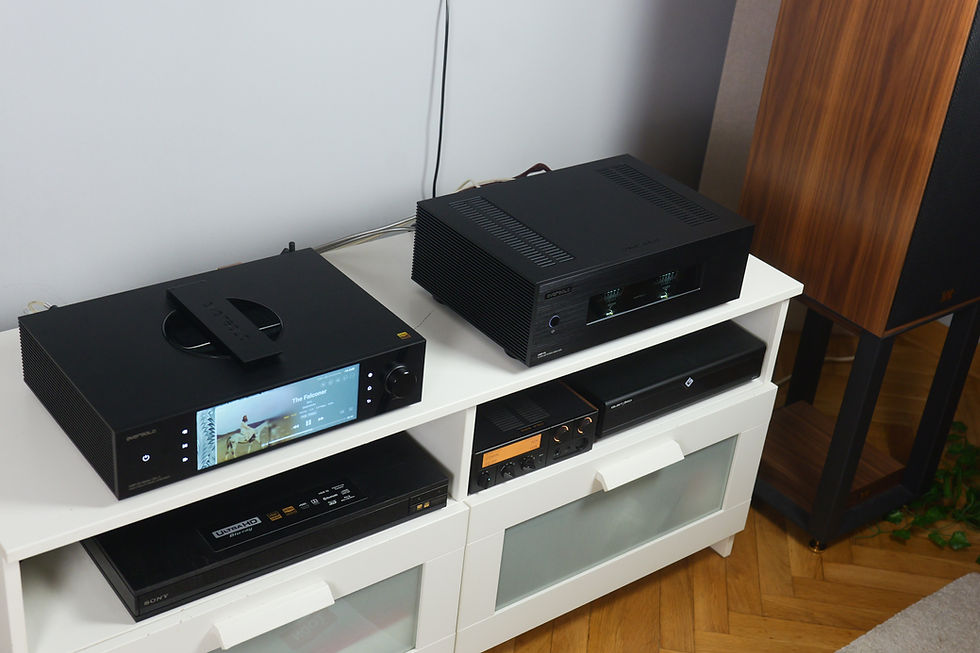
Pick the AMP-F8 up and the first thing you notice is that Eversolo didn't cut corners to hit $1,800. CNC-machined aluminum chassis, a custom 800W toroidal transformer, three pairs of matched, high-current MOSFETs per channel running on separate left and right boards rather than sharing one. There's a DC-blocking circuit ahead of the transformer specifically to stop mains-borne DC offset from making the toroid hum, which is a detail that tells you someone on this design team has actually been annoyed by a humming transformer before. Twenty-four filter capacitors handle transient response. This is not a company phoning it in on the engineering.
And honestly? The fit and finish backs that up. Nothing about the AMP-F8 feels cheap.
But here's where I have to be blunt. The design itself is bland.
Not ugly. Not offensive. Just… forgettable. It's the industrial design equivalent of a well-tailored gray suit. It does the job, it won't embarrass you, and nobody at the party is going to ask where you got it.
The VU meters are the clearest example. They're there, they're backlit, they do the job a VU meter is supposed to do. But the needle sweep is thin, the meters themselves are small, and there's nothing about them that invites you to actually watch them the way a great VU meter should. Put this next to something like Advance Paris's meters, big, legible, genuinely satisfying to watch from across the room, and the AMP-F8 comes off looking like it was designed by an engineer who was told "add VU meters" as a checklist item rather than someone who wanted you to fall in love with them.
Great build quality. Competent, quiet, correct design. Not a design you'll talk about.
What's Actually Happening Inside
The AMP-F8 is a Class A/B amplifier delivering 180W per channel into 8Ω, 280W into 4Ω, and up to 500W bridged into 8Ω as a mono block. Total harmonic distortion is rated at 0.003%, signal-to-noise at 115dB, damping factor above 400.
Here's the number that should make you pause: those figures are actually better than the AMP-F10's, Eversolo's own $2,480 flagship. The F10 measures 0.008% THD and 113dB SNR. The cheaper amp, on paper, is the quieter and more linear one. What the F10 gives you instead is more raw headroom, five MOSFET pairs instead of three, a bigger 1000W supply, a damping factor over 600, and the ability to bridge into 4Ω loads, which the F8 can't do.
So the honest way to frame the two amps isn't "better" and "worse." It's "which job do you need done." A normal 8 or 4Ω speaker load, which covers most bookshelf and mid-size floorstanding designs, plays to the F8's strengths. Genuinely difficult loads, monoblock pairs into low-impedance speakers, or just wanting the biggest number available, that's what the F10 is for.
The bridging story itself is worth dwelling on. Buy one AMP-F8 now to run your system in stereo. Buy a second one later, flip both into bridged mono, and you've got a 500W-per-side monoblock pair without having sold the first amp or started over. That's a genuine, sensible upgrade path, not a marketing bullet point.

Sonic Quality
Here's where the Marantz comparison from earlier actually pays off, because it's not just a spec-sheet parallel. Of everything on the competitor list, the AMP-F8 sounds closest to that classic Marantz house sound, the one I'd tie to the brand's A/B amps specifically, and closest of all to the Model 30.
A quick word on method before the impressions, since it matters here more than usual. The bulk of my listening happened through the F8's intended, visually matched partner, the DMP-A8, because testing that exact synergy is the actual point of this review. Stacked together, the two genuinely look like they belong to each other, and that pairing was where I spent most of my time. But to separate what the amp itself is doing from what its source is doing, I also ran three different DAC chip philosophies through it as reference points: FiiO's K17 R2R for a proper R2R ladder presentation, Gustard's X26 III for a flagship ESS take, and the DMP-A8's own built-in AKM section for the amp's actual intended partner. A few cheaper DACs got a spin too, but those three were the main switching points. More on what that revealed in a moment.
The character
Smooth is the word that kept coming back, but big is the second one. The F8 gives the lower mids noticeably more decay, softening transients right in that region rather than snapping them shut, and it backs that up with bass that's firm, open, and genuinely large rather than just loud, the kind of low end that fills a room rather than just anchoring a track. That size carries through to the soundstage too, which is consistently wide and expansive rather than boxed in, giving instruments real room to breathe. It's a decently clean and detailed amp, but I'll be honest, it isn't the cleanest or most detailed thing at this price point. What it does have is enough resolution that vocals stay intelligible even in dense, layered production, and enough treble precision that fine detail still registers. It just isn't chasing you down to prove it. This amp leans laid back. It's not showman-like, and it's not trying to sound impressive from across the room, though the sheer size of what it throws into that room does the impressing on its own.
That laid-back leaning is exactly why the DAC pairing matters so much. Of the three chip philosophies I tried, the Gustard's flagship ESS implementation was the most neutral partner for this amp, specifically because ESS pushes the presentation a touch more forward, adds a bit more perceived detail, and tightens things up just enough to counterbalance the F8's own easygoing nature. The FiiO's R2R ladder leaned further into warmth and ease, that's simply the character R2R ladders bring to a system in my experience. The AKM chipset in the DMP-A8, gorgeous as that streamer is on its own terms, sat closer to the R2R than to the Gustard, leaning into the amp's smoothness rather than working against it, which makes for a warmer, more relaxed overall picture. None of the three is wrong. It depends whether you want the F8's personality doubled down on or gently corrected.
Massive Attack, Butterfly Caught and A Prayer for England. Both from 100th Window, and both excellent stress tests for exactly what this amp does well. Butterfly Caught is dark, moody, led by a synth bass that needs real breath and reach to land properly, and the F8 gave it both, firm, weighty, and large enough to feel like it's coming from somewhere much bigger than a single driver. What impressed me more was everything happening behind that bassline, the constant swelling and shifting of background instrumentation, expanding and contracting throughout the track across a genuinely wide soundstage, all of it staying clean rather than turning to mush. A Prayer for England asks something different, a marching synth drum underpinning Sinéad O'Connor's vocal, and that vocal came through completely uninterrupted, never fighting the mix for space.
Fleetwood Mac, Dreams. The rhythmic core of this track lives in the bass, snare, kick and high toms, and it's a good test of whether an amp can keep a groove honest. The F8 isn't the most informative amp I've heard here, it won't hand you every last microdetail on a platter, but I never once lost the thread across a large, spacious soundstage. Instrument placement and layering were clear even with plenty of air between them, and every drum hit was noticed, felt, and shown rather than just implied, the kick in particular landing with real size behind it.
Kamasi Washington, Change of the Guard. The opening track off The Epic, and one of the denser things you can throw at any amplifier. Piano, saxophone, upright and electric bass, vocals and choir all competing for space, and the amp needs to stay dynamic and surefooted enough to keep everyone audible without collapsing into noise. The F8 handled it well, helped considerably by just how much room its soundstage gave everyone to sit in without crowding. How well depends a little on your own taste and how far you lean into the mix, but if an amp can carry a track this dense through to the end while staying composed, that's a genuine mark in its favor.
Hans Zimmer, Time. My own addition to the list, and a deliberate one. Everything above tests texture, vocals or rhythm. This one tests scale, and scale is arguably the F8's strongest suit. Time builds from almost nothing into a wall of strings and deep, sustained low end, and it's a good way to actually hear what that 180W-per-channel rating and damping factor above 400 are doing rather than just reading them off a spec sheet. The bass stayed firm and large rather than swelling into mush, and the soundstage kept expanding right alongside the music instead of hitting a ceiling. An amp with real headroom stays composed as the track swells. One without it starts to sound strained or congested right when the piece needs the opposite.
Put it all together and the AMP-F8 reads as a big-sounding amp built for people who want to sink into music rather than sit up and analyze it, generous bass, a wide, spacious soundstage, and a character that fills a room rather than pointing at itself. That's a character, not a flaw, and it's one worth keeping in mind for the pairing advice that follows.

The Competition
This is a power amp, no volume knob, no digital inputs, no streaming, so its competition is a specific and slightly unusual list: other people's dedicated power amps.
Primare A35.2 ($3,495, roughly $1,700 more than the F8). Primare actually walked the opposite direction from Eversolo, and I want to say plainly that this isn't a story about a brand cutting corners. Primare used to build Class A/B amps. They moved to what they call "analog Class D" with the A35.2, chasing 200W per channel and 800W bridged. And sonically, it delivers on that ambition: an iron grip on bass, control that doesn't loosen even on demanding, deep-reaching speakers, a vast and boundless soundstage. But here's the trade-off: don't expect a romantic sound out of it, no coloration, no added warmth. That's the exact opposite instinct from the F8's softened lower mids and generous low end.
Sonic verdict: if grip, control, and a genuinely honest presentation matter most to you, the Primare wins, and its bridging headroom into truly difficult loads backs that up. But it's explicitly not chasing the ease and warmth that defines the F8, and you're paying nearly double to get there.
Marantz Model 30 ($2,499 to $3,500 depending on finish). It's the clearest example of everything I said in the opening about respecting Class D at the top of the market, built around Hypex's NC500 modules and tuned in-house by Marantz's own "Sound Master." It's primarily sold as an integrated amp, but Marantz built in a power-amp-only input, meaning you can bypass its preamp section entirely and run it exactly like a dedicated power amp, which makes the comparison fair rather than a stretch. And of everything on this list, it's the amp the F8 sounds closest to, easygoing, smooth, effortless, warm without smothering detail. But it has real weak points too: a slight softening of dynamics, a bit less bass grip than pricier rivals, and a soundstage that doesn't always plumb the same depth as more aggressively resolving amps.
Sonic verdict: these two are genuinely close cousins in philosophy, which makes this the most interesting comparison on the list rather than the most different. The Marantz's own weaknesses, softened dynamics and limited bass grip, are precisely the areas where the F8 measured its own strongest traits, firm, large, generous bass. The F8 isn't just aping the Marantz's easygoing character for less money, it's doing the exact thing the Model 30 falls a little short on.
Roksan Caspian 4G Power Amplifier ($3,750, more than double the F8). Roksan's been building this way since the 1980s, and their current flagship, built around what they call "Euphoria" architecture, is explicitly designed to add as little of its own character as possible. It shows: vice-like grip through the frequency range, muscular but agile bass, tonally neutral without tipping into sterile. That's a genuinely different goal from the F8's, which leans into its own personality rather than trying to disappear. And there's a real cost to that pursuit of neutrality. Compared to the older, warmer Caspian M2 it replaced, the 4G has traded away a fair bit of that classic Roksan warmth, and the treble can turn hard and a touch brassy where the older amp stayed easier on the ear.
Sonic verdict: if you want the source and recording to speak for themselves with minimal amplifier coloration, the modern Caspian is built for exactly that, and it delivers only 105W to the F8's 180W while charging more than double. If you want the amplifier itself to be part of the sound, warm, big, and forgiving, the F8 is doing something the Roksan is deliberately trying not to, at a fraction of the cost. And I'll admit a personal bias here: of every amp on this list, the Caspian is my own favorite in pure power amp mode. That grip and neutrality genuinely does something for me. It just isn't the same thing the F8 is trying to do, and at less than half the price, the F8 doesn't need to be.
Onkyo M-80 ($1,999, the closest price match of the whole field). Onkyo effectively went quiet as a serious hi-fi brand for years before this Icon series relaunch, and the M-80 explicitly revives design language from their Integra amplifiers of decades past, VU meters included. Sonically, it leans toward precision and treble clarity, closer to that classic "Japanese" house sound, with crisp cymbal definition, an open and honest midrange, and bass that's lean and precise rather than big or bloated. It's not aggressively colored one way or the other, but the bass stays controlled and tight rather than generous, the opposite instinct from the F8's approach.
Sonic verdict: this is the cleanest apples-to-apples matchup on the list, nearly identical price, same topology, comes with a proper matching preamp Eversolo doesn't offer. Where it leans lean and precise, the F8 leans big and forgiving, and if you're shopping for the single best alternative to the Eversolo, closest in price and closest in raw numbers, this is it. But between the two, I think Eversolo comes out ahead. More power, a bigger and more generous low end, and a character that does more of the emotional heavy lifting rather than asking the recording to do it alone.
.

Building a System Around It
The AMP-F8 has no volume control and no digital inputs. It needs a partner.
Eversolo's own answer is the DMP-A8 Gen 2, a streamer, DAC and preamp in one box, and the F8's chassis dimensions were clearly sized to stack underneath it. Put the two side by side and they visibly complement each other, this isn't just a spec-sheet pairing, it's a matched physical set. That's the intended, out-of-the-box system, and it's a coherent one given how Eversolo's whole catalog is built around all-in-one thinking. It's also, for what it's worth, the exact pairing this review set out to put through its paces.
But it's worth noting that Eversolo is the outlier here. Primare, Roksan and Onkyo all sell a dedicated, purpose-built preamp alongside their power amps. Eversolo doesn't, not yet. Whether that's a gap worth filling or simply a different, equally valid philosophy is a genuinely open question, and one I'd rather pose than answer for them.
If you want to go the separates route instead of the all-in-one route, a few options worth knowing:
On the preamp side: the Topping Pre90 ($599) is about as close to sonically invisible as a preamp gets, useful if you want to hear the F8 without anything else coloring the picture. The Parasound Halo P6 ($1,595) and Onkyo P-80 (around $1,999) both fold in a DAC, phono stage and streaming, closer in spirit to what the DMP-A8 already does. Further up, Primare's PRE35 and Roksan's Caspian 4G Streaming Pre-Amplifier are the matched partners for the two competitor amps above, useful if you're building a genuine A/B comparison system.
But the Topping is absouletly my choice. Just a great pairing, and can keep up with the reast of preamps here easy, for less money.
On the DAC side, there are really two paths. A DAC with a genuinely good variable output, the RME ADI-2 DAC FS (around $1,200) is the reference case, can skip the preamp question entirely and feed the F8 directly. Or you pair a fixed-output DAC with one of the preamps above. Eversolo's own answer here is brand new too: the DAC-R8, a 24-bit R2R DAC unveiled alongside the F8, pricing still unannounced as of this writing, their first standalone DAC outside the all-in-one DMP series. Of the DACs I actually ran through the F8 for this review, Gustard's X26 III ($1,599, flagship dual ES9039SPRO chips) is worth calling out directly, it was the most neutral-sounding partner I found, correcting for the amp's laid-back nature rather than adding to it. FiiO's K17 R2R (around $990) is the softer, warmer alternative if you'd rather lean into the F8's own character than balance it out.
And here's an interesting side note while we're on the topic of chips: Eversolo's own streaming lineup isn't running one DAC philosophy across the board either. The DMP-A6 uses dual ESS Sabre chips, the DMP-A10 flagship jumps back to ESS too, just the top-tier ES9039PRO this time, and it's only the DMP-A8, the F8's intended stack partner, that breaks the pattern and runs AKM's flagship pairing instead. So Eversolo's own internal ladder isn't a straight line either, it's ESS, then AKM, then ESS again.
As covered in the sonic section above, the chip question turned out to matter for the F8 specifically. I did the bulk of my listening through the A8, since stacking it under the F8 is both the intended pairing and the actual synergy this whole review set out to test, and visually the two genuinely look designed for each other, not just sized to fit. But swapping in a Gustard X26 III, running flagship ESS chips, gave a more neutral read on the amp, more forward, a touch more detailed, slightly cleaner, which suits an amp that already leans smooth and laid back on its own.
A FiiO K17 R2R leaned further into that same smoothness rather than correcting for it. That's not a knock on the A8, which is a genuinely excellent streamer in its own right. It's a synergy observation. The pairing you're "supposed" to buy isn't automatically the one that gets the most neutral result out of the amp, even when it's the one that looks best doing it. But I had fun and enjyoment with all of three DAC combination. Eversolo AMP is neutral enough, that DAC will just steer it in one sonic character or other. And depending on your needs and wants, one might be more for you than others. Big suprise for me was R2R, that sounds awesomly smooth and expended the sound to have big presence and scope.
On the speaker side, the AMP-F8's job description splits into two very different pairings, and which one you pick depends on what you actually own, and on whether you'd rather lean into the amp's own laid-back character or gently correct for it.
If your speakers are already easy to drive, high sensitivity, a friendly load, the F8's 180W per channel is headroom you'll rarely touch, and what you're really buying is control. A pair like the Klipsch RP-8000F or something from the Klipsch Forte line fits this brief nicely, efficient enough to sing off a fraction of this amp's output, and built around a horn-loaded house sound that's bright, forward, and dynamic, exhilarating in the right room, occasionally a bit much in a reflective one. That's exactly the kind of energy that pushes back against the F8's laid-back nature rather than doubling down on it. Onkyo pairs its M-80 with the Forte for this same reason, worth noting since it's the same amplifier class and roughly the same power bracket as the F8.
The Wharfedale Super Linton ($2,499) sits in that same easy-to-drive category, 90dB sensitivity and a 6Ω nominal load Wharfedale itself recommends running with as little as 25W, but it's a different flavor entirely, and I want to be honest about what it actually does rather than force it into a role it doesn't play. This is a warm, inviting, easy-going speaker, detailed highs without harshness, a smooth and full midrange, deep bass that doesn't overpower. It doesn't correct the F8's character, it matches it. If you want the amp's own personality amplified rather than balanced out, a big, warm, room-filling sound built on a big, warm, room-filling amp, this is the pairing to try. Just go in knowing that's what you're choosing.
For something more revealing without asking the amp to fight for its life, a stand mount like the Bowers & Wilkins 705 S3 Signature offers an open, easy midband with firm, controlled bass and treble that's smooth but revealing, with a slight lift around 10kHz that adds air without tipping into brightness. That's a genuine counterbalance to the F8, adding openness and resolution without adding warmth on top of warmth. This pairing has already proven itself on the AMP-F10, so it's a solid reference point for the F8 too.
But if I had to pick one pairing above all the others, it's the Dali Rubikore 2 ($2,598). Dali's whole signature is a rich, textured midrange and genuinely awesome levels of detail retrieval, some of the most articulate stand mounts you'll hear at this price. The catch is the bass. On its own, the Rubikore 2 is a little light and a little soft down low, not a dealbreaker, but noticeably the weakest part of what it does. Pair it with the F8 and that weak point stops being a weak point. The F8's firm, large, generous low end fills in exactly what the Dali is missing, while getting completely out of the way of everything the Dali does brilliantly on its own. The midrange richness and the detail get to shine without a thin, underfed bottom end dragging the whole presentation down. This is the pairing where the F8 isn't just compatible, it's actively making the other component better. That's the one to build a system around.
If you own genuinely demanding floorstanders, low impedance, low sensitivity, the kind of load that punishes an amp for running out of current, this is where the F8's 280W-into-4Ω rating and its damping factor stop being spec-sheet trivia and start being audible. And if those speakers dip toward 4Ω or lower, the bridging story stops being theoretical too: two AMP-F8 units bridged into 500W monoblocks per side is a genuinely serious way to feed a speaker that would otherwise make a lesser amp clip.

The Verdict
Come back to where this piece started. This was never an argument that Class D doesn't belong at the top, Marantz, NAD and even Primare's own flagships make a strong enough case for that on their own. It's simply that, given the choice, Class A/B is where my ears land once price stops being the deciding factor. The AMP-F8 is Eversolo agreeing with that particular instinct, not as a slogan, but as an actual lineup decision: keep GaN Class D for the compact, efficient amp, and build two genuinely serious Class A/B amps for the people who are done compromising.
The AMP-F8 doesn't need to win an argument about topology the way Primare's A35.2 does, or lean on decades of history the way Roksan's Caspian does. It just needs to be a very good amp for not very much money. On paper, against a field where every rival costs more and most of them deliver less power, it does exactly that, and once you actually line the numbers up side by side, as the Competition section above does, how much ground the F8 is closing on amps costing nearly double is honestly a little startling. This isn't a budget amp punching slightly above its class. It's undercutting brands with decades more amplifier pedigree on price and, in more than one case, beating them on raw output too.
The design won't turn heads. The VU meters won't make you stop and stare. But underneath a slightly forgettable exterior sits an amplifier built by people who clearly understand what Class A/B is supposed to do, and who priced it like they still have something to prove. For more information about this device, look here:
Pros
Excellent build quality for the price: CNC-machined aluminum chassis, custom 800W toroidal transformer, matched MOSFETs on separate left/right boards, a DC-blocking circuit ahead of the transformer, and 24 filter caps
Measures better than Eversolo's own pricier flagship, the F10 (0.003% THD and 115dB SNR vs the F10's 0.008% and 113dB)
Genuine bridging upgrade path, two units bridge into a 500W-per-side monoblock pair without needing to replace anything
Big, warm, smooth, musical sound signature with firm, large bass and a wide, spacious soundstage
Vocals stay intelligible even in dense mixes, and treble detail still registers despite the laid-back tuning
Handles genuinely demanding, dense material with composure rather than congesting under pressure
Strong value: undercuts every competitor on price (Primare, Roksan, Marantz Model 30, Onkyo) while matching or beating most of them on raw power
Neutral enough as a foundation that different DAC pairings genuinely reshape its character, giving real flexibility to tune the system to taste
Exceptional synergy with the right partner, the Dali Rubikore 2 pairing in particular doesn't just work, it actively improves on both components' weak points
Cons
Bland, forgettable industrial design, competent but nothing you'd point out to a guest
VU meters are underwhelming: thin needle sweep, small, less satisfying to watch than rivals like Advance Paris
Not the cleanest or most detailed amp at this price point, resolution is good but not chart-topping
Can't bridge into 4Ω loads, unlike the pricier F10
No volume control and no digital inputs, it's entirely dependent on a separate preamp or DAC to function
Eversolo doesn't offer a dedicated matching preamp, unlike Primare, Roksan, and Onkyo, all of whom sell one alongside their amp
Some uncertainty remains over whether it runs Class A bias at low output or plain Class A/B, unconfirmed against the manual
The laid-back, non-forward presentation won't suit listeners who want an analytical, "in your face" sound rather than an easygoing one


Comments