

If I Were an Audio CEO for a day, This is how I would Redesign 99$ Streamer - Atonemo Streamplayer
Here is the Full presentation as slides, for more explanation please read review further:
And here is the video review:
I own more audio gear than most people ever will. Amps, preamps, streamers, DACs, and a frankly embarrassing number of cables.
And I couldn’t plug a €99 streamer into a single one of them.
That’s how my time with the Atonemo Streamplayer started. A tiny black box from Stockholm that promises to bring streaming to any speaker or stereo you already own. A lovely idea. So why was it sitting on my desk, connected to nothing?
Full confession first
I adore Scandinavia. Scandinavian design, Scandinavian hi-fi, the whole thing. One day I hope to live somewhere up there. So when a brand-new product from Stockholm came along, with a promise like that? I didn’t need to be asked twice.
This isn’t a normal review
I’ve been an audiophile for ten years and reviewing hi-fi for four. But my day job is project and product management, and product design. Building products and leading teams is literally what I do for a living.
So for once, I’m reviewing a product the way I’d build one. Imagine I’m the CEO of a small audio company, and this is our €99 streamer. What problem does it solve? Who is it for? Where does their journey break? And what would I ship instead?
Quick disclaimer before anyone emails Stockholm. This is a fictional, just-for-fun exercise. I don’t work for Atonemo, and they don’t know about this concept. The research and market numbers are real, and the sources are at the end. The personas and the redesign are assumptions. A real redesign would need budgets, timelines, engineers and far more data than one reviewer with a spreadsheet.


The promise: a whole streamer the size of a business card
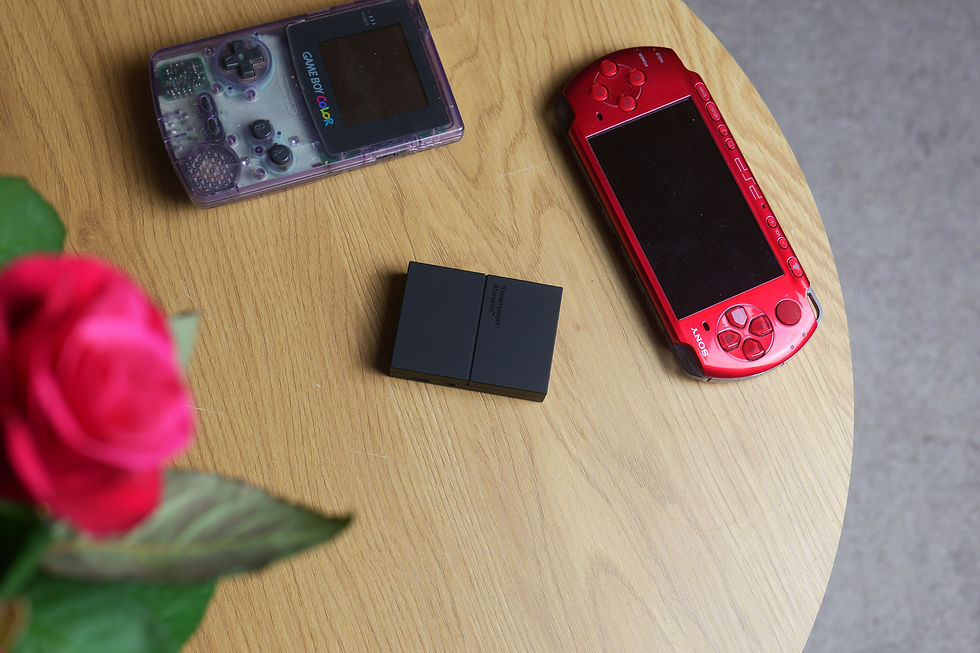
On paper, the Streamplayer is a smart little package. It streams from your phone, it speaks both Apple and Google, and it costs €99.
Spec | Atonemo Streamplayer |
Price | €99 |
Streaming | AirPlay 2, Google Cast, Spotify Connect, Tidal Connect |
Resolution | Up to 24-bit / 192 kHz |
Network | Wi-Fi 6, dual band |
Output | One 3.5mm jack: analog, or optical through a Mini-Toslink plug |
Power | USB-C, 5 V |
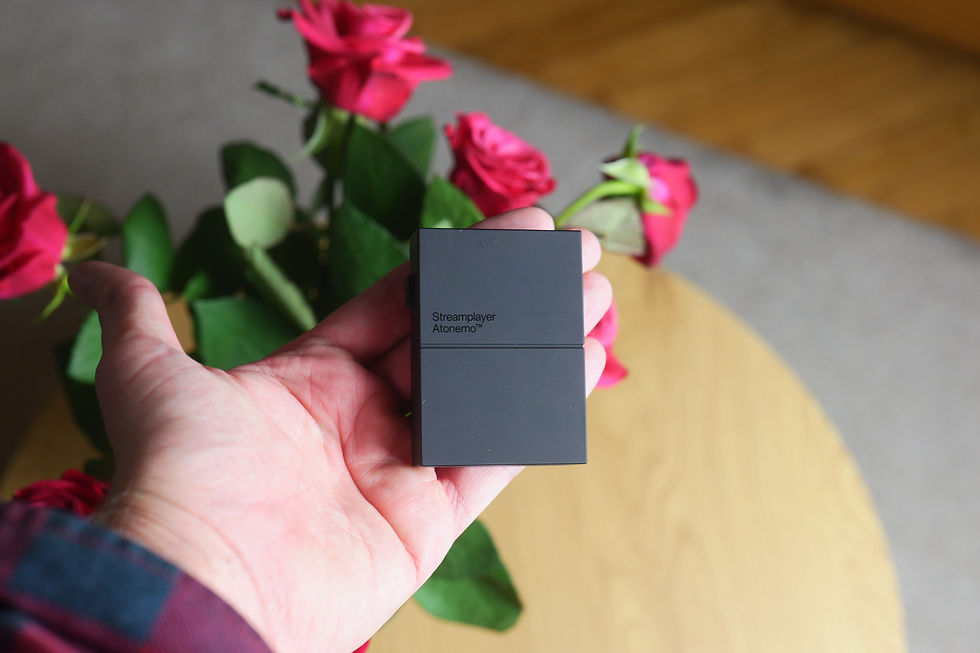
Size and weight | 50 × 70 × 18.5 mm, 45 g |
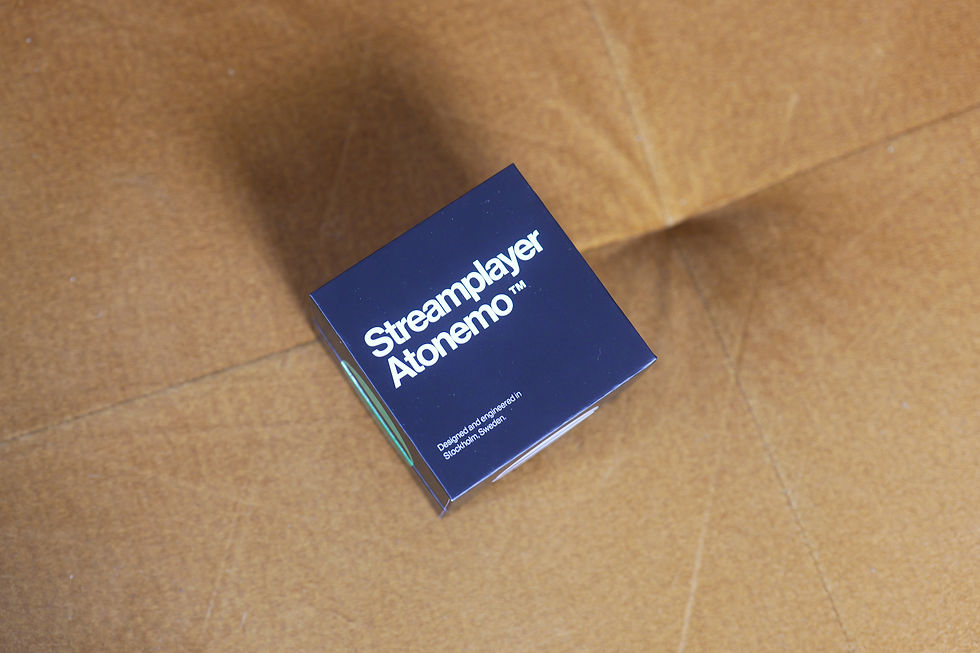
In the box | 0.5 m 3.5mm AUX cable, USB-C cable, quick-start guide |
Made by | Atonemo AB, Stockholm |
The pitch is simple: no fiddly app, no library to manage. You set it up once, and from then on it shows up as a speaker inside Spotify, Apple Music or anything that casts. Atonemo likes to call it an Apple TV for your speakers.
And honestly? I want this to exist. Millions of perfectly good stereos are sitting in homes with no way to stream.
But look at that last row of the table again. Hold that thought.

Is the problem real? Absolutely
Yes, and that’s the frustrating part. Atonemo picked a genuinely good problem.
People have stopped buying new hi-fi. Futuresource Consulting reports that hi-fi system shipments fell nearly 15% in 2024, with double-digit drops expected every year through 2029. Wireless speakers still sold 138 million units, but even they slipped 7.5%, and Wi-Fi speakers are falling faster than Bluetooth ones.
Meanwhile, only about 19 out of 100 EU adults used an internet-connected home audio system in 2024, according to Eurostat. The other 81? Plenty of them are sitting next to a perfectly good stereo.
And they stream from their phones. Spotify alone holds 31.4% of the world’s 921.6 million music subscriptions, and in the Nordics, 67% of people use it.
So here’s the problem space, written like a product team would write it: people keep the stereo they love, they live in streaming apps, and nothing connects the two cheaply and simply. A €99 box that bridges that gap should be an easy win.
Should be.


The €99 streamer meets a real amplifier


Remember that last row? The only audio cable in the box is a 3.5mm-to-3.5mm lead. And Atonemo’s own FAQ admits it: if your amp needs RCA, DIN or optical, that cable is not included.
That’s a strange choice for a product marketed to people reviving old hi-fi. Classic amplifiers use RCA. Older European gear often uses DIN. Almost none of it has a 3.5mm socket.
In the end, I dug out my trusty AudioQuest 3.5mm-to-RCA cable, the same one I used with my Chord Mojo. So if you’re a Mojo owner, you might already have the fix sitting in a drawer, and you’ll feel right at home. But that’s the exception. Most people don’t own that cable.
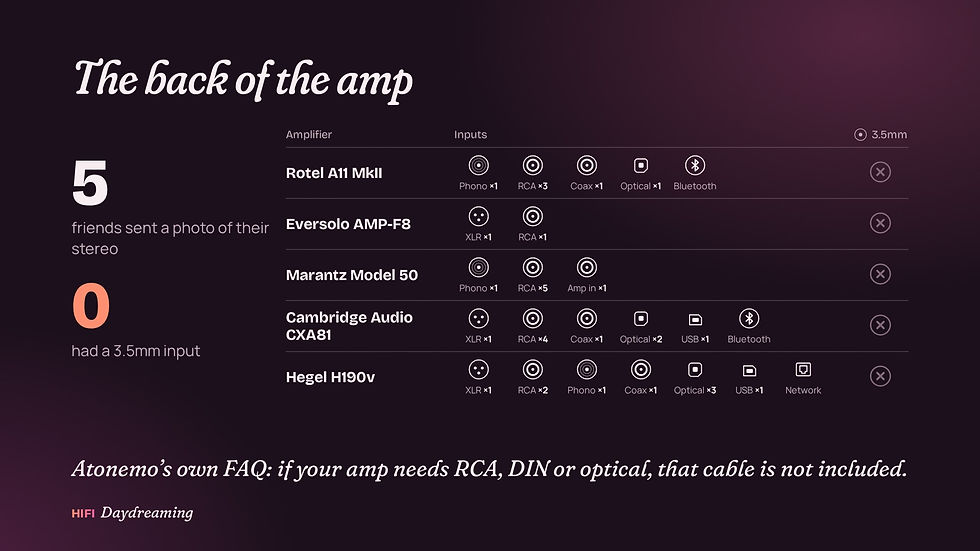
Five friends, five photos, zero 3.5mm inputs

I asked five friends to send me a photo of the back of their stereo. Here’s what came back:
Amplifier | Inputs | 3.5mm input? |
Rotel A11 MkII | Phono, 3× RCA, coax, optical, Bluetooth | No |
Eversolo AMP-F8 | XLR, RCA | No |
Marantz Model 50 | Phono, 5× RCA, power amp in | No |
Cambridge Audio CXA81 | XLR, 4× RCA, coax, 2× optical, USB, Bluetooth | No |
Hegel H190v | XLR, 2× RCA, phono, coax, 3× optical, USB, network | No |
Five friends isn’t a study. It’s a hint. But it’s a pretty loud one. Every single one has RCA. Not one has a 3.5mm input.
What the competition puts in the box
In the box | Atonemo Streamplayer (€99) | WiiM Mini (€99 list) | Arylic S10 (about $69) |
Power adapter | No | Yes | Yes |
3.5mm-to-RCA cable | No | Yes | Yes |
3.5mm cable | Yes | Yes | Yes |
Optical cable | No | Yes | No |
Remote | No | No | Yes |
At the same money, the competition hands you the cable that the Streamplayer makes you go and buy.
We’ve seen this movie before
Google’s Chromecast Audio used the same trick: one tiny 3.5mm jack doing both analog and optical. It launched in 2015 at $35, was discounted to $15 by 2017, and was discontinued in January 2019. The idea isn’t new. That’s exactly why the details matter.


So who is this actually for?
This is where a product team builds personas. Not real people, but composites built on assumptions. Here are mine.
Luka, 28, the second-hand hi-fi kid. He bought a used amp and bookshelf speakers online. RCA inputs, of course. He streams Spotify on his phone and wants one thing: Spotify, through his amp, tonight. He’s not alone, either. In a 2025 Vinyl Alliance survey of young vinyl fans, 80% owned a record player and 87% said great sound matters in their home setup.
Marko, 36, the powered speaker owner. He has a pair of powered speakers in the kitchen, with Bluetooth. The music stops every time his phone rings, or every time he walks into the next room. He’s not technical. He just wants music that keeps playing.
And here’s the twist. The box was packed for Marko. The marketing speaks to Luka.
Audiophile product or lifestyle product?
Which raises a bigger question. Is the Streamplayer an audiophile product, or a lifestyle product?
The spec sheet talks audiophile: 24-bit, 192 kHz, Tidal Connect, an optical output. But the shelf it’s sold from, the design and the no-app experience? That’s lifestyle.
And here’s the problem with trying to be both. Does Marko care about Tidal Connect? Does he know what 24-bit means? Probably not. To him, Spotify Connect isn’t a feature. It’s just Spotify showing him a speaker. Tidal is so niche it doesn’t even show up in the big market-share charts.
Meanwhile, Luka reads the same spec sheet and starts asking where Qobuz is, where Roon is, and where the remote is.
Too much for one, not quite enough for the other.


Living with it: one crash, then smooth sailing
A real product team would hand the sealed box to ten strangers, start a timer and watch. My budget covered one tester. Me.
And honestly? I’m the easiest test subject this product will ever get. I review this stuff for a living. I still got stuck. Once, right at the cable, before a single note of music. If an experienced reviewer stumbles at step one, imagine Marko.
Here’s how the whole journey feels, stage by stage:
Stage | How it felt |
Discover | Good. A clear promise and a lovely product. |
Buy | Good. €99 feels fair. |
Unbox | Great. Beautiful packaging, the first high point. |
Connect | Awful. Wrong cable, no power adapter, before any music. |
Fix | Slow recovery. A trip to the shop for most people. |
Setup | Good. Quick, and no account to create. |
First song | Great. It just works, the second high point. |
Daily use | Fine. Your phone does everything. |
Credit where it’s due: with every app that works with Chromecast, it worked properly. Once it was set up in the devices app, not a single hiccup. No dropouts, no drama.
But daily use is all phone. There’s no remote and no button, so pausing a song means finding your phone first.

Sound: clean, lean, and a little cold

So how does it sound?
Honestly? Nothing special. It’s okay.
And at €99, okay isn’t a crime. Especially because what you actually hear will be dictated heavily by what it’s plugged into: your DAC, your amp, your powered speakers.
But on its own, the Streamplayer has a clear character. It’s lean. The bass is very recessed, and there’s no sense of scale. Nothing ever feels big.
It’s a bright streamer. Depending on your setup, your bass may end up leaner and with less impact than you’re used to. So if you can, pair it with something on the warmer side.


The good news
The soundstage is okay. Clarity and the midrange are serviceable. Vocals sit decently centred and present.
And it’s clean. Clean enough that, for better or for worse, it won’t make your recordings or your gear sound any worse than they are.
What actually bothered me
Not that it’s lean. It’s that the sound lacks body. It tries so hard to be informative up top that it forgets it needs to be musical first.
So if you don’t have a streamer and you need one? It’s okay. It works great, the design is beautifully minimal, and that tiny frame makes total sense as a lifestyle product.
Competition: the WiiM-shaped problem
Here’s my real problem with the Streamplayer as an audiophile product.
At the same price, there’s the WiiM Mini, with the RCA cable, the optical cable and the power adapter already in the box. Add 30 to 50 euros, and you’re into much stronger streamers, with better DACs and much better sound.
So what does the Streamplayer have that they don’t? Real advantages, to be fair. It does AirPlay 2 and Google Cast together, it’s Wi-Fi 6, it’s genuinely tiny, and there’s no app to fight with after setup. For a design-minded buyer with powered speakers, that combination is lovely.
But for anyone who cares mainly about sound or connections, the competition simply gives more for the same money, or a little more.
So as an audiophile product? It doesn’t work. Not yet.

The Streamplayer, HIFI Daydreaming edition
A CEO has to make the hardest call first: who is this for? I pick Luka. The person with a real stereo and no way to stream to it.
Then I sort every possible fix by two things: how much it helps the customer, and how much it costs us. The cheap, high-impact fixes go first. The expensive ones wait.
So here’s my plan. Not one product. Two releases.
Release one: ship now, at €109
A 3.5mm-to-RCA cable in the box, plus a DIN version for older European gear.
A USB power adapter, because nobody has a free USB port behind a 1982 amplifier.
Setup that starts with “Show us the back of your amp,” and tells you exactly which socket to use.
A warm sound preset, on by default. Fuller vocals, more bass, kinder to bad recordings, with a neutral setting for anyone who wants it flat. That’s a software job, not new hardware.
An honest spec page. Only list what actually ships.
Notice what number four does. I designed for Luka. But Marko gets better sound out of the box too, without me building two products.
Release two: the V2
A better DAC chip.
More connections on the back.
A physical play button.
Real audio engineers spending proper time on the DSP. Not to win on measurements, but to make it sound musical first.
That’s where the sound grows up. It’s also where the price really climbs, and where it has to beat the WiiM question.
Would release one cost a few euros more to make? Probably. But I’d rather pay €109 for a box that works tonight than €99 for a box that needs a trip to the shop.
How I’d know it worked
I’d track how many buyers hear music on the day the box arrives, aim for under ten minutes from opening the box to the first song, and watch support emails about cables. If those emails aren’t close to zero, we just redesigned the box.


Verdict: a great answer, still looking for its question
So, should you buy it?
Buy it if you have powered speakers or anything with a 3.5mm input, you live in Spotify, Apple Music or Cast, and you want the smallest box possible. For that person, it works great, and as a small, beautifully minimal lifestyle product, it makes sense.
Buy it, plus a cable if your amp has RCA inputs. Budget a few euros and a trip to the shop.
Look elsewhere if you want a remote, a music library, Roon or a proper app. That’s not what this is trying to be.
So can I recommend it? Honestly, I’m not sure I can.
It’s a device with a genuinely interesting promise. It truly is. And it comes in a beautiful design. But that promise feels like something that will really happen in a V2, or a V3. And that might be a product I can recommend to everyone, wholeheartedly.
Atonemo didn’t build a bad product. The setup is fast, the protocols are right, and when the music starts, it just works. They built a great answer. They just never decided whose question it was.
And if Atonemo shipped my release one tomorrow? I’d happily take another look.
What I liked
Beautiful, tiny, genuinely Scandinavian design
AirPlay 2 and Google Cast in one box
Quick setup with no account, and rock-solid casting once it’s running
Clean sound that won’t make your recordings worse
What I didn’t
The only audio cable in the box fits almost no hi-fi amplifier
No power adapter, no remote, no button
Lean, bright sound that lacks body and bass
Promised features that never reached the spec sheet
To Learn more and buy: https://atonemo.com/products/streamplayer?srsltid=AYCX9vJuVAn1k0cXf2aY6WgVDJ8oxPpJ-rNzS1tNtOMiCeb93hPnjBta



Comments