

I was at Vienna High End 2026 and this are my Favorite Devices part 2 / Eversolo, Luxsin, Arcam, Volumio, Fiio, Elac, Ifi
Updated: Jun 23
This marks the start of Part 2 of my Vienna High End coverage — if you'd like to see Part 1, click on the link below.
Volumio

I stopped by the Volumio booth, where they had the Rivo Ultra on a big, shiny display. It does look like a Volumio product, but at the same time, it completely departs from their usual philosophy of no-screen, smaller devices.
I guess this is Volumio's way of catching up with modern streamers and staying future-ready. The original Rivo and Rivo Plus established themselves as some of the smartest network transport choices on the market because they did one thing exceptionally well: deliver a clean, reclocked digital signal to an external DAC, with the entire user experience handled through the Volumio app on a phone or tablet. That headless approach kept the products compact, focused, and relatively affordable.
A display changes the equation. It opens up direct-on-device interaction (album art, playback status, simple navigation) without needing a phone in hand for every action. It brings the Rivo line closer to the Motivo touchscreen flagship in user experience, but presumably without the Motivo's built-in DAC and headphone amplifier keeping the Rivo Ultra positioned as a pure-transport choice for listeners who already own a serious DAC.
I really enjoyed the look of the device the leather on top feels so Italian.
Also on display were the Rivo and Rivo Plus, devices I've wanted to review for some time — these are pure streamers with no DAC. There was also the Primo Plus, which combines a streamer and DAC, and the Integro, which is an all-in-one solution.
Volumio's Vienna 2026 was a multi-layered presence rather than a single product launch. The Rivo Ultra preview is the headline news a new top-tier within the Rivo family, the first to add a display, with full specifications still to come. But the deeper story is the maturity of the Volumio platform now that Volumio 4 has launched and the OEM division is openly courting hi-fi brands at the industry's biggest European show.
The Rivo Ultra, Motivo, Primo Plus, Integro, and original Rivo together cover almost every streaming use case, from compact desk to flagship listening room. The OEM operation expands the platform's reach into other brands' products, and the underlying Volumio OS 4 platform now sits on a foundation built to support the next decade of streaming innovation. For a brand most audiophiles still think of as "that Raspberry Pi software project," Volumio in 2026 is operating at a scale and ambition that few in the streaming category have matched.
The two-track strategy is stated bluntly: keep building exceptional consumer products that showcase what Volumio OS can do (Rivo Ultra, Motivo flagship, Primo Plus), while quietly licensing the same platform to as many audio brands as possible (Ferrum, Pequod, and growing). Vienna 2026 was the right show to execute both at once.
Arcam

Another company I really enjoy, and one I was quite intrigued to see at Vienna, is Arcam and I wasn't disappointed. They brought two new devices: the CD25 and the A50 amplifier. I was already quite fond of the A15, and I've recommended the SA35 on my channel whenever I could, so the A50 was a great surprise to me.
The A50 Signature is described by Arcam as the most complete integrated amplifier the company has ever produced. The headline architectural achievement: it is the first Arcam integrated amplifier to use a fully dual-mono Class G architecture. That distinction matters substantially fully dual-mono means each channel operates as a completely separate amplification path, physically and electrically isolated from the other within the same chassis. Each channel gets:
Its own dedicated PCB
Its own dedicated output stage
Its own dedicated Class G lifter stage
Its own dedicated power regulation
Its own dedicated transformer windings — separate secondaries on the toroidal transformer
This architectural approach is more commonly associated with separates — a dedicated mono power amplifier per channel rather than with integrated amplifiers at this price point. Arcam describes the goal as maximizing channel separation and minimizing crosstalk to deliver the cleanest possible stereo signal path. The rear panel layout reflects this dual-mono thinking: speaker terminals are placed at opposite ends of the chassis to keep the left and right channel cabling physically separated.
Co-founder John Dawson was involved throughout the project. His signature appears on the rear cowl and on the internal PCBs of the A50 Signature connecting the brand's earliest amplifier work to its 50th anniversary flagship without turning the product into a museum piece.

The CD25 is the more strategically interesting of the two launches. Arcam's commitment to CD playback as a serious high-end discipline at a time when significant parts of the industry treat optical disc as dead or as a token afterthought places the CD25 alongside the Eversolo DMP-A8 Master Edition Gen 2, Musical Fidelity's multi-tier CD player rollout, and Gustard's CD26 transport as the strongest evidence yet of a real CD revival happening at the high end.
The dual-mono DAC approach is explicitly designed to improve channel separation, noise performance, and spatial presentation taking the CD25 beyond a straightforward digital-to-analogue conversion stage and positioning it as a true analogue source component with its own sonic responsibility.
Arcam treating CD replay as a dedicated hi-fi discipline rather than a legacy convenience is a meaningful brand statement. The CD25 is not a streaming platform with a disc slot bolted on it's a focused, purpose-built CD player with serious mechanical engineering, contemporary conversion technology, dual-mono architecture, and a clean analogue output stage. For listeners with substantial CD collections (and there are many CD remains a vital sales format in many countries, and used-CD markets are thriving), the CD25 is one of the strongest dedicated CD players launched in 2026.

Arcam handled its 50th anniversary the way a serious British hi-fi brand should: more engineering than ceremony, more new product than retrospective. The A50 Signature's fully dual-mono Class G architecture with separate PCBs, output stages, power regulation, and transformer windings per channel is the brand's most technically ambitious amplifier design to date, and at £2,499 it sits at a price point that's genuinely competitive against established British rivals. The CD25 is the more strategically meaningful launch: a dedicated reference-grade CD player with dual-mono ESS Hyperstream 4 DAC architecture, linear power supply, and vibration-damped transport, at a moment when most manufacturers have written off optical disc entirely. Combined with similar commitments from Eversolo, Musical Fidelity, and Gustard, Arcam's CD25 confirms that the high-end CD revival is real and engineered, not just nostalgic theater.
The full Radia system ST25 streamer, CD25 player, A50 Signature amplifier, and matched speakers is the most coherent and complete British two-channel ecosystem at under £6,000 combined. Co-founder John Dawson's signature on the rear cowl and PCBs is the right kind of heritage gesture: not a museum exhibit, but evidence that the same engineering DNA running through the 1976 A60 still flows through the 2026 A50 Signature. Vienna 2026 was the right show for this brand at the right moment.
iFi

One product that surprised me a lot was the iDSD GR2 — the Gryphon successor.
iFi describes the iDSD GR2 as their most capable true-portable DAC/amp to date. This is not a minor refresh the GR2 has been rebuilt from the ground up. A new DAC architecture, a fully balanced amplification stage, lossless Bluetooth connectivity, a color OLED touchscreen interface, and JVCKENWOOD K2HD Technology integration are the headline upgrades. The strategic message is clear: the Gryphon's blueprint was strong enough to define a category, and the GR2 takes the same template and improves nearly every aspect of it.
The xDSD Gryphon was, for many audiophiles, the most "no compromises" portable DAC/amp under $1,000. It combined real desktop-grade DAC performance, serious headphone driving capability, and full feature flexibility in a travel-friendly chassis. The iDSD GR2 takes that template and pushes it further: a more sophisticated DAC chipset, 50% more output power, a much more usable touchscreen interface, lossless Bluetooth, and K2HD processing. At $529, it's arguably one of the strongest portable values at the show.

iFi's Vienna 2026 was less about a single revelation and more about brand maturity on display. The iDSD GR2 is the headline launch a meaningfully better Gryphon with 50% more output, a Burr-Brown PCM1795 DAC, K2HD processing, aptX Lossless Bluetooth, a touchscreen interface, and a fully balanced amplification stage, all at $529. That's serious value for what it delivers, and it will be one of the most-reviewed portable launches of late summer 2026.
The bigger picture, however, is the complete iFi ecosystem on display: from a £59 dongle to a £4,499 reference all-in-one, with consistent design language, consistent engineering signatures (Burr-Brown DACs, K2HD, XBass/XSpace, fully balanced amplification), and a coherent upgrade path through every tier. Few mid-tier audio brands execute this kind of complete lineup with this much consistency. Vienna 2026 was iFi at its current peak a brand that knows exactly what it is, executes it well, and continues to push forward on multiple fronts simultaneously.

FiiO
It was really hard to say which device from FiiO surprised me the most, since there were so many of them I'll try to be brief here, more so than usual.
My favorite device is the FiiO Class A that's literally its name, simple but architecturally the purest of the bunch. It's a fully discrete, pure Class A headphone amplifier. Class A topology means the amplifier's output devices are always conducting, regardless of the signal, eliminating the switching distortion that Class AB designs introduce during low-level transitions. The sonic character is typically smoother and more natural, at the cost of higher heat output and lower efficiency.
The Class A amp completes the K17 R2R + JT9 system from FiiO. A listener can buy the source (K17 R2R Pro), the amplifier (Class A), and the transducer (JT9) all from one brand, in matched aesthetics and engineering DNA. The three together represent FiiO's most coherent desktop personal-audio stack to date. At roughly $360 USD, the Class A amp is also one of the more accessible serious Class A headphone amplifiers on the market.

The K17 R2R is FiiO's most ambitious all-in-one desktop product to date. It combines DAC, network streamer, headphone amplifier, and preamp functions in a single chassis and unlike the standard K17, variant is built around a proprietary FiiO R2R PRO resistor-ladder DAC architecture rather than a chip-based delta-sigma DAC. R2R conversion is the older school of digital-to-analogue design that audiophiles consistently associate with a more analogue, organic, naturally warm tonal character — distinct from the sharper, more analytical sound that ESS Sabre implementations typically produce.
The K17 R2R is FiiO's clearest statement of upper-tier ambition. The original K17 ($989) reviewed well as a strong all-in-one. The K17 R2R Pro takes the same chassis platform, upgrades the DAC to the brand's higher-tier proprietary R2R PRO architecture, adds streaming and Wi-Fi connectivity, integrates a 31-band EQ system, and refines the analog stage with substantial linear power supply engineering. At the expected price point (likely $989.99 USD the same price as K17, based on positioning above the K17), it would represent serious value against established mid-flagship competition.

A few more quick shoutouts:
The Jade Audio Level 1 (Desktop Stereo Power Amplifier) carries the most provocative price tag of the entire show. FiiO claims up to 2 × 300W of output from a compact desktop stereo amplifier priced at $139. That figure will generate skepticism — peak power versus continuous, into what load, at what distortion — and rightfully so, but the engineering substance behind it is solid for the price.
There are also two devices that don't have much information available yet, but are extremely interesting. One is a large, full-tube DAC that continues the legacy of the FiiO Warmer it's bigger, with more tubes and valves, creating an even wider and warmer presentation.
And something that genuinely shocked me was FiiO's large passive speakers. They look interesting, and it's a rare move from a Chinese company to go in the passive direction when so many others are opting for active speakers. They look really nice, and I'd love to try them. The naming on both of these devices hasn't been decided yet, or I simply didn't fully understand it when they explained it to me.

And also worth a mention: the very nicely priced FiiO M25 and M25 R2R.
ELAC
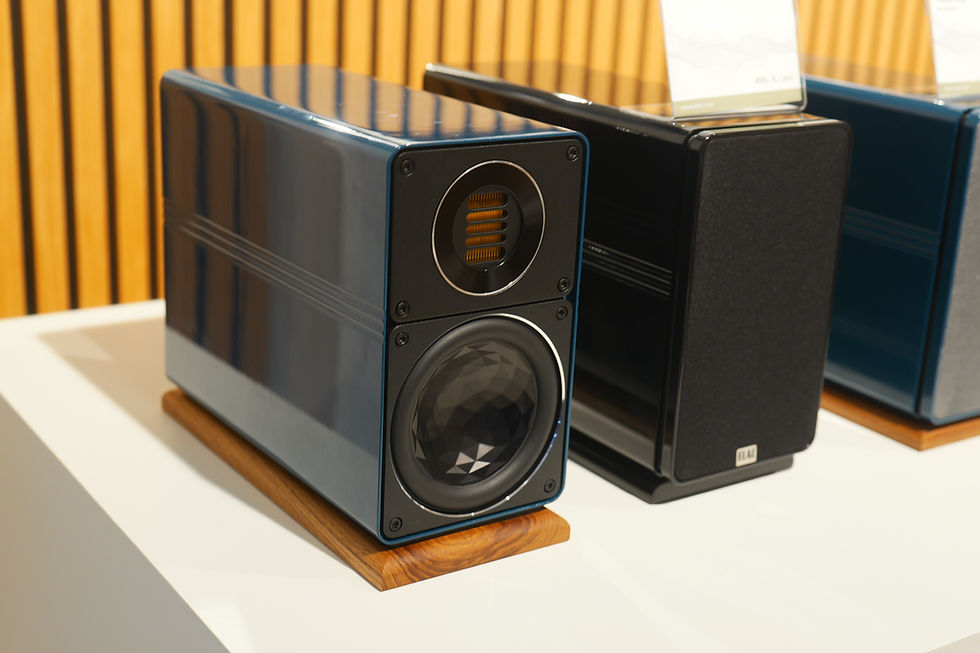
The ELAC showroom was the most impressive presence I saw at Vienna, blending old and new in a way that really worked. And it's where I saw one of the most interesting products of my time at the show: the ELAC 4Pi attachable dome tweeter.
The 4Pi is technically not a "dome" in the conventional sense — it's a vertically-oriented ribbon tweeter that radiates omnidirectionally in 360 degrees around its axis. The visual design looks dome-like or capsule-like because of the housing, but the radiator itself is a ribbon. The 4Pi name comes from physics "4π steradians" is the mathematical measure of a full sphere, the entire 360-degree solid angle around a point. That's exactly what ELAC is claiming the tweeter does: radiate into all 4π of space.

This is one of the most historically significant claims about the 4Pi: it was first developed by ELAC engineers in 1984 more than 40 years ago. The patented 4Pi tweeter has been a core part of ELAC's high-end engineering identity throughout that time, evolving through multiple generations to the current 4Pi PLUS V. At Vienna 2026, it appeared as part of ELAC's 100-year anniversary heritage display both as a current product that listeners can buy and as a historically grounded piece of acoustic engineering that connects ELAC's modern lineup directly back to its mid-1980s technical innovation.
The 4Pi is sold as an add-on accessory to be placed on top of main loudspeakers. It does not replace the main speaker tweeter it supplements it with omnidirectional ultrasonic and upper-treble information.
The intended placement is on top of the main speaker. The rotating base on the 4Pi PLUS V is specifically designed to allow it to sit on the slanted top surfaces of ELAC's own Concentro and VELA floorstanding speakers which are not flat-topped boxes. This means the 4Pi PLUS V can be tilted to its optimal orientation regardless of the surface it sits on.
The 4Pi connects to the same speaker terminals as the main loudspeaker (passively, with no external amplifier needed). It draws power from the same amplifier that's driving the main speakers, with the adjustable crossover frequency letting you choose where the 4Pi takes over from the main speaker's tweeter.
You have to see it, you have to try it. It adds a whole new dimension to your speakers — it completely unlocks the soundstage and adds more presence in the upper midrange and treble. And you can reuse it across many, many models.
ELAC's centennial at Vienna 2026 marks one of the most historically grounded anniversaries in the entire audio industry. Founded on September 1, 1926 in Kiel as ELECTROACUSTIC GmbH, the company began as sonar researchers and acoustic engineers studying signal sound channels in both air and water military and scientific work decades before the brand entered consumer audio. ELAC's first consumer audio product, the PW1 turntable, didn't appear until 1948 twenty-two years after the company's founding. The journey from sonar research lab to high-end consumer loudspeaker manufacturer is unusual in the industry, and the acoustic engineering DNA that runs through today's products (the JET ribbon tweeter family, the VXe coaxial driver array, the room-tuning principles in the Concentro series) traces back directly to that scientific foundation.

The 100-year anniversary year is not being treated as a marketing exercise. ELAC came to Vienna with seven distinct new product launches spread across multiple product categories flagship statement loudspeakers, heritage-revival compacts, expanded mid-tier ranges, two new turntables, and a reissue of a 1970s lifestyle product. The strategic message is clear: ELAC at 100 is a forward-facing brand with deep history, not a museum.
The total ELAC Vienna footprint is unusual in scale. Foyer E on the ground floor houses the main exhibition stand. Suite E and meeting rooms 61, 62, and 63 host private demonstrations and dealer meetings. Listening Room 51 is dedicated to extended audition sessions with the flagship products. Managing Director Lars Baumann was personally on stand at the Concentro M 809 reveal a measure of the strategic weight ELAC is placing on this anniversary year.
The BS 100 and Elegant 100 are interesting products, born from ELAC's legacy lineup. The BS 100 is the most overtly heritage-focused of the new Vienna loudspeakers, and the one most directly tied to ELAC's modern brand identity. It revives the ELAC design language established in 1997 that reached its apex with the legendary BS 403 of 2012 — the speaker that, for many critics, defined what an ELAC compact monitor sounded like at its best.
The Elegant 100 sits in ELAC's modern mid-tier compact line. At €900/pair, it's positioned below the BS 100 (a limited heritage edition) and complements the existing Debut and Debut Reference series. The combination of Van den Hul internal cabling, an included oiled wood base, and copper-cap pole-piece refinement on the mid-woofer makes it a meaningfully better package than the original BS 312.2 it evolves from.
But what I liked most was the entirely new Debut series: the Debut Reference 3 Series. Especially the new Debut DRB63, but also the additional tower and center speaker. The three Debut Reference 3 models together provide a complete stereo and home theater speaker family at price points that significantly undercut most competing premium-mid offerings, while inheriting the engineering DNA of ELAC's higher Debut and Concentro ranges. Available in three colorways, including wood veneer.

There was also the ELAC retro radio alarm clock. The RD100 is one of the more emotionally charged products of ELAC's anniversary year a direct revival of the cult radio alarm clock from the 1970s. The original was a fixture on bedside tables for an entire generation of European households. The new 2026 RD100 preserves the silhouette and design language while modernizing every internal function. The RD100 represents ELAC saying that a 100-year-old design vocabulary still works in 2026, because the design was correct in the first place. It's a heritage gesture without being a mere reissue.
ELAC handled its centennial the way a serious heritage brand should: more engineering than ceremony, more new product than retrospective. Seven launches across loudspeakers, turntables, and lifestyle products every one of them a real product with real engineering substance, not commemorative front-panel exercises. The Concentro M 809 at €66,000/pair establishes the brand's current engineering ceiling with doubled driver count and the new VXe 12 dispersion control. The BS 100 brings the 1997 design language back as a strictly limited 100-year anniversary edition. The Elegant 100 evolves the BS 312.2 with Van den Hul wiring and a copper-cap mid-woofer refinement. The Debut Reference 3 series gives mid-market buyers a complete three-model home theater family.

The Miracord 50.2 and Miracord 40 expand vinyl into both refined-mid and accessible-entry segments. The RD100 brings a 1970s icon back at a moment when physical product design is having a renaissance. And the Hall of Fame heritage exhibition in Foyer E provides the historical context that makes all of this make sense. One hundred years of continuous acoustic engineering, with the receipts on display. Vienna 2026 was the right show for this brand at the right moment.
Eversolo
Like FiiO, Eversolo and Luxsin brought plenty of new devices too many to go through all of them in a video like this. I'll highlight a few.
To me, the best product is the Eversolo DMP-A8 Gen 2. It's not just that this is a good upgrade it's that it's now nearly an all-in-one solution with the addition of a CD player. Yes, the A8 now comes with a CD player, at least in the Master Edition. And given how much I've talked about CD players in these videos, it really does seem like we're in a CD player renaissance.

The DMP-A8 has been Eversolo's flagship streaming hub for two years combining streamer, DAC, balanced analogue preamplifier, music server, digital transport, and system control center in one chassis, and an EISA Best Product Award winner. The original DMP-A8 launched at £1,890. The Gen 2 series doesn't reinvent the platform it refines and expands every aspect of it.
Two versions are available:
DMP-A8 Gen 2 Standard
DMP-A8 Master Edition Gen 2 Adds top-loading CD playback plus an OCXO clock
This is one of the more strategically interesting products from the entire Vienna show. Most streaming-era brands either ignore CD or include it as a basic afterthought. Eversolo has gone the other direction entirely top-loading mechanism, dedicated mechanical isolation, OCXO clock, expensive engineering investment in a category most of the industry has written off. Combined with Arcam's CD25, Musical Fidelity's multi-tier CD launches, and Gustard's CD26 transport, the Vienna show signaled that the CD revival is real at the high end, not just nostalgic theater. The DMP-A8 ME Gen 2 makes the strongest single statement of that revival.
And then there's the device everyone keeps talking about: the T10. The T10 is Eversolo's clearest statement of audiophile intent. It has one job: receive, organize, and output the cleanest possible digital audio signal to an external DAC. No digital-to-analogue conversion. No preamplifier. No headphone output. Just focused single-purpose engineering, with every architectural decision in service of timing accuracy, electrical isolation, and signal purity.

This is for listeners who already own a DAC they trust and want a meaningfully better digital source feeding it. It's a direct play at the same audience that currently buys the Innuos Zen, Aurender N200, or Lumin U2 Mini at a price expected to undercut all of them significantly.
It's the first Eversolo product that says, clearly and definitively, "we are no longer a budget streamer brand." OCXO clocking, SFP fiber networking, 2.5GbE, up to 16TB of SSD storage, and isolated digital outputs across the full spectrum these are architectural choices typically made by brands building products at significantly higher price tiers. If the T10 ships at the expected Q3 price point (likely in the $2,000–$3,000 range), it will reshape the conversation about what serious digital transport quality should cost.
There were many, many more devices, like the DAC-R8, the AMP-F8 and AMP-F6, and the SA200 streaming amp. I would absolutely love to review at least one of these products.
Vienna 2026 was Eversolo's coming-of-age moment. The T10 is the headline news a serious dedicated streaming transport with OCXO clocking, SFP fiber networking, 2.5GbE, isolated digital outputs across every format, dual NVMe storage to 16TB, and the engineering attention typically associated with components costing two or three times what the T10 is likely to cost.

If it sounds as clean as the architecture suggests, this is one of the most important streaming-transport launches of the entire 2026 hi-fi calendar. The DMP-A8 Gen 2 series refines an already award-winning platform with the AK4499EX + AK4191EQ flagship DAC, R-2R analogue volume control, a 20μV power noise floor, SFP fiber, and in the Master Edition the most thoughtful top-loading CD playback design in any 2026 streaming hub. And the broader Vienna lineup T10, C10, DAC-R8, AMP-F8, AMP-F6, SA200, alongside the DMP-A8 family completes the picture of a brand that has fundamentally outgrown its "affordable streamer" origins. Eversolo is now operating at the level its hardware implies. Vienna was the moment that became impossible to miss.
Luxsin
Luxsin is a company I really, really love. They're on the cutting edge of both software and hardware, and they had an incredible amount of hardware on display.

Vienna 2026 was Luxsin's most ambitious show appearance to date. Four entirely new products were on the floor, plus the X8 and X9 in their final production form. The reps were so busy that some attendees couldn't get full information from staff — but the products were visible, hands-on, and generated real interest among headphone media.
We have the BD9 + BH9 — a desktop separates stack with a detachable wireless volume knob:
Internal construction visible through inspection shows massive R2R resistor arrays inside both units
The BH9 is a dedicated headphone amplifier with its own headphone outputs
The BD9 is a desktop DAC designed to feed the BH9 (or any external amplifier)
The detachable wireless volume knob, explained: the volume wheel sits on the front of the BH9 and looks completely ordinary at first glance, featuring a small color display integrated into its center. But the entire volume wheel is detachable it can be removed from the chassis and doubles as a wireless remote control. Rotate it in the air to adjust the volume from across the room, or tap it to change inputs. The color display in the center confirms the current setting, whether the knob is attached to the chassis or in your hand.
This is a genuinely original piece of interaction design. It looks incredibly cool and surprisingly practical, though I'll need to spend some quality time with it in my own system before deciding whether it's a genuine quality-of-life improvement or simply a very clever gimmick.

Luxsin came to Vienna 2026 with the kind of show presence that says: we're not a new brand anymore. The BD9 + BH9 stack with its detachable wireless volume knob is one of the more inventive interaction design moments at the entire show the kind of detail that separates a product from the spec-sheet crowd. The X8's eight-DAC AI-EQ architecture and the X9's R2R relay volume are genuine engineering not borrowed reference designs from chipmakers' application notes and both have earned the awards and reviewer enthusiasm to back the technical claims.
The brand's biggest task now is the practical one: get full specifications and pricing published, get review units into the right hands, and convert the strong floor reaction at Vienna into actual sales. The hard work building the products with real engineering substance appears to be done. Whether Luxsin can maintain this pace of genuine innovation as the lineup expands is the key question for the next twelve months.

Conclusion
And that's about it. There are probably a bunch more products I'd love to highlight Wharfedale, Primare, Sendy Audio, Matrix Audio, Cyrus, and others but this video is already long enough. The big problem with Vienna High End is that it's simply too big: so many rooms, so many shows, so many brands, that it's honestly impossible to experience it all. I tried my best not just to experience as much as possible, but also to learn as much as I could about the upcoming devices. I'm still a little sad, since it felt like I needed more than the two days I had. But hopefully you enjoyed this two-part video, and you're as excited about all these devices as I am. *Big shoutout to Cyrus, and their 40 and 80 series of Amps, streamers and CD Players. Brand that recently reimagined it self, brought serious system matching solutions that sounds and feel very modern and excellent. If I had more time they would be another brand here. Their vintage CD players have long time been my favourite cd players in existence.
Keep daydreaming, and see you in the next video. Bye!


One thing I appreciate about Free Web Games is how quickly you can switch between genres. You can play a competitive IO game, take a break with a puzzle, and then jump into a horror game without changing devices or installing anything. That flexibility is hard to beat.