

I Tested All the New SMSL CD Players and Picked the Best Buy - PL150, PL100 Pro, PL20, PL200 review
So I recently got the SMSL PL150, and with that I had in my possession the entire new line of SMSL CD players. While I could do a regular review of the PL150, with my previous reviews of the PL100 Pro and PL200 I think there is not much I could have added here. So something came to my mind as I listened to all of their CD players. Four CD players. One company. And somewhere between 150 and 670 dollars, there is a line where spending more stops making sense.
Today, we find that line.
Quick recap about state of CD Players in past 10 years
Shanling and SMSL are, in my opinion, the companies that create the best desktop CD players on the Chi-Fi market. They pushed the envelope when CD player stagnation was real, but we will focus on SMSL here only.
You guys know my story. I started this whole audiophile journey by collecting CDs. It is still the format that speaks to my soul the most. Not the most convenient, not the trendiest, but when I lower a disc into a player and press play, something in my brain goes quiet in the best possible way.
And for years, the budget CD player market was a graveyard. You either bought a wobbly DVD drive in a plastic coffin, hunted for a twenty-year-old Japanese deck on the second-hand market, or you paid proper hi-fi money for the privilege of spinning polycarbonate.
Then SMSL happened.
A Shenzhen company that built its reputation on ruthlessly measured DACs and amplifiers looked at this dying format and decided, apparently, to resurrect it single-handedly. First came the PL200 and the flagship VMV T2. Then the little PL100. Then the PL150, the PL20, the PL100 Pro, the PL200t. In about two years, SMSL went from zero CD players to having more current CD models than Sony, Denon, and Marantz have had new releases in the last five years combined.
So today we are doing something I have wanted to do for a long time. Four SMSL CD players, one video. The PL150, the PL100 Pro, the PL20, and the big PL200.
A little about each one. And then the real question.
Not which one is the best. That answer is boring, it is the most expensive one, thank you for watching, like and subscribe.
No. The question is: for which of these do you get the most for your money? Where is the value sweet spot? And where does SMSL start charging you for jewelry instead of sound?
Let's find out.
Gapless Problem
I want to add something really important.
There is one issue in the SMSL PL20, 100 and 150 that might be a big no-no for many buyers. And that is that there is no gapless playback. I made the mistake of not testing this in the PL100 Pro review, and instead trusted what is written. A mistake I did not want to happen again. I used a lot of gapless albums I have. Scenes From a Memory, Ulver with a Norwegian orchestra, Genesis' The Lamb Lies Down on Broadway, Mars Volta, Pink Floyd... etc. And realised that the PL150 is not gapless. I really do not care about that, but I guess if there are people who enjoy seamless experiences of live recordings or conceptual albums, they are going to be disappointed here. It is strange that SMSL cannot do gapless in their budget line. Personally, I do not mind.
And honestly? I find the whole situation bizarre. These machines measure superbly. They convert digital to analog with vanishingly low distortion. One of them will rip a disc to a USB stick and beam it to your headphones over Bluetooth. And then they trip over a capability that a forty-year-old player handled without thinking. My best guess is that these compact drives and their firmware handle the disc track by track, like a car unit or a boombox, instead of reading it as one continuous stream. Cheap to implement, invisible on a pop record, and fatal to Genesis.
So here is the honest guidance. Look at your shelf. If your collection is pop, rock, jazz, electronic, anything with natural silence between songs, you will live your whole life with the budget trio and never notice any of this. But if live albums, classical, or concept records are your love language, then three of today's four contenders are disqualified before we even discuss sound, and the PL200 quietly stops being the luxury option and becomes the only option.
Quick roll call, so we all know the battlefield.
The PL150, around 150 dollars. The purist of the family. One good DAC chip, a Philips disc mechanism, and a small built-in headphone amp with both 3.5mm and 4.4mm balanced jacks. No gadgets beyond that.
The PL100 Pro, around 160 dollars. The Swiss Army knife of the budget tier. CD player, transport, DAC section, headphone amp, and a preamp, all in a box the size of a thick paperback.
The PL20, around 200 to 210 dollars. The gadget. It plays CDs, yes, but it also rips them to a USB stick, plays files back from that stick, and does two-way Bluetooth.
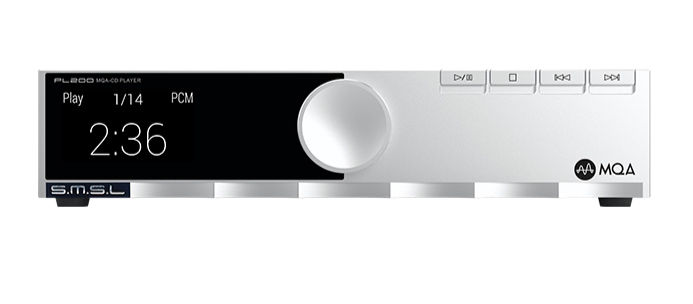
And the PL200, launched at around 670 dollars, often found closer to 600. The statement piece. Top loader, magnetic puck, flagship AKM DAC, piano-key buttons that click like a mechanical keyboard.
Four players. One shared DNA. And one very uneven distribution of value.
Shall we start from the bottom of the price ladder and climb?
SMSL PL150 Review, THE PURIST

The cheapest one has the best DAC chip. Let that sink in.
This is the part of the SMSL lineup that genuinely made me laugh when I first mapped it out. The PL150 costs 150 dollars, and inside it sits a Cirrus Logic CS43198. Its more expensive siblings, the PL100 Pro and the PL20, run dual CS43131 chips. On paper, per chip, the cheapest player of the trio got the nicer silicon.
The rest of the package is deliberately simple. A Philips slot-in mechanism with a PLL circuit to keep jitter in check. RCA analog outputs. Optical and coaxial digital outputs if you want to use it as a pure transport. On the front, a proper full-fit IPS color display, plus two headphone outputs, a 3.5mm single-ended and a 4.4mm balanced, with 75 steps of volume. It reads standard CDs, CD-Rs, CD-RWs, MP3 discs, even the little 8cm mini CDs. And yes, it will spin MQA-CD and HDCD pressings too, but let me be precise about what that means, because the retail listings are slippery here: they play as normal CDs. There is no MQA or HDCD decoding on board. If you want the full unfold from an MQA-CD, you would need to send the digital output into a DAC that actually decodes it. Power comes from a simple 5V USB supply, which means yes, technically, a power bank can run your hi-fi source. We live in strange and wonderful times.
What do you not get? No XLR outputs. No preamp mode. No Bluetooth. No USB playback. No ripping.
It plays discs, into your system or straight into your headphones. That is the job. That is the whole job.
So how does the purist sound?
And honestly? This is where the PL150 earns its keep.
Out of its own analog outputs, this is the most grown-up sounding of the three budget players. Where its siblings sound like very well-behaved students, clean, neat, hands folded on the desk, the PL150 sounds like the one student who also plays in a band on weekends. There is more chest to the sound. Notes land with a bit of weight behind them instead of just appearing and politely leaving.
Bass has genuine authority for this price. Not bloated, not slow, but present, like a double bass actually standing in the corner of the room rather than being described to you over the phone. The midrange has a touch of warmth and roundness that makes voices feel breathed rather than printed. And the treble extends nicely without ever picking a fight with your tweeters.
Is it a romantic, golden-hued, tube-like sound? No. It is still SMSL. The house style is honesty. But within that honesty, the PL150 is the one that remembered music is supposed to have a body, not just a skeleton.
But it is not all sunshine.
The headphone outputs are the weak point. The power on tap is modest, fine for sensitive IEMs and easy headphones, but ask it to drive anything demanding and it starts wheezing like me on the fifth floor of a building with no elevator. And I have to be blunt about one more thing: this player does not do gapless playback. If you live on live albums, concept albums, classical works, anywhere the music is supposed to flow seamlessly from one track into the next, that is a real problem, and it is strange enough that it gets its own chapter later in this video.
The PL150 in one sentence? The best pure sound per dollar in the lineup, wrapped in the fewest features.
But what if you want the features?
More about this CD Player:
SMSL PL100 PRO Review, THE FUTURE

For a longer review of these product look here:
Ten dollars more. Twice the machine.
Long-time viewers know I already reviewed this one on its own, and I called it the best value CD player on the market. So the PL100 Pro walks into this comparison as the defending champion. The question today is whether its siblings can take the belt.
Let me remind you what 160 dollars buys here, because the spec sheet reads like a typo.
Dual Cirrus Logic CS43131 DAC chips. Balanced XLR analog outputs. Yes, XLR, on a 160-dollar CD player, I checked twice. RCA outputs. Coaxial and optical digital outputs for transport duty. A 3.5mm and a 4.4mm balanced headphone output, with around 200 milliwatts into 32 ohms from the balanced jack, which is triple-ish what the PL150 manages. A preamp mode with remote volume, so you can plug it straight into active speakers or a power amp and skip the preamp entirely. USB-C power, quiet slot-loading mechanism, crisp IPS display, aluminum chassis that feels denser than the price tag deserves.
Count the boxes it ticks. CD player. CD transport. Headphone amp. Preamp.
Four products. One box. 160 dollars.
Okay, but does it sing?
Here is the thing. Through its own DAC, the PL100 Pro is the sound of a freshly cleaned window. You do not hear the player. You hear the disc. Neutral, tidy, transparent, with everything in its place and nothing sticking out to grab your sleeve.
For a while you think that is the whole story, polite and clean. And then a track with a proper bassline comes on and the little box surprises you. The low end has real snap to it. Kick drums arrive with a defined edge, bass guitar has texture and grip, and there is a sense of rhythmic punctuality that keeps busy music organized instead of smeared.
Vocals come through uncolored and clear, sitting exactly where the mix engineer left them. Treble is smooth and unforced. Nothing sparkles artificially, nothing is rolled off to hide sins.
But, and this is the fair comparison, put it directly against the PL150 out of the box and the 150 sounds fuller, more authoritative, more finished. The PL100 Pro sounds slightly leaner, slightly more matter-of-fact. If these two players were people describing a sunset, the PL150 would tell you how it felt. The PL100 Pro would tell you the exact time the sun went down.
So why did I crown it?
One word: trajectory.
The PL100 Pro is the only player at this price with a genuine growth plan. Today, you use it as an all-in-one. Next year, you add a 300-euro external DAC through the coaxial output and suddenly you have a source that embarrasses systems costing multiples more. Add a cleaner power supply, it steps up again. It is a CD player designed to be your first move in a long game, not your last.
And as a pure transport? Quiet, fast, precise, and it hands off a clean digital signal without editorializing.
If the PL150 is the best sound today, the PL100 Pro is the best system in three years.
But what if you want your CD player to do things no CD player from 1995 ever dreamed of?
More about this cd player:
SMSL PL20 Review - THE GADGET

This one rips. Literally.
The PL20 is the odd duck of this comparison, and I say that with affection. At around 200 to 210 dollars it is the most expensive of the small players, it shares the dual CS43131 DAC platform with the PL100 Pro, and sonically the two are close relatives. So what is the extra money for?
Party tricks. Genuinely useful ones.
First, ripping. Hold the RIP button, and the PL20 copies the entire CD to a USB stick as lossless WAV files. No computer, no software, no drama. A full album takes somewhere in the ten to fifteen minute range. For anyone with a shelf of 300 CDs and a car that only has a USB port, this feature alone is the purchase justification. Sticks up to 256GB are supported, formatted as exFAT or FAT32.
Second, USB playback. It does not just write files, it plays them. WAV, FLAC, APE, WMA, MP3, and even DSD64 files straight from the stick. Your 200-dollar CD player is quietly also a hi-res file player.
Third, two-way Bluetooth 5.3. It receives, so your phone can stream to your hi-fi through the PL20's DAC. And it transmits, so the CD spinning inside it can play wirelessly to Bluetooth headphones or a speaker. A CD player that broadcasts. Somewhere, a 1980s Sony engineer just felt a disturbance in the force.
Wrap that in the familiar recipe, slot loader, aluminum body, RCA plus 3.5mm plus 4.4mm outputs, coax and optical out, wide clear display, USB power, and you have the most versatile disc spinner under 250 dollars I can think of.
And the sound?
Cut from the same cloth as the PL100 Pro. Clean, lean, well-lit, detailed. The presentation is like a photograph taken at noon, everything visible, shadows short, no mystery but also no mistakes. Detail retrieval is genuinely good for the class, small percussion and room sounds surface easily, and the stereo image is drawn with a fine pen.
If I nitpick, and nitpicking is my love language, the PL20 shares the family tendency toward slimness. Big orchestral swells and heavy rock production would like a bit more shoulder width than this player naturally offers. Feed its digital output into a warmer external DAC and it becomes an excellent, obedient transport that vanishes from the signal chain.
Now the cold shower.
Because the PL20 has quirks, and you deserve to know them before spending your money.
There is no gapless playback. None. SMSL says so themselves in their own product FAQ, and their defense is essentially that most traditional CD players did not have it either, which is a bold way of describing a limitation as a heritage feature. If your musical life revolves around Pink Floyd, live recordings, DJ mixes, or opera, every track boundary will greet you with a tiny gap. For some of you that is nothing. For some of you that is disqualifying. You know which one you are.
It also refuses to stop at the end of a disc. The album finishes, and the PL20 simply starts again from track one, forever, like a haunted jukebox. SMSL frames this as a party feature. I frame it as me getting up at 1 a.m. because the album I fell asleep to is on its fourth lap.
And early units shipped with a volume control bug that has since been sorted, but it tells you these products are developed fast and patched in flight. You are an early adopter whether you signed up for it or not. Oh, and there is no power adapter in the box, just the cable, so bring your own 5V brick.
The PL20 in one sentence? Not the best sound, not the best price, but by far the most things per dollar, if those things are things you actually need.
Which brings us to the machine that needs none of these excuses.
More about this CD Player:
SMSL PL200 Review - THE STATEMENT
For longer product review look here:
This is the one you buy with your heart.
Full disclosure before anything else: I have already spent quality time with this platform, because I reviewed the PL200t, the transport-only version of this machine, and I adored it. So I walk into this segment with a known bias. Let's see if I can keep myself honest.
The PL200 is the player that started SMSL's whole CD adventure, and it is a different species from the three little ones. This is not a paperback-sized USB-powered box. This is 20 by 17.5 centimeters of dense aluminum with a top-loading mechanism, a hinged lid, and a magnetic puck that clamps the disc with a soft, expensive-feeling click. The loading ritual alone is half the purchase. You lift, you place, you clamp, you press a physical piano key that clicks like a proper mechanical keyboard. It is the closest a CD player gets to the ceremony of a turntable, and I am not even a little bit ashamed of how much I enjoy it.
Inside sits AKM's flagship AK4499EX DAC paired with the AK4191 modulator, the kind of silicon you normally meet in serious standalone DACs. SMSL claims distortion measured down at 0.00006 percent, which is a number so small it is basically a philosophical statement. There are two low-phase-noise clocks. The disc reading is handled by SMSL's own P.A.S.S. servo system built around a Philips CD program, with in-house vibration dampers, and in practice it is fast, quiet, and decisive. Discs load and read quicker than on decks costing four figures.
Connectivity is where the little players get embarrassed. Balanced XLR and RCA analog outputs. Optical and coaxial digital outputs. A USB-C DAC input taking PCM up to 32bit/768kHz, DSD512, and full MQA decoding from a computer. Bluetooth 5.1 with LDAC as an input. And it will even convert USB or Bluetooth signals to its digital outputs, so it moonlights as a digital-to-digital converter. Plus a proper headphone amplifier with SMSL's patented PLFC circuit on board.
One box. It replaces a CD player, a desktop DAC, a Bluetooth receiver, a DDC, and a headphone amp.
And a small spoiler for the next chapter: it is also the only machine in this entire video that plays gapless. Hold that thought.
But you did not come here for the spec sheet. How does it sound?
Like the little players went to a conservatory abroad and came back with posture.
The immediate impression is space. The PL200 draws a wider, deeper stage, and it places performers in that space with air between them instead of shoulder to shoulder. Where the PL100 Pro gives you a clean window, the PL200 removes the glass entirely. Micro-detail is not just retrieved, it is organized, textures of bows on strings, the decay of a cymbal dissolving into the room, the small intake of breath before a vocal line.
Bass goes deeper and, more importantly, is more articulate, with pitch definition that makes basslines melodic instead of merely rhythmic. The whole presentation is precise, incisive, brilliantly lit.
And that is also my warning.
This is a lean, transparent, truth-telling machine. Through the XLR outputs into neutral electronics, it can tilt toward the analytical, and on bright recordings or bright systems it will not save you from yourself. Pair it with warm amplification and forgiving speakers and it is glorious. Pair it with an already clinical system and you may find yourself admiring your music more than enjoying it. Know your system before you buy this sound.
And one more dose of honesty.
For all the flagship talk, the transport mechanism under that beautiful lid is not some legendary Swiss-watch drive from the golden era. It is a competent, fast, modern mechanism doing an excellent impression of a high-end one. At this price, fine. But do not expect this thing to be spinning discs at your grandchild's wedding. Also, if you already own a good DAC, the PL200 makes less sense than its own sibling, the PL200t transport, which drops the analog stage, adds I2S and AES outputs, and costs meaningfully less. The PL200 is for people who want the whole meal in one dish.
The PL200 in one sentence? The best player here by a comfortable margin, at four times the price of the cheapest one.
Which is exactly the problem this video exists to solve.
More about this CD Player:
So the award for best value SMSL CD Player goes to....
Let's do this properly, like a process of elimination.
Elimination round one: the PL200.
I know. I am sorry. I love this machine, it is the best sounding and best built device in this video, and if someone gifted me one, I would consider him a dear friend.
But this video is about value, and value is ruthless math. The PL200 costs roughly four PL150s. Is it four times better? It is not even close to four times better. It is meaningfully, audibly, satisfyingly better, maybe the kind of better you notice every single listening session. But the law of diminishing returns kicked the door in somewhere around 300 dollars and the PL200 lives well past that line.
With one giant exception, and you already know what it is. If gapless playback is non-negotiable for you, ignore my math entirely, because the PL200 is not the best player here, it is the only player here. For the live album devotee, the classical listener, the concept album romantic, the other three are not cheaper alternatives, they are broken alternatives, and value for money means nothing on a machine that interrupts your music.
For everyone else, the PL200 is the right purchase for someone who wants one beautiful box, the ceremony of a top loader, and a built-in flagship DAC. It is not the best buy. Eliminated, with honors and an asterisk.
Elimination round two: the PL20.
Here the math is more subtle. For 40 to 50 dollars over the PL100 Pro you gain ripping, USB playback, and two-way Bluetooth. You lose the XLR outputs and the preamp flexibility. Sound quality between them is a coin flip with the same coin.
So the PL20 is not really competing as a CD player. It is competing as a digitization station and wireless hub that happens to spin discs. If you specifically need to rip a collection or beam CDs to Bluetooth headphones, buy it, be happy, skip the rest of this video. For everyone else, you are paying extra for features you will demo once and never touch again, on a player that also refuses to do gapless and will loop your album until the heat death of the universe. Eliminated, with a useful asterisk.
So, the final between the PL150 and the PL100 Pro.
Ten dollars apart. Two philosophies.
The PL150 says: put the money into the sound. One better DAC chip, fuller and more authoritative presentation out of the box, and nothing else to distract you. Plug into amp, press play, done. If you have no external DAC, no headphone ambitions beyond easy loads, and no upgrade plans, the PL150 gives you the most music per dollar today. That is a completely legitimate way to win.
The PL100 Pro says: put the money into the future. Slightly leaner sound today, but XLR outputs, a genuinely powerful balanced headphone stage, preamp mode for active speakers, and transport duty into any DAC you will ever buy. It is not just a player, it is a foundation.
So who takes it?
Well, it is really hard to say, but I will say probably the PL100 Pro. And that is only because I believe that if you buy a player like that, you will eventually buy a better DAC, and that ladder has a far bigger ceiling than the PL150. Which, out of the box, sounds better.
And here is my reasoning, as honestly as I can give it. A best buy is not the product that is perfect on day one. It is the product that keeps being the right answer as your system, your habits, and your curiosity evolve. The PL150 is the better sounding dead end. The PL100 Pro is the slightly leaner open road. Add a DAC next year and it leaps past the PL150. Add active speakers and it replaces your preamp. Add balanced headphones and it becomes your desk rig. Every direction you grow, it grows with you, for 160 dollars.
That is not just value. That is compounding value.
With one asterisk I refuse to hide: the PL100 Pro does not play gapless, and neither do the other two budget players. So this verdict comes with a library check. Know what you listen to. If your shelf is full of albums that must flow, scroll back to the gapless chapter and let the PL200 take your money instead.
Conclusion
And honestly? The real winner of this video is not any single box. It is the fact that in 2026 you can walk into this hobby with 150 dollars, buy a brand new, well-built, great-sounding CD player from an actual audio company, and start spinning the shiny discs that streaming services keep threatening to make obsolete.
Ten years ago this lineup did not exist. Today there are four of them fighting over your money. Physical media is not dying. It just changed its address to Shenzhen.
So tell me in the comments: which one would you pick? Are you a PL150 purist, a PL100 Pro strategist, a PL20 gadget goblin, or a PL200 romantic? And if you own any of these, especially tell me about your gapless experience, because I want real-world data from real listeners.
If you enjoyed this deep dive, you know what helps the channel: a like, a subscribe, and sharing this with that one friend who still keeps their CDs alphabetized. Full written thoughts, as always, on hifidaydreaming.com.
Thank you for daydreaming with me.
I will see you in the next one.


While budget-friendly models like the PL100 Pro and PL150 offer impressive performance and features for their price points, the lack of gapless playback support is a regrettable drawback for listeners who enjoy continuous albums or symphonic music. Meanwhile, the SMSL PL200 delivers the most refined audio and user experience, yet its price tag puts it out of reach for the Among Us average consumer.