

My Favourite CD Player Got an Upgrade, and I Have Mixed Feelings About It (SMSL PL200 MK2 Review)
Intro: A Cheaper Sequel Should Make You Nervous
A few months ago I crowned the original PL200 the best SMSL CD player you can buy.
Not the best value. The best. And I genuinely loved living with it. It was the one player in the lineup that could get through a live album without hiccuping between tracks, and the one that made its cheaper siblings sound like they were trying a little too hard. An overview and review of SMSL PL20, PL100pro, PL150 and PL200:
And it wasn't only the player. Back in June 2025, I called its transport-only sibling, the PL200T, the future of CD players. Compact, built like a brick, top-loading, and so flexible on the back panel that it embarrassed decks costing twice as much. My review of SMSL PL200t:
I meant every word. This family felt like it was going somewhere.
So when SMSL announced a Mark II, I got genuinely excited.
Then I saw the lower price, and a small suspicious voice in the back of my head cleared its throat.
Because in hi-fi, "new version, lower price" usually means one of two things. Either the company found a smarter way to build the same product, or it found a cheaper way to build something that looks the same. And SMSL releases new boxes at a pace that makes my review backlog cry quietly at night, so that little voice deserved a hearing.
The PL200 MK2 costs $599. The original launched at around $670. On paper, the new one does more for less: an ESS DAC instead of AKM, two-way Bluetooth, front-panel headphone outputs, a dedicated transport mode, and an external clock input.
But more features is not the same thing as better sound.
And after weeks with the MK2, that's exactly my problem with it.
This isn't a step forward. It's a step to the side.
Which leaves me with mixed feelings. I'm genuinely excited about what SMSL built here. But I didn't want a different PL200, I wanted a better one. So next to the excitement sits a small pinch of disappointment, and yes, a little of it is about the sound.
Not a lot. But enough that I'd be lying to you if I didn't mention it.
Let me show you why.

Specs, Features and Build: Five Boxes in One Small Brick
The PL200 MK2 is a top-loading CD player, a USB DAC, a headphone amp, a preamp, a Bluetooth receiver, a Bluetooth transmitter and a CD transport. That's a lot of jobs for something smaller than a hardback cookbook.
Spec | PL200 MK2 |
Price | $599 |
DAC | ESS ES9039Q2M |
USB interface | XMOS XU-316, PCM up to 32-bit/768kHz, native DSD512, MQA and MQA-CD |
THD+N | 0.000079% (-122dB) |
Dynamic range / SNR (XLR) | 127dB |
Analog outputs | XLR balanced, RCA, switchable fixed line or variable preamp |
Digital outputs | Coaxial, optical |
Digital inputs | USB-C, Bluetooth (no coax or optical in) |
Headphone outputs | 4.4mm balanced, 3.5mm single-ended, two gain settings |
Headphone power | Up to 1.5W per channel into 16Ω, 750mW into 32Ω (balanced) |
Bluetooth | 5.1, receive and transmit, LDAC, aptX HD, AAC |
Extras | External clock input, transport mode, magnetic stabilizer |
Size / weight | 200 x 175 x 47.9mm, 1.58kg |
The lid is the whole point, and that's fine
You lift a clear cover, drop the disc on the spindle, place the magnetic stabilizer on top, and press play. Is watching a CD spin necessary? No. Did I catch myself staring at it like a cat watching a washing machine? Repeatedly.
And honestly? There's something genuinely beautiful about it. A silver disc turning under a clear lid, light sliding across its rainbow surface, the machine openly doing its job instead of hiding it in a drawer. It turns pressing play into a small ritual, and rituals are half the reason we still buy CDs.
You can even run it with the lid off. Leave the stabilizer on the disc, hold play for a couple of seconds, and it spins in the open. It's pure theatre, and I'm not above theatre.
The disc mechanism is SMSL's own P.A.S.S. servo system, and it's quick. Discs are recognized in seconds, track skips are instant, and the mechanism is close to silent.

Built like it costs more than it does
The chassis is CNC-machined aluminium with no visible screws on top. The piano-key buttons have a precise, positive action, the volume knob clicks with real intent, and the IPS display is sharp and easy to read from your chair. The remote is plain plastic, but it's a genuinely good thing to have. It covers everything: inputs, outputs, volume, filters and sound presets, so you can tweak the whole player from your chair instead of doing desk aerobics every few minutes.
And those piano keys deserve more than half a sentence. They're tactile, they travel just enough, and every press lands with a crisp, chunky click straight out of an 80s boombox. I caught myself pressing stop and play just to hear it.
Yes, I'm that person. No, I'm not sorry.
Very satisifying clicking sound
And honestly? Next to most CD players at this price, this feels like a different class of object.
The features that actually matter
Transport mode shuts down the internal DAC and analog stages and turns the MK2 into a pure digital source for your external DAC. The outputs switch between fixed line level and variable preamp, so you can run it straight into powered speakers or a power amp.
Bluetooth now goes both ways, so you can play a CD and send it to wireless headphones on the sofa, which is a sentence that should not make sense in 2026, but here we are.
You also get the usual ESS digital filters plus SMSL's "sound color" presets: Standard, Rich 1 to 3, Tube 1 to 3 and Crystal Clear. Remember those. They come back later.
MQA-CD unfolding is here too, and since I still have a soft spot for the format, it gets its own test further down.

What's missing
No 6.35mm headphone jack. On a desktop unit aimed at full-size headphones, that's a strange omission, and it means either an adapter or a 4.4mm cable.
USB is the only wired digital input. You can't plug a streamer into the MK2 over coax or optical and use its DAC.
No SACD layer playback. Hybrid discs play their CD layer only.
And there's no de-emphasis filter. If your collection is full of early-80s pressings mastered with pre-emphasis, some of them will sound thinner and brighter than they should.
Versus the SMSL PL200: Upgrade or Sidegrade?
Here's the twist nobody puts on the box: on paper, the MK2 measures slightly worse than the player it replaces.
SMSL PL200 | SMSL PL200 MK2 | |
Launch price | ~$670 | $599 |
DAC | AKM AK4191 + AK4499EX | ESS ES9039Q2M |
THD+N | 0.000068% (-123.5dB) | 0.000079% (-122dB) |
XLR dynamic range / SNR | 132dB | 127dB |
Headphone outputs | Rear-mounted | Front 4.4mm + 3.5mm, two gain settings |
Headphone power | 1000mW x2 into 32Ω | 750mW x2 into 32Ω (balanced) |
Bluetooth | Receive only | Receive and transmit |
Transport mode | No | Yes |
Five decibels of dynamic range is not something you'll hear on a CD, which only carries about 96dB to begin with. So don't panic.
But it tells you where the money went. The AK4499EX is a far more expensive chip than the ES9039Q2M, and SMSL used the savings to pay for Bluetooth transmit, front-panel headphone jacks, transport mode and a lower price tag.
Where the MK2 wins
Usability, clearly. Headphones plug in at the front now, which sounds trivial until you've spent two years reaching behind a CD player like you're looking for a dropped earring. Gain switching makes it friendlier with sensitive IEMs. Transport mode makes it a cleaner partner for an external DAC. And Bluetooth transmit is genuinely useful if someone else in your home has the audacity to sleep.

Where the original still wins
Space and bass. In my SMSL lineup video, I said the PL100 Pro gives you a clean window and the PL200 removes the glass entirely. That still holds. The PL200 draws the wider, deeper stage, and its bass goes lower, with real pitch and texture.
Neither player is warm. But the PL200 is lean like a sprinter. The MK2 is lean like someone who skipped lunch. More on that in a second.
But the bigger question is philosophical. Is this a replacement for the PL200, or a different player for a different person?
I think it's the second one.
Sound Quality: Sharp Pencil, Thin Paper
I ran the MK2 three ways: XLR line out into my Rotel RC-1572 MkII and RB-1582 MkII driving the DALI Rubikore 2, as a transport into the Eversolo DMP-A8 Gen 2 Master Edition, and straight into headphones from the 4.4mm output. Everything on factory settings unless I say otherwise.
The first ten seconds
The MK2 does not sound cheap. No thin, distant midrange. No polite, papery bass. It's quick, clean and very sure of itself.
So let me say this clearly before I start nitpicking: on its own, the PL200 MK2 is an excellent sounding CD player.
If you've never heard the original PL200, nothing here will leave you wanting. It's the comparison with its older sibling, not the player itself, that makes me picky in the paragraphs below.
The centre image is the headline. Vocals lock into place between the speakers with a precision that frankly embarrasses some players costing three times as much. On Portishead's "Roads", Beth Gibbons sits dead centre, small and fragile, with the strings opening up around her rather than smearing into her.
Dense mixes stay untangled too. Instruments keep their own outline, and you can follow a single line through a crowded track without squinting.
But the bottom end goes on a diet
This is where the original PL200 pulls away. Bass on the MK2 is tight, fast and well defined, but there's less of it, and less weight behind each note. Kick drums land with a snap instead of a thud. Bass lines are easy to follow but don't quite fill the floor.
On Massive Attack's "Teardrop", the original PL200 gives that heartbeat pulse real heft. The MK2 gives you its outline. Accurate? Probably. Satisfying? A touch less so.
Now, if you read my PL200T review, you might remember me saying AKM DACs push SMSL's sound leaner and more upbeat, while ESS chips bring more clarity to the mids. So shouldn't the ESS-based MK2 be the fuller one?
I expected that too.
But the DAC chip is only one ingredient. The output stage, the power supply and SMSL's tuning matter just as much, and here they all land on the lean side. The midrange clarity I'd expect from ESS is there. The body just didn't come along with it.

And the upper mids can run a little hot
Most of the time, the treble is clean and nicely extended. But on brighter, hotter masters, the upper midrange picks up a hard edge. Electric guitars and pushed vocals get a little glassy, a little forward, a little "eager to please."
To be fair, the original PL200 was never a warm player either. I called it brilliantly lit, and on bright systems it could tip toward analytical. The difference is where the light lands. On the PL200, the brightness comes with a big stage around it, so it reads as air. On the MK2, it gathers in the upper mids, closer to you, with less room to breathe.
Those presets? Actually useful
I normally treat DSP sound modes like hotel shampoo: there, but never trusted. Here I'll make an exception. The Rich presets add body to the lower mids and take the edge off the glare without turning everything to fog. Tube 2 goes further and rounds off the leading edges a touch. If the stock tuning feels lean in your system, try these before you blame the speakers.
As a transport, it disappears
In transport mode into the Eversolo, the MK2 adds nothing and takes nothing away. The Eversolo sounds like the Eversolo. That's exactly what a transport should do, and it's the cleanest way to use this player if you already own a DAC you love.
But if transport duty is the main reason you're shopping, the PL200T is still the better tool. It gives you AES/EBU, I2S and a 5V DC input for a linear power supply, all things I loved when I reviewed it. The MK2 gives you coax and optical, and that's it. Transport mode is a nice bonus here, not a replacement.
Headphones: neutral and honest
The 4.4mm output is clean, quiet and properly powerful for most headphones. The character mirrors the line out: precise, controlled, a little lean. It's a very good built-in amp, but not a reason on its own to skip a dedicated one if your headphones are hungry.
And yes, it's gapless
The Lamb Lies Down on Broadway by Genesis played straight through, track to track, with no gaps and no clicks. After the rest of SMSL's CD lineup tripped over this, I'm relieved the PL200 platform still gets it right.

Synergy: What the MK2 Wants Next to It
So who should this player share a shelf with?
The MK2 has a clear personality: clean, fast, precise, a touch lean in the bass and a little eager in the upper mids. That's classic ESS done the SMSL way. It isn't a flaw, it's a direction. And your job is to pair it with gear that leans the other way.
Amplifiers: give it body
The MK2 loves an amp with some warmth and weight in the midrange. Classic Class A/B integrateds with a rich, full tone are a natural match, and a tube or hybrid amp is even better, adding exactly the bloom and roundness this player holds back.
But be careful with bright, clinical amps, especially cheaper Class D designs tuned for maximum sparkle. Stack lean on lean and glare on glare, and you'll admire your music more than you enjoy it.
Speakers: soft tweeters, generous bass
This is where you can fix almost everything. Warm-tilted speakers with soft-dome tweeters and a confident low end turn the MK2's precision into a strength. Something like the Wharfedale Super Linton is a lovely partner: it adds the body, the MK2 adds the focus.
Bright speakers with forward metal tweeters are the risky pairing. You'll get detail for days, and a listening session that ends sooner than you planned.
Headphones: warm or balanced, not treble-forward
The same rule applies to your desk. Headphones with a slightly warm or neutral tuning and a rich midrange sound fantastic from the 4.4mm output. Bright, treble-happy headphones will find that upper-mid edge and underline it twice.
And if the system is already set?
Use the presets. Rich 1 to 3 add body, Tube 2 rounds things off. And if you own a warm DAC you love, transport mode lets the MK2 do the clean digital part while your DAC brings the flavour.

MQA-CD: Finally, the Test I've Been Waiting For
If you read my PL200T review, you know I spent a suspicious number of words on MQA CDs. I called them the future of the format, and I meant it. But the PL200T is a transport, so the full unfold needed an MQA-decoding DAC further down the chain. The MK2 does the whole job in one box.
So I finally got to test it properly. And I'm not going to pretend I was calm about it.
The perfect A/B, in one jewel case
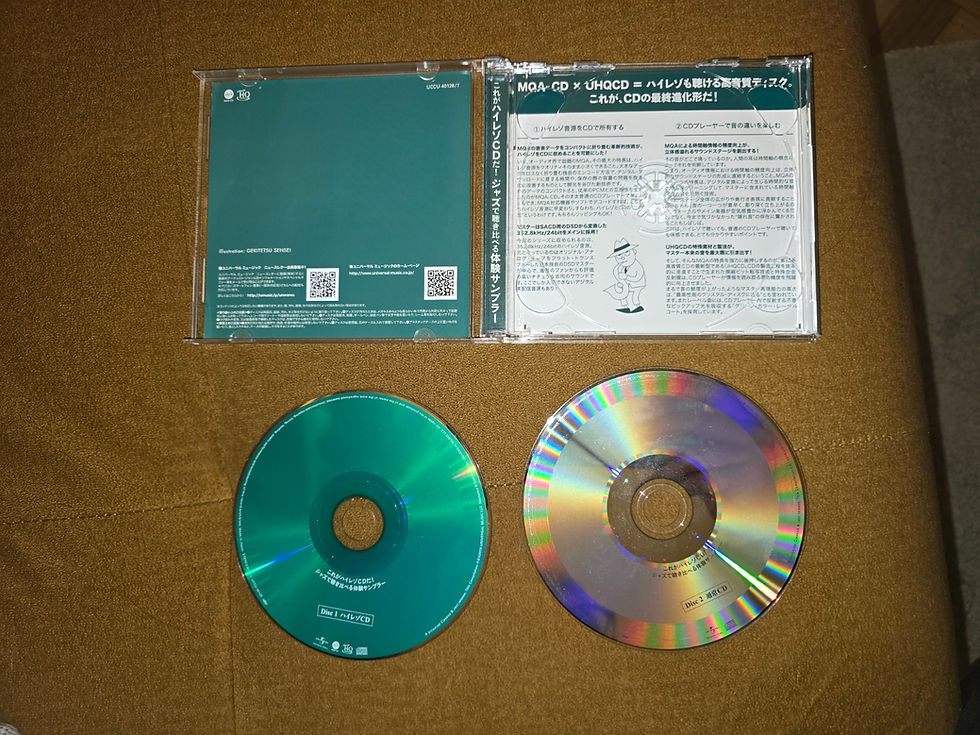
I bought a jazz compilation that comes as two discs: CD 1 is the MQA-CD, CD 2 is a regular CD with exactly the same music. Same tracks, same running order, one folded, one not. For a reviewer, that's basically Christmas morning.
A quick refresher on why this matters. An MQA-CD is still a normal Red Book disc, so it plays in any CD player. But hidden inside that 16-bit/44.1kHz stream is folded high-resolution information, and a decoder like the one in the MK2 unfolds it into a 24-bit signal. No special layer, no special player, no format war in your rack. Every CD player can play it. The right one plays it better.
And that's still a brilliant way to go beyond the limits of a regular CD without throwing your CD player away.
So does the unfold actually bring anything you can hear?
Yes.
Not heaven and earth, but it's there
Let me manage expectations first. This is not night and day.
But the MQA disc sounds better overall, and where it really shows is dynamics and space. The music opens up. The soundstage grows wider and deeper, and that's the biggest difference of all.
On "Autumn Leaves" from Cannonball Adderley's Somethin' Else, with Miles Davis on muted trumpet, Cannonball's alto sax roars a little harder, with more air around it and a more three-dimensional shape. It stops being a sound coming from between the speakers and starts being an instrument standing in a room.
On Stan Getz's "The Girl from Ipanema", the bigger stage gives the percussion more texture when it comes in mid-song. Each hit has its own grain and its own little patch of space to land on. Everything feels more organic, more finished, like someone spent an extra afternoon on the master.
Drastic? No. Real? Absolutely.
And honestly? I loved every minute of swapping those two discs back and forth.
The small print Especially after the scandal with Tidal.
MQA has had a rocky few years. The company behind it went into administration in 2023 and was bought by Lenbrook, the owner of NAD and Bluesound, and most streaming services have moved on to FLAC. MQA-CDs remain a niche, kept alive mostly by Japanese pressings. You'll find them on eBay, in second-hand shops, and if you're lucky, in that one record store that still has a "Japan import" shelf.
But if you already own some, or you enjoy the hunt, the MK2 is one of the easiest ways to hear what they can really do. For me, that alone is a small reason to smile every time I lift that lid.

Outro: The Better Product, Not the Better Player
So, was my excitement justified?
Mostly, yes.
The PL200 MK2 is not the cheaper copy I was worried about. It sounds excellent on its own, it's beautifully built, ridiculously versatile and gapless, and it does more jobs than any CD player this size has a right to. If you want one box on your desk that plays CDs, feeds your headphones, runs your laptop audio and handles Bluetooth in both directions, I can't think of a better $599 answer right now.
But it is not a better-sounding PL200.
The original has the bigger stage, the deeper and more articulate bass, and a brightness that feels like air rather than glare. The MK2 trades some of that scale for focus, and it's focused to a fault on bright recordings. The presets help. A good external DAC fixes it completely. But out of the box, the older player is the more refined listen.
But let me put that in perspective.
It may not be the upgrade I was hoping for, but the PL200 MK2 is still amazing value, and one of the best CD players you can buy at this price. If the original PL200 weren't standing right next to it, it would simply be the best.
So here's how I'd buy:
Desk setup, headphones, mixed sources: the PL200 MK2, no hesitation.
Speakers first, CDs only, sound above everything: find an original PL200 while you still can.
You already own a DAC you love: the MK2 in transport mode is great, but the PL200T is the purer tool.
The PL200 MK2 is the better product.
The PL200 is still the better player.
And honestly? For a lot of you, the first one matters more. You can lern more about device SMSL PL200 MK2 here:
✅ Pros
Sound Quality
An excellent sounding CD player on its own: clean, fast and confident, with a beautifully precise centre image.
Dense, busy mixes stay organized, with every instrument keeping its own outline.
Full MQA-CD decoding with audible gains in dynamics and soundstage over the same music on regular CD.
Gapless playback, so live albums and concept records flow as they should.
Transparent transport mode that lets your external DAC speak for itself.
Rich and Tube presets that genuinely help tune the sound to your system.
Build & Design
CNC-machined aluminium chassis that feels more expensive than it is.
Top loader with a clear lid and magnetic stabilizer, plus open-lid playback. Watching the disc spin turns every album into a small ritual.
Piano-key buttons with a tactile, crisp 80s boombox click.
Sharp, easy-to-read IPS display.
Compact enough to sit on a desk or a shelf without needing its own spot in a rack.
Connectivity & Features
True all-in-one: CD player, USB DAC, headphone amp, preamp, transport and two-way Bluetooth in one box.
XLR and RCA outputs, switchable between fixed line level and variable preamp.
Front 4.4mm balanced and 3.5mm headphone outputs with two gain settings and plenty of power for most headphones.
Two-way Bluetooth 5.1 with LDAC and aptX HD: stream from your phone, or send a CD to wireless headphones.
USB DAC up to 32-bit/768kHz and DSD512.
External clock input for those who want to go further.
A full-featured remote that controls everything from your chair.
Value
$599, less than the original PL200 cost at launch, with more features.
One of the best CD players you can buy at this price, and the best if the original PL200 weren't around.
❌ Cons
Sound Quality
Leaner bass and a smaller soundstage than the original PL200.
The upper mids can run a little hot on bright recordings and bright systems.
Asks for careful synergy: best with warm amps, speakers and headphones.
Measures slightly below the original PL200 on paper (127dB vs 132dB dynamic range), though you won't hear that from a CD.
Design Limitations
No 6.35mm headphone jack, odd for a desktop unit aimed at full-size headphones.
USB-C is the only wired digital input, so no coax or optical in for a streamer.
No SACD playback, CD layer only.
No de-emphasis filter for early pre-emphasized CDs.
Top loader needs free space above it, so no stacking on top.
Transport Caveats
Coax and optical outputs only. The PL200T, with AES/EBU, I2S and a 5V DC input, is still the better pure transport.
MQA Caveats
MQA-CDs remain a niche format, mostly Japanese pressings, with an uncertain future.


Comments