

R2R Is Quietly Taking Over HiFi Again, FiiO K17 R2R Review
The R2R Question
I'll admit something upfront: the moment a brand slaps "R2R" on a press release, my eyebrow goes up before my ears do. It's gotten to the point where it feels like walking into a coffee shop and being asked if you want regular or artisan coffee. It might genuinely be better. Or it might just be a marketing word stapled onto the same bean to justify charging more for it. That's the audiophile equivalent of "artisanal," a word that's supposed to signal soul and craft but usually just means "we changed one component and hope you don't ask what else stayed the same."
R2R vs Delta Sigma DACs
So let's actually talk about what that word means before I let FiiO off the hook.
R2R stands for resistor-two-resistor, and it's the oldest DAC architecture there is. No oversampling, no noise-shaping, no modulator doing clever math to hide its own mess. You build a ladder out of precision resistors in two values, hand each bit of the digital word its own weighted pair, sum the whole thing electrically, and out comes your analog waveform. Direct. Almost stupidly simple on paper.
Compare that to what's actually inside most DACs you've owned. Delta-Sigma, the ESS Sabres and AKMs and Cirrus chips that took over the industry, oversamples the signal at an absurd rate, shapes the quantization noise up out of the audible band, and cleans the result up with heavy digital filtering. It's cheap to make at scale, measures beautifully on a bench, and is why almost nobody builds their own DAC chip anymore.
And honestly? That's exactly the problem R2R fans have with it. Skip the modulator, and you skip its specific sonic fingerprint. Skip the brick-wall reconstruction filter, especially in non-oversampling mode, and you skip the pre- and post-ringing it smears around every transient. That's where R2R's whole "more analog, more tactile" reputation comes from. It's also, to be fair, where the marketing department gets overexcited and starts writing checks the resistors can't always cash, because tolerance is brutally hard to hold at the most significant bits, and a tiny mismatch there causes real, measurable non-linearity. On a bench, a good chip will usually out-measure a ladder. That's not opinion, that's just where the technology sits.
But some people build ladders anyway, and some of them are very good at it. MSB does it at the reference tier. Denafrips made it a real enthusiast-budget option. Holo Audio built a whole house sound around it. Schiit's Yggdrasil has a cult following for a reason. Audio Note goes full purist and pairs it with tubes. And now you've got Gustard, and FiiO, dragging the whole concept further down into mainstream pricing than it has any business being.
Which brings me to the box actually sitting on my desk.
FiiOs Relationship with R2R
FiiO isn't new to this. Since 2024 they've shipped the K11 R2R, the K13 R2R, the WARMER, the M33 R2R, the BR15 R2R and the DM15 R2R, and every single one of them ran the exact same 24-bit ladder built from 192 thin-film resistors. Different chassis, different price tag, same guts underneath. At some point that stops being a product line and starts looking like a sticker.
So when FiiO announced the K17 R2R, taking their well-liked all-in-one desktop DAC and amp and swapping the AKM chips for a genuinely new in-house ladder, without moving the $989.99 price an inch, my first reaction wasn't excitement. It was "here we go again."
Then I actually spent proper time with it. And this might be the one time the marketing story and the engineering story actually agree with each other.

The Numbers That Matter
Let's get the spec sheet out of the way so we can talk about things that actually matter more.
The amplifier section is fully discrete, an OP-plus-transistor current design built around the classic ON Semiconductor MJE243/MJE253 pairing, and it'll push up to 4,000mW per channel balanced into 32 ohms. That number drops hard into high-impedance territory, down to roughly 950mW at 300 ohms, so don't let the headline figure fool you if you're running vintage-impedance planars or old-school Sennheisers. USB decoding goes through an XMOS XU316, handling PCM up to 32-bit/768kHz and DSD256, with full MQA unfolding along the way.
Bluetooth runs through a Qualcomm QCC5125 chip with support for LDAC, aptX HD and aptX Adaptive, and the networking side covers Gigabit Ethernet plus dual-band Wi-Fi with Roon Ready, AirPlay, QPlay and UPnP/DLNA.
Peek under the hood and the parts bin backs up the sales pitch. The analog stage runs on Rubycon solid capacitors plus a scattered lineup of audio-grade parts, Nichicon, ELNA SILMIC II, ELNA RA3 and WIMA among them, all feeding into NEUTRIK gold-plated connectors on the outputs. Timing duty falls to three low phase-noise femtosecond oscillators, two ACCUSILICON AS318-L units plus a FiiO-customized third, which matters more than it sounds: jitter control at this level is usually the first thing manufacturers cut corners on to hit a price point. Processing is split across an Ingenic X2000 multi-core chip for the general system and an ESP32-S3 handling the lighter background tasks, while a separate M21586Q DSP chip, running 64-bit floating point math at 360MHz alongside an ES9821Q ADC, is what actually crunches the PEQ without touching bit-perfect playback elsewhere in the signal path. None of this is stuff you'll consciously hear. It's stuff that keeps you from hearing problems you'd otherwise blame on the DAC chip.
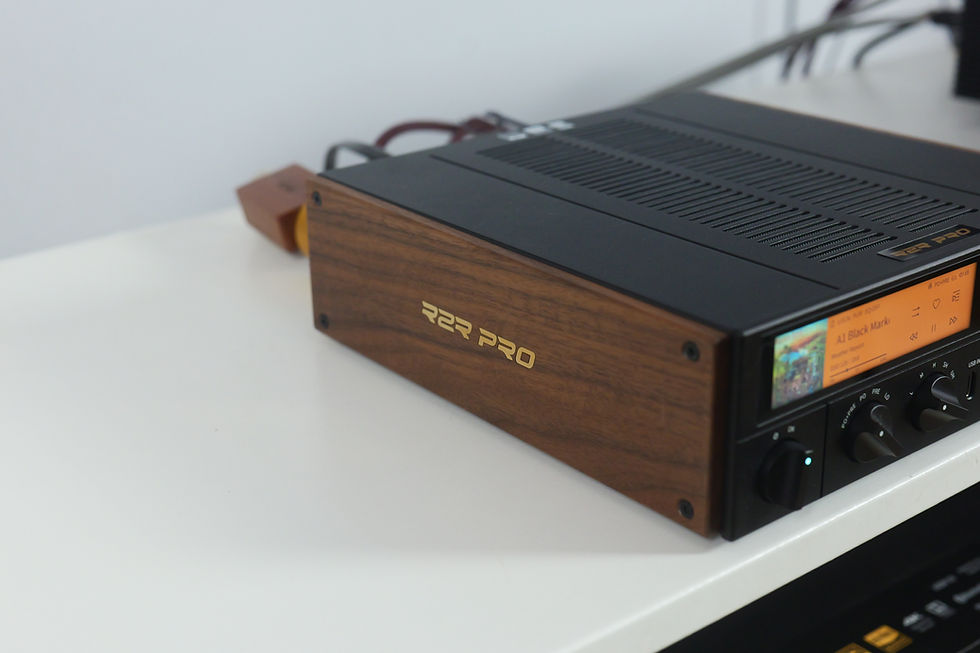
There's a 31-band lossless parametric EQ with AutoEQ support, editable from the FiiO Control app or straight from a browser, with curves you can save to the unit itself. A 35W linear power supply sits behind five 4,700uF capacitors, which is not something you casually find under $1,000. It ships in two finishes: silver with white ash side panels, or black with black walnut, and because it's real wood, no two units grain the same way. The one I had in for review was the black walnut, and if I'm picking for myself, it's the finish I'd actually choose.

Features That Earn Their Keep
Connectivity here is genuinely excellent, and I mean that as someone who tests a lot of these boxes.
Eight operating modes cover streaming, local onboard or NAS playback, USB DAC, Bluetooth reception, optical input, coaxial input, and both balanced and single-ended analog input, which effectively means this box can sit at the center of almost any desk or rack setup you throw at it. The front panel carries 6.35mm, 4.4mm balanced and 4-pin XLR balanced headphone outs plus a USB-C port for quick device hookups, while the back handles the heavier lifting: RCA and 4.4mm balanced line inputs if you want to run it purely as an amp, coaxial and optical digital in and out, RCA and XLR line outs for preamp duty, the RJ45 and antenna for networking, and a USB-B for computer connection.
The one back-panel switch I didn't expect to appreciate as much as I did is the ground-loop lift. If you've ever chased a hum through your entire signal chain at 11pm questioning your life choices, you'll understand why a single flick of a switch feels like a small miracle.
If I have one real complaint about the feature set, it's what's missing rather than what's there. The K17 R2R can act as a network receiver for Roon, AirPlay and QPlay, but there's no on-screen Tidal, Qobuz or Spotify app to browse directly from the unit itself. You're always tethered to a phone or a Roon core to actually pick what plays. For a unit this feature-complete otherwise, that's a real gap.
And that gap makes me want something FiiO probably isn't planning. FiiO already builds a full Android streamer with native Tidal, Qobuz and Spotify apps baked right in: the S15, running on the same AK4191/AK4499EX chip combo the original K17 used. Now imagine that exact idea, a proper full-size streamer with a real app layer, but built around the R2R PRO ladder instead of AKM chips. Call it the S17 R2R. FiiO, if you're reading this, you already have both halves of the recipe sitting in your own lineup.

Build Quality
Machined aluminum up front, real hardwood on the sides, and it sits on the desk with the presence of something from the 1970s that somebody lovingly restored rather than something assembled last quarter. It's not light either, sitting close to three kilos, which gives it that reassuring "I paid for a component, not a peripheral" weight. FiiO clearly leaned into the retro angle on purpose here, and the touchscreen backs that up: the menu system itself stays deliberately simple, basically a two-color affair, like someone at FiiO watched a vintage tuner documentary and decided the UI needed to match the aesthetic, not just the chassis. But the second you hit play, it switches gears entirely and pulls up full album art, whether you're playing off internal storage or streaming over the network, which is a genuinely nice touch I didn't expect from something this understated. It's also exactly the kind of detail that makes a desktop component feel considered instead of assembled from a parts bin.
I'll be honest, I adore the way this thing looks. It's one of those rare desktop units that actually looks like it costs what it costs, and the wood panels running down the left and right sides are what sell that feeling. Sitting in your eyeline for hours a day, that kind of detail matters more than people give it credit for.
One small thing I didn't expect to fall for: the remote. Nicely designed, properly weighted, sized just right in the hand, not one of those flimsy plastic afterthoughts that feel like they'll snap in a month.
There's also a neat customization touch I didn't expect: the button and screen theme colors aren't fixed, you can swap them to match your setup, or just your mood that day. Small thing, but it's the kind of small thing that shows someone actually thought about who's going to be staring at this all day.

Software And Everyday Use
FiiO Control is the app doing the heavy lifting here, and using it is straightforward once it's paired. Phone and unit need to sit on the same network, and the first pairing usually finds the K17 R2R automatically. When it doesn't, you can punch in the unit's IP address manually from the settings menu, which takes about thirty seconds once you know where to look, and approximately three hours the first time you don't.
I have to be blunt about something here, because it's part of FiiO's history whether they like it or not. FiiO has a well-earned reputation for shipping the hardware and letting the software catch up later, sometimes months later. Control support for features on brand new units has historically trailed the actual product launch, which is a frustrating pattern if you're the person who paid full price on day one. The good news is that by the time the K17 R2R landed, it inherited a platform and app support that had already matured through the original K17's release cycle, so this isn't a "wait for firmware v3 before it actually works" situation. Firmware updates still come in two flavors, main controller and MCU, both installed via a USB drive rather than over the air, which feels slightly old-fashioned for a device that otherwise wants to be your network hub. But once it's set up, day to day operation is genuinely pleasant: the physical knobs cover volume and input switching without ever opening the app, and the touchscreen handles everything else.
The app itself is useful for more than just pairing. There's a genuinely detailed equalizer section in there, both ready-made presets and a full parametric EQ to build your own curve from scratch. You can also manage playback source from the same screen, switching between NAS, USB or internal storage, along with a handful of other customization options I kept finding tucked away. More importantly, it's stable. I say that as someone who's been burned by FiiO's software before and went in expecting the usual rough edges. I never used the standard K17, but I've run plenty of other FiiO decks sharing this same configuration and architecture, and I know this platform is a genuinely well-engineered one when it's built around good clocks. This app confirms that reputation rather than testing it.

Sonic Quality
Right, the part you actually clicked for.
I went in skeptical, because I've heard "R2R warmth" oversold by marketing copy more times than I can count. I'll admit I was genuinely afraid this would turn out to be a beautiful sticker and nothing else: those gold "R2R" letters on the front are gorgeous, and I half expected them to be selling a vintage feeling rather than actual clarity and transparency. I wanted to know if this was audible character or just a story I was primed to hear. So I ran it against a stack of albums I know intimately, on repeat, over several days, switching between R2R PRO and other sources in my chain rather than trusting first impressions.
Here's my honest problem: I was wrong, genuinely wrong, and that doesn't happen to me often with gear at this price. I can see myself daily driving this unit, headphone amp duties and all, which isn't something I say lightly given how much gear passes through here. I love this thing, and I need you to trust that's not marketing goodwill talking. What comes out of the K17 R2R is a big, forgiving sound, not vague or smeared, just genuinely large and unbothered.
That forgiveness is exactly why it works across such a wide range of gear. Pair it with something already neutral or on the brighter side and it does exactly what you'd hope, rounding off the edges without dulling anything important. Pair it with something already warm, and it still works, it just leans further into that same musical, analog character instead of fighting it. There isn't really a bad pairing here, just better and slightly-less-better ones.
Vocals are where this thing does its best work: genuinely gorgeous and full bodied, with none of the thinness that creeps in on lesser desktop units at this price. Instruments sit just behind that same rounded, soft warmth, but soft doesn't mean vague.
There's real definition here and real scope on the soundstage, the edges are just polished rather than sharp. And the soundstage itself might be the single best thing about this DAC: wide, deep, and it never once felt congested, even on the busiest tracks I threw at it.
John Cale's Paris 1919 was the first thing I reached for, mostly because its orchestral arrangements are so densely layered that a lesser DAC turns the strings and woodwinds into a single blurred mass. Here, everything stayed separated without losing any warmth: the strings had real bite, Cale's laid-back baritone sat perfectly centered, and even the busiest passages never collapsed into mush. It's a baroque-pop record where Cale's voice has to do something tricky: stay melodic and laid-back while still being genuinely present in the mix, not buried under the arrangement. A DAC that can't resolve that balance either pushes him too far forward or lets him disappear. This one got it right.
Kendrick Lamar's To Pimp a Butterfly is where I test whether warmth comes at the cost of low-end control, because that album lives and dies on whether the upright bass and drum work stays taut under all that jazz-inflected density. It did. The bass had proper texture rather than a single undifferentiated thud, and even during the most chaotic moments, individual instruments kept their own space instead of collapsing into a wall. There's a lot going on underneath Kendrick's vocals on this record, Kamasi Washington's saxophone work weaves through most of it, and the live drumming on "i" needed to read as genuinely live rather than programmed. The real test is balance: when the 808s hit, that low end needs real presence without burying the sax or the percussion underneath it. The K17 R2R got that balance right.
Portishead's Third is deliberately more abrasive than Dummy, all glitchy programming and distorted textures sitting right next to Beth Gibbons' fragile voice, and it's exactly the kind of record where an R2R DAC's smoothing tendency could work against it. It didn't. A track like "Machine Gun", built almost entirely out of stark, distorted drum programming, still bit the way it's supposed to, while Gibbons' voice floated above all that noise with its fragility completely intact. I'll be honest about one thing here: her voice sits in a slightly brighter register, and a sharper Delta-Sigma chip might edge this one out on that specific top-end sparkle. But that's a minor preference, not a flaw. What actually matters is that the K17 R2R never cut her emotion to get there, and it held her voice's edge firm instead of rounding it off.
Max Richter's The Blue Notebooks is one of my most beloved pieces of modern classical music, and you've probably heard its centerpiece, "On the Nature of Daylight," without knowing it, it's been used in Shutter Island and more films than I can count. The album tests something completely different from everything else on this list: not scale, but restraint. It's mostly just piano, strings and spoken word sitting in near silence, and there's nowhere for a noisy DAC to hide on a recording this sparse. The piano decay stretched out naturally, string harmonics floated without any grain, and the noise floor stayed genuinely black behind all of it.
What struck me most is that this same unit handled the album's rare big swells and its tiniest, just-piano-or-just-voice passages equally well. Neither extreme caught it out.
So does the R2R swap actually change the sound, or is it placebo dressed up in wood veneer? After genuinely trying to catch myself out, my answer is that it's real, but it's not a transformation. It's a flavor shift: a bit more roundness, a touch less edge on the top end, more perceived note weight in vocals and mid-bass, without giving up the detail retrieval that makes an all-in-one unit worth owning in the first place.
And honestly? This is my favorite DAC in this price range right now. Whether you're using it purely as a headphone amp, or just running it as a DAC feeding a separate system, it does sonic wonders either way, precisely because it doesn't demand a specific kind of system to sound its best in.

Competitors
The honest comparison set here isn't other all-in-ones, because there aren't many at this exact intersection of price, power and feature count. Denafrips' Ares 15th sits close in price at around $1,199 and is a genuinely excellent balanced R2R DAC, but it's just a DAC. No streaming, no headphone amp muscle, no touchscreen. You're buying separates and building the rest of the chain yourself. And even then, I don't think it sounds meaningfully different from what the K17 R2R gives you. FiiO just wraps a comparable sound in far more features for considerably less money.
The two real rivals worth talking through properly are Gustard's R26 and Topping's DX9 Discrete, and they sit on opposite ends of the same argument.
The R26 is also a resistor ladder, and it's chasing a genuinely similar goal to what FiiO is doing here: a big, musical, full-bodied presentation with an extended, unfatiguing treble and a soundstage that goes deep rather than just wide. It leans warm without turning syrupy, and it's one of the more universally likeable R2R DACs out there regardless of what you feed it. Where it pulls ahead of the K17 R2R is refinement, a slightly blacker background, a touch more resolving power in the midrange, the kind of gap you'd expect from something built to a higher cost target. Where it falls behind is everything else. It's $1,649.99, two-thirds more than the K17 R2R, and it has no integrated headphone amplifier at all. You're paying a steep premium for a marginally more polished version of the same sonic idea, and you still need to buy an amp separately to drive headphones.
Topping's DX9 Discrete takes the opposite philosophy entirely. It uses Topping's own discrete 1-bit PSRM architecture rather than a resistor ladder, and it sounds like it: cleaner, faster, more controlled, with tighter bass and a more analytical, precision-first character than anything approaching the K17 R2R's musicality. It also throws a genuinely massive 7,080mW per channel at your headphones and adds a ten-band PEQ and crossfeed. At $1,299, it's roughly a third more expensive, though in real terms that's only about $300 separating the two, with none of the retro looks or wood, and it's simply chasing a different goal: technical neutrality over romance.
So who actually wins once you factor in price? If pure sonic refinement is all you care about and budget isn't a constraint, the R26 edges ahead, but you're paying a steep premium for a small step up and losing the headphone amp entirely. If clinical precision and raw power are the priority, the DX9 Discrete is the better tool for that specific job. But judged on sonic character per dollar, the K17 R2R wins outright. It gets you most of what makes the R26 special, wrapped in a genuine all-in-one, for a third less money than either rival. That's not a close call.

Synergy
I ran this both as a headphone rig and as a full preamp into my reference chain, because the K17 R2R's balanced XLR line outs make that second use case genuinely viable, not just a checkbox feature. Feeding it into my Rotel RB-1582 MkII power amp, driving both the DALI Rubikore 2 and the Wharfedale Super Linton, the K17 R2R held its own as a source component, not just a headphone box that happens to have RCA jacks bolted on. Against my Eversolo DMP-A8 Gen 2 Master Edition as a benchmark, the Eversolo still edges it slightly on outright resolving power and streaming polish, which is fair given the price gap between the two, but the K17 R2R's tonal balance made a genuinely compelling case for itself rather than feeling like the budget option in the room.
On headphones, the 4W balanced output gives it real authority with harder-to-drive planars, while the noise floor stayed low enough that sensitive IEMs off the front 4.4mm jack never picked up hiss. That range, from power-hungry planars to sensitive in-ears, is exactly what an all-in-one desktop unit needs to nail, and it does.
Outro
Here's a fun bit of continuity for anyone who's been following along: this thing was first teased under the name K17 R2R Pro, and I actually covered that tease when it happened. By the time it shipped, the "Pro" quietly vanished from the box, even though the internal DAC module still carries that name internally. Corporate naming amnesia, or somebody finally realized having a "Pro" R2R version next to a plain K17 R2R with no non-Pro R2R model to distinguish it from was just going to confuse everyone. Either way: less confusing branding, same wood, same price. I'll take it.
So, is the K17 R2R worth it? If you want one box on your desk that acts as a streamer, a USB DAC, a Bluetooth receiver, a headphone amp with real muscle, and a legitimate preamp for a full speaker system, all wrapped in a chassis that looks like it belongs in a hi-fi magazine from 1978, yes. It's not a revelation over the standard K17 for everyone, and if pure measured neutrality is your religion, the Topping crowd will serve you better. But if you've been curious whether R2R hype is real or marketing, and you want that curiosity answered without spending more money to find out, this is the one that actually earns the conversation.
I'll admit what I actually came in wanting to write: a piece about how R2R has become a marketing crutch, a word companies stamp on a product to justify a price it probably shouldn't carry. And that criticism isn't wrong in general. R2R done cheaply sounds worse than a cheap Delta-Sigma chip, because a $100 to $150 DAC built around a decent chip can still sound perfectly fine, while a budget resistor ladder with no real engineering behind it usually can't. R2R only works when it's actually done right.
I came in ready to roll my eyes at another "R2R" press release. I'm leaving mildly annoyed that I can't. Learn more about Fiio K17 R2R here:
Pros
Genuinely good R2R implementation, the segmented 24+5-bit array specifically fixes the top-bit accuracy problem that usually plagues cheaper ladder DACs
Big, musical, forgiving sound that works across almost any pairing, leans into warmth with warm gear, tames brightness with brighter gear
Vocals and soundstage are the standout strengths, wide, deep, never congested even on dense tracks
Doesn't sacrifice detail retrieval to get that warmth, handles both big dynamic swings and delicate, sparse passages equally well
Strong amp section, 4000mW+4000mW balanced output with real authority on hard-to-drive planars
Excellent connectivity, eight operating modes covering USB, Bluetooth, optical, coaxial, balanced/unbalanced analog, streaming, and NAS/local playback
Genuinely good value, cheaper than Denafrips Ares 15th, Gustard R26, and Topping DX9 Discrete, while matching or beating them on features
Versatile role, works equally well as a pure headphone amp or as a DAC/preamp feeding a separate system via its XLR pre-outs
Build quality stands out, machined aluminum plus real wood side panels, nearly three kilos of "this is a component, not a peripheral" heft
Nice small touches: album art on the touchscreen, customizable button/theme colors, a genuinely well-made remote
The app is detailed and stable, ready-made and parametric EQ, easy source switching between NAS/USB/internal storage
Quality internals back up the price, good capacitors, NEUTRIK connectors, triple femtosecond oscillators for jitter control
Ground-loop lift switch is a small but genuinely useful practical touch
Cons
No native streaming apps on the device itself, no on-screen Tidal, Qobuz, or Spotify, it only works as a network receiver via Roon/AirPlay/QPlay, so you're always tethered to a phone or a Roon core
Firmware updates still require a USB drive rather than over-the-air, which feels dated for something this network-centric
Slightly less refined than the Gustard R26 (blacker background, a touch more midrange resolving power), though the R26 costs two-thirds more and has no headphone amp at all
Not as clinically precise as the Topping DX9 Discrete if outright technical neutrality is what you want
On material with a brighter vocal register (Beth Gibbons on Portishead's Third specifically), a sharper Delta-Sigma chip might edge it out slightly on top-end sparkle, a minor trade-off rather than a real flaw
Not framed as a must-upgrade from the standard K17 for everyone, more of a flavor shift than a transformation


Comments