

Sivga Anser Review: A Wooden Voice in a Plastic World
Updated: May 8
Introduction
There is a quiet conviction in everything Sivga makes. The Dongguan-based outfit has, since its founding in 2016, refused to participate in the race-to-the-bottom aesthetics that define so much of the budget headphone market. Where others reach for matte plastics and edgy industrial silhouettes, Sivga reaches for rosewood, Zebrawood, hand-polished metal, and a kind of quiet, neo-retro elegance that feels closer to a vintage hi-fi cabinet than to a 2026 consumer electronics product.
The Phoenix put them on the map, the SV023 cemented their identity, and the Robin and Oriole proved that the recipe scales. The Anser, sitting at $219 with a 50mm dynamic driver and an open-back enclosure, is the latest iteration of that recipe — and arguably the most refined to wear the badge so far.
What makes the Anser interesting, and what makes it worth talking about at length, is the way it positions itself against an unusually well-armed peer group. At this price, the Sennheiser HD 600 still casts the longest shadow it has cast in any decade since 1997. The HiFiMan Sundara is right there. The HD 660S2 sits one step up. Beyer's DT 880 lurks. The Anser doesn't try to beat any of these on their own terms. It does something quieter and, in some ways, harder: it offers a different proposition entirely. A warm, organic, midbass-forward, easy-to-drive open-back that wears its musicality on its sleeve and lets the spec sheet take a back seat to feel.
This is a review about that proposition. Whether it works, where it works, and where the cracks show.
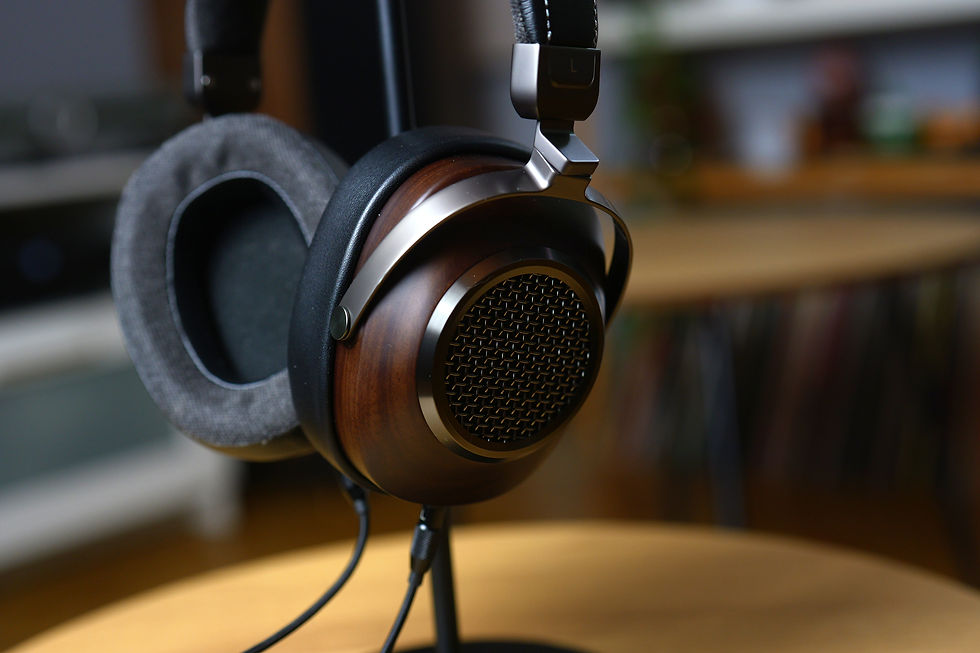
Specifications
Driver | 50mm in-house dynamic, titanium-plated diaphragm, organic carbon fibre polymer dome |
Magnet | 24.5mm NdFeB, 350 kJ/m³ |
Voice coil | Copper-clad aluminium |
Impedance | 38Ω (±15%) |
Sensitivity | 105 dB (±3 dB) |
Frequency response | 20 Hz – 20 kHz |
Enclosure | Open-back, solid wood (high-density rosewood/Zebrawood), CNC-milled |
Weight | 342 g |
Cable | 2 m, detachable, dual 3.5mm TRS to 3.5mm TRS, fabric-braided |
Termination | 3.5mm single-ended (6.35mm adapter included) |
Accessories | Hemp/canvas carry pouch, 3.5mm-to-6.35mm adapter |
Price | $219 |
Features and Engineering
The Anser is built around a 50mm dynamic transducer that Sivga developed in-house, and the choices made in the driver's construction tell you a fair amount about what the company is after sonically. The diaphragm is titanium-plated on the surround — a choice that buys lightness and a degree of structural rigidity without pushing the cone into the metallic, ringing territory you'd get from a fully metal diaphragm. The dome itself is a high-molecular organic carbon fibre polymer, which is the kind of phrasing that sounds more impressive than it is, but the engineering rationale is straightforward: damp the dome, let the surround do the work, and you end up with a presentation that has body and grip without hardness. The voice coil is copper-clad aluminium, a now-common compromise that trades some absolute conductivity for a lower moving mass, which favours transient response.
Behind the diaphragm sits a 24.5mm neodymium magnet rated at 350 kJ/m³ — fairly stout for a headphone in this price tier — and the rated 105 dB sensitivity at 38Ω makes the Anser one of the easier open-backs to drive that you'll meet at this price point. A phone dongle will run them. A serious desktop chain will not embarrass them. Both extremes are usable, which is more than can be said of, for example, the HD 600.
The "open-back" designation deserves a small asterisk. There is a metal grille on the outer face of each cup, but Sivga has fitted an internal damping fabric behind the driver that meaningfully reduces leakage in both directions. Compared to a true open design like the HD 600 or the Sundara, the Anser feels more semi-open in actual use. You will still annoy a quiet office, but you will not annoy it the way an HD 600 does.
Cabling is detachable via dual 3.5mm TRS — the same connector standard Sivga has used across the line — which means the entire aftermarket of Sivga-compatible cables, balanced or otherwise, is open to you. The stock cable is fabric-braided, supple in hand, and unfortunately also microphonic enough that I'd reach for an aftermarket replacement before long. A 4.4mm balanced terminated cable would be my first upgrade and probably my second, third, and fourth. The absence of a balanced option in the box, at this price, is a missed opportunity rather than an offence.

Build Quality and Comfort
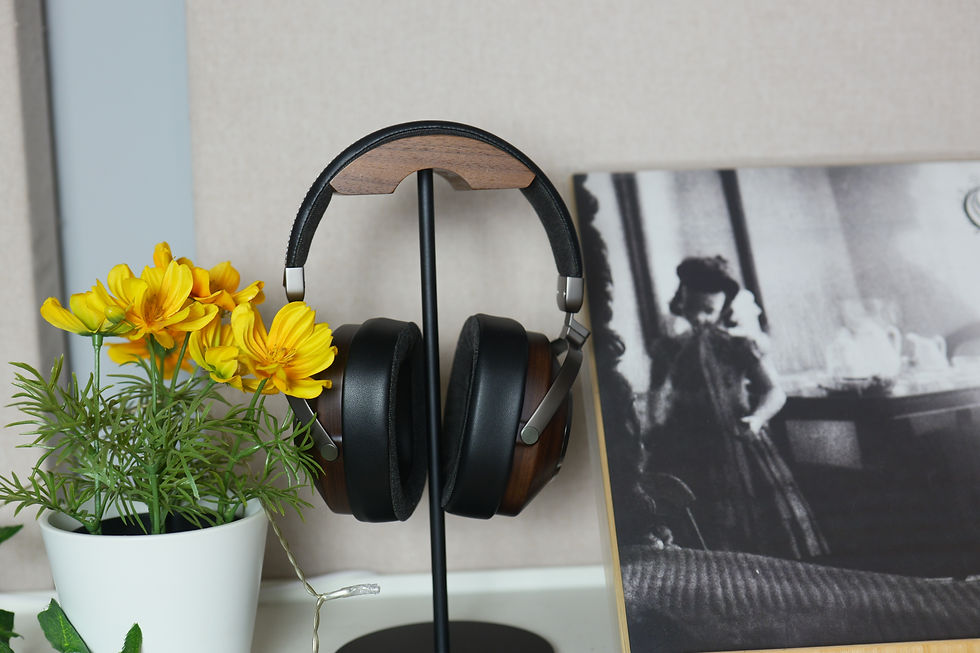
Pick the Anser up and the first thing you notice is how little plastic there is to find. The cups are solid wood — CNC-carved, hand-polished, painted, and air-dried in the way Sivga has been doing this for the better part of a decade — and the yokes, gimbals, and headband structure are metal throughout. The headband is wrapped in pleather on the outer face and lined on the underside with a breathable woven fabric that, in addition to looking cleaner than the all-pleather underside of the Oriole, holds up better under longer sessions. The earpads are a pleather perimeter with a microfibre or velour-adjacent inner contact surface — a hybrid that's become a kind of de facto standard for warm-leaning open-backs and that does, in practice, breathe and feel better than full pleather.
The dark Zebrawood against the satin-grey metalwork is one of the better-looking finishes I've seen at any price below the four-figure mark. There's a small, almost incidental detail of white contrast stitching down the edges of the headband, which keeps the design from looking too monastic, and the metal grilles on the cups are subtly textured rather than aggressively perforated. This is a design that wants to look at home on a desk next to a tube amplifier and a turntable, and it succeeds.
Comfort is mostly very good, with one caveat. At 342 grams, the Anser is not light by dynamic-driver standards — most of its peers in the category live in the 280–330g range — but the weight is well distributed by the headband, and the average clamping force keeps the cups stable without locking them down. The earpads are deep enough at around 25mm to prevent driver contact for most ear sizes. The caveat is the cup aperture itself: the inner opening is on the smaller side, and listeners with larger ears will find their pinnae brushing the inner edges. It doesn't quite cross into on-ear territory, but it's closer to the line than I'd like, and over hours-long sessions this is the comfort variable most likely to limit you. If you have small or average-sized ears, none of this will register; if you have larger ears, audition before committing.
The included accessory bundle is sparse — a hemp carry pouch and a 6.35mm screw-on adapter — and the lack of a hard case is regrettable for a wood-cupped headphone that you might reasonably want to take to a friend's place to A/B against their gear. I'd budget for a $20 third-party hard case as part of the purchase.

Sound Quality
Tonally, the Anser is a warm, midbass-leaning, slightly mid-recessed, treble-relaxed open-back with surprisingly competent staging and an easy, unhurried temperament. It is, in plain terms, a musicality-first tuning. If you've grown up on the BBC house sound or the warmer reading of the Harman target — if you reach for the HD 6XX over the HD 800S, the LCD-2 over the Arya, the Bifrost over the Modi Multibit — the Anser will feel native. If you want analytical, ruthlessly neutral, or aggressively detail-forward, you will find this headphone soft.
Bass
The low end is the headline. Sub-bass extension is genuinely good for a vented dynamic at this price, with audible energy down into the 30–35 Hz region and a clean, satisfying rumble on tracks that demand it. James Blake's Limit to Your Love, with its sub-bass drops that work or don't depending on the headphone, works here — not in the seismic way an LCD-X works, but with enough weight to feel intentional rather than implied.
Where the Anser tips its hand is in the midbass. There's a noticeable lift in the 80–150 Hz region that gives kick drums a fuller body and adds a warm chest-resonance to male vocals and lower strings. It's not the muddy, indistinct midbass elevation of cheaper warm-tuned headphones; it has reasonable definition and doesn't smear into the midrange. But it is a colouration, and on busier music — a Massive Attack track with a dense low-end mix, say Angel off Mezzanine — you will hear the headphone reaching for cohesion in a way a more neutral tuning wouldn't. The trade is a bass response that's emotionally rich and rhythmically engaging at the cost of some definition. For most listeners, most of the time, that trade favours the Anser.
Midrange
The midrange is the part of the Anser's tuning that requires the most careful description, because "slightly recessed" can mean very different things depending on the headphone. Here it means that the lower midrange carries the warmth bleed from the midbass and gives male vocals additional weight — Nick Drake's River Man, one of my reference tracks, has a wonderfully resonant low-baritone presence on the Anser — while the upper midrange and presence region (roughly 1.5–4 kHz) sits a touch behind the bass and lower mids in the overall balance.
The effect is a midrange that's smooth, pleasant, never strident, and slightly veiled in the way the HD 6XX is sometimes accused of being. Female vocals retain their character and don't sound dulled, but they don't have the immediate, in-the-room presence you get from a more forward upper-midrange tuning. Bill Evans' piano on You Must Believe in Spring — that decaying, harmonically rich left hand — lands beautifully; the right-hand figures, at the top of the piano's voice, are a touch softer than I'd ideally want. Nothing is wrong here. But on tracks where the magic lives in the upper midrange's leading edges, the Anser is doing a friendlier reading than a more analytical headphone would do.
Treble
The treble is the most polarising part of the tuning and, depending on your priorities, either the Anser's most appealing feature or its most frustrating one. There is a clear dip in the lower treble, a gradual roll across the upper treble, and very limited air above 12 kHz. The result is a presentation that's effectively immune to sibilance, fatigue, and the sharp-edged percussion artefacts that can plague brighter headphones. Cymbals have body but lack shimmer. Sibilants in vocals are tamed almost to the point of disappearing. Hi-hats sit politely in the back of the mix.
For long evening listening sessions with jazz, ambient, folk, or vocal-led recordings, this is genuinely lovely — Arvo Pärt's Spiegel im Spiegel on the Anser has a meditative weight to it, the violin's bow-on-string texture present but not exposed. For complex orchestral material, dense electronic music, or anything where treble energy carries the excitement of the recording, the Anser feels gentle to the point of polite. The HD 600's treble, often called soft itself, is significantly more energetic and resolved than the Anser's. The Sundara is in another league entirely up top.
Soundstage and Imaging
Here the Anser surprises. For a closed-pad open-back at this price, the staging is genuinely expansive — wider than the HD 600, deeper than I'd expected, with a left-right axis that's particularly well-developed. Imaging precision is good rather than great; instruments sit in defined positions but don't have the laser-pinpoint quality of the better planars. The intimate-but-spacious presentation works especially well for small ensemble jazz and acoustic music, where the headphone's ability to render a credible "room around the performer" lands more convincingly than its absolute resolution would predict.
What the Anser doesn't do is layered front-to-back depth at the level of the better Sennheisers. Its stage is wide and somewhat shallow, with most of the action happening on a single plane. This is a meaningful limitation for orchestral material but rarely an issue for the small-scale music the Anser is most obviously tuned for.
Technicalities
Resolution is good for the price but not exceptional. The Anser is decisively below a Sundara on micro-detail retrieval, slightly below an HD 600 on transient definition, and broadly competitive with anything else at $200–$250. Dynamic contrast is the area where the dynamic driver shows its breeding most clearly — macro swings have weight and impact in a way no entry-level planar can quite match. Note attack is on the softer side, which contributes to the warm, unhurried feel of the tuning but takes some of the snap out of percussive material.


Pairing and Synergy
Despite an easy 38Ω/105 dB profile that lets the Anser scale down to dongles, the headphone genuinely benefits from being paired with sources that don't reinforce its existing tonal character. Warm-on-warm pairings — a Burr-Brown-equipped iFi product into the Anser, for instance — push the headphone into territory that's pleasant for thirty minutes and exhausting for three hours. The bass thickens, the midrange pulls back further, and the already-relaxed treble becomes properly reticent.
The better pairings, in my testing, lean transparent or gently bright. An ESS-based desktop DAC/amp — a Topping E50/L50 stack, the Geshelli J2 with a Burson V6 Vivid op-amp swap, or anything of that lineage — restores some of the upper-midrange presence and treble articulation the Anser needs to feel fully resolved. The Questyle CMA18 Master, which has come up in a few recent professional reviews of this headphone, is a particularly good match: its current-mode topology gives the Anser a cleaner transient edge without making it sound thin. From the portable side, the Lotoo PAW Gold Touch — still the reference for proprietary-OS DAPs in my book — drives the Anser with the kind of authority and resolution that genuinely scales the headphone up. The iBasso DX180 and DX260 are excellent value pairings if the Lotoo is out of reach.
What the Anser does not need is more power. Anything past about 200 mW into 32Ω is irrelevant. Anything past about 500 mW is inviting damage. Save the budget for source quality rather than amplifier headroom.
I would also strongly recommend a balanced cable upgrade. Whether you're plugging into a 4.4mm output on a DAP or a 4-pin XLR on a desktop amp, the Anser benefits noticeably from the lower noise floor and better channel separation that a proper balanced chain provides. A $40–$60 aftermarket cable transforms the staging in particular.

Competition
At $219, the Anser is in one of the most-contested neighbourhoods in headphones, and it survives the comparison better than the spec sheet would suggest.
Sennheiser HD 600 ($299–$399 depending on availability). The reference. The HD 600 is more neutral, more resolving in the midrange, and tonally more balanced top to bottom. The Anser is warmer, more bass-capable, has a wider stage, and is significantly easier to drive. The HD 600 will show the Anser up on solo classical and chamber recordings; the Anser will show the HD 600 up on electronica, ambient, and anything rhythm-driven. They are not the same headphone trying to be the same thing, and the comparison should be read in those terms.
Sennheiser HD 660S2 ($499). The 660S2 is the closer technical analogue — also warmer than the HD 600, also bass-emphasised — and it's better than the Anser in nearly every measurable category. Better resolution, better midrange transparency, better treble extension, better imaging. It also costs more than twice as much. The Anser is not a giant-killer here, but it gets you 70–75% of the way there for 40% of the money, and on the right material the gap closes further.
HiFiMan Sundara ($299). The Sundara is the obvious analytical counterpoint at this price and the headphone I'd recommend instead of the Anser to anyone whose primary listening is detail-forward, treble-energetic, or technically demanding. It's faster, more resolving, and has a more linear treble. It is also less forgiving, less comfortable for many head shapes, and has a thinner, less satisfying low end. Different tools.
Beyerdynamic DT 880 ($249, 250Ω version preferred). The DT 880 is brighter, more diffuse, and significantly harder to drive. Listeners who find the Anser too warm and the HD 600 too narrow often land on the DT 880. The Anser comprehensively outbuilds it.
Sivga SV023 ($449). Sivga's own house comparison. The SV023 is more refined across the board — better midrange, better treble, more sophisticated overall — but the Anser captures the family character at a fraction of the price, and for a lot of listeners the marginal gain isn't worth the marginal cost.
The honest take: at $219, the Anser is one of two or three headphones I'd consider in this price band, and the one I'd recommend most readily to listeners coming from consumer Bluetooth gear who want a first taste of "real" hi-fi without the analytical austerity that often accompanies the entry-level audiophile rite of passage.
Conclusion
The Sivga Anser is a headphone with a clear point of view, and that, more than any individual technical achievement, is what makes it worth recommending. In a market segment dominated by either reference-pretender neutrality or budget-bright excitement-mongering, the Anser offers something that's becoming rarer at any price: a deliberately warm, deliberately musical, deliberately unhurried tuning that prioritises long-session enjoyment over short-session spec-sheet impressiveness. It is beautifully built, comfortable for the great majority of listeners, easy to drive from almost anything, and tuned in a way that flatters most of the music most listeners actually listen to.
It is not a technical reference. It is not the headphone you reach for when you want to evaluate a recording or chase the last 5% of resolution. The treble will frustrate detail-oriented listeners. The midbass colouration will annoy purists. The slightly tight cup aperture will rule it out for some larger-eared listeners.
But for $219 — and given how the rest of the market currently looks — the Anser is exactly the kind of thoughtful, opinionated product that the budget end of this hobby needs more of. A wooden voice in a plastic world.
Score: 8.5 / 10
Pros
Beautiful premium build with real wood cups, metal yokes, and elegant neo-retro aesthetics
Excellent craftsmanship and finish for the price
Warm, musical, relaxed tuning that prioritizes long listening enjoyment
Strong and satisfying bass response with good sub-bass extension
Midbass adds engaging weight and punch without becoming muddy
Smooth, fatigue-free treble presentation with virtually no sibilance
Spacious soundstage with surprisingly good width and depth for the price
Easy to drive from dongles, portable gear, and desktop setups alike
Scales well with higher-quality DACs and sources
Comfortable overall with good weight distribution and deep pads
Hybrid pads breathe better than full pleather designs
Wider stage and fuller bass than HD 600
More forgiving and less analytical than Sundara
Strong macro-dynamics and impactful presentation
Detachable dual 3.5mm cable system supports aftermarket upgrades
Good synergy with transparent or slightly bright sources
Excellent value proposition at $219
Particularly good for jazz, folk, ambient, vocal music, and relaxed listening
More semi-open than fully open, reducing sound leakage somewhat
One of the better-looking headphones under four figures according to the reviewer
Cons
Treble is heavily relaxed and lacks sparkle, air, and shimmer
Limited upper-treble extension above 12 kHz
Can sound overly polite or soft on energetic, complex, or orchestral music
Midrange is slightly recessed and mildly veiled
Female vocals and upper-mid details lack immediacy and presence
Midbass coloration reduces neutrality and can affect clarity in busy mixes
Resolution and micro-detail retrieval are only average for the category
Softer note attack reduces snap and percussion impact
Imaging is good but not class-leading
Front-to-back layering and depth are weaker than better Sennheiser models
Smaller ear cup opening may be uncomfortable for users with larger ears
Stock cable is microphonic
No balanced cable included in the box
Sparse accessories for the price
No hard carrying case included
Warm sources can make the sound overly thick and dark
Not suitable for listeners seeking analytical, neutral, or highly detailed sound
Sundara, HD 600, and HD 660S2 outperform it technically in several areas
Heavier than some competitors at 342g
Stage can feel somewhat shallow despite its width


From my experience, whether you’re working in high-end audio or RF engineering, performance always comes down to precision Microwave Absorbers , material consistency, and control of unwanted