

Snowsky Oak Nano Review: FiiO's Flagship in Disguise
I'll be honest with you. When a Snowsky box lands on my desk, I brace myself for something shaped like a cassette tape.
That's what this sub-brand has been so far: FiiO's playground for retro nostalgia and pocket-money prices, aimed at people who think a Walkman aesthetic is a personality. So when the Oak Nano showed up, a 449 dollar flagship IEM machined from pure titanium, my first reaction wasn't excitement.
It was suspicion.

A flagship with a complicated birth certificate
Here's the part FiiO's marketing won't lead with, so I will. The Oak Nano was never supposed to be a Snowsky product. It started life as the FD17, the direct successor to the FiiO FD7, a genuinely respected single dynamic driver IEM built around a pure beryllium diaphragm. Then the beryllium supply chain collapsed under its own weight. The material comes from essentially one facility in the United States, lead times ballooned, and FiiO quietly killed the FD7 rather than fight for scraps.
The Oak Nano is the workaround. Instead of pure beryllium, you get a 13.8mm dynamic driver with a beryllium alloy dome, which FiiO claims behaves closer to the real thing than the beryllium-plated diaphragms half the industry slaps on a spec sheet. Somewhere late in development, the FD17 badge came off and the Snowsky badge went on, making this the first flagship in a line otherwise known for toy-adjacent charm.
Is that a branding masterstroke or an identity crisis? I genuinely don't know. But the engineering underneath deserves to be judged on its own terms, so let's do that.
Titanium, and they mean it
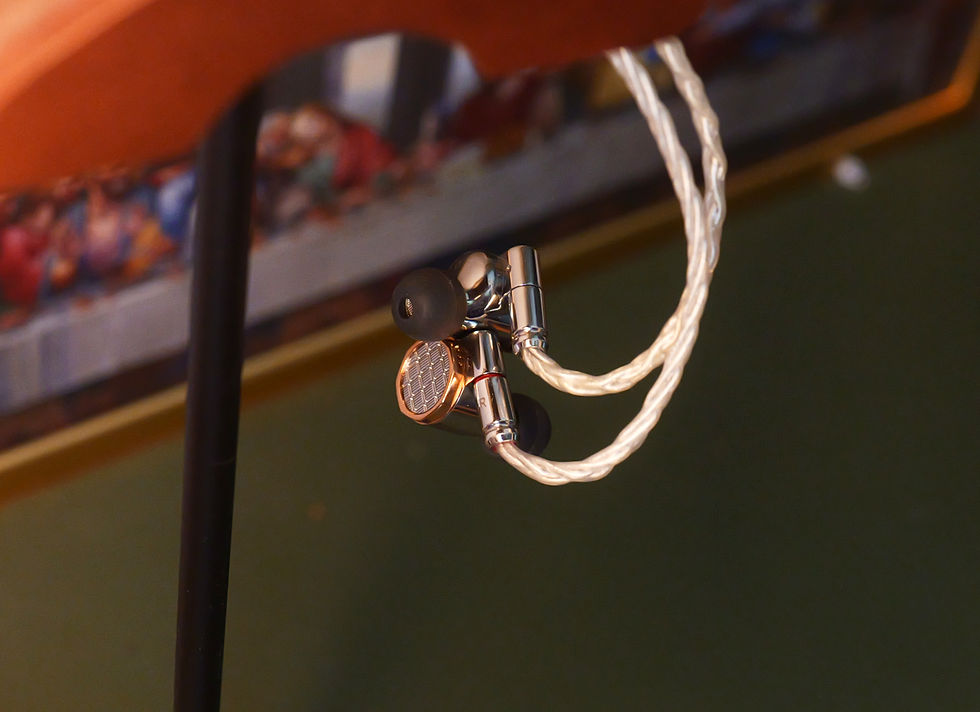
The shells are CNC-machined from pure titanium, mirror polished and PVD coated, with an octagonal faceplate that borrows openly from luxury watch design. In the hand, this is the most convincingly premium thing Snowsky has ever shipped, and it's not close. Nothing creaks, nothing feels like cost-cutting, and the finish catches light in a way photos undersell.
And honestly? The watch-face styling will split the room. On my desk it looks expensive. In my ear it looks a bit like I lost a bet with a jeweler. You'll know within five seconds which camp you're in.
Comfort is better than the 13.8mm driver size suggests. Titanium keeps the weight sensible, the shell shape is rounded where it counts, and long sessions never turned into an ergonomics negotiation for me.

The accessory box is doing overtime
This is where FiiO plays its strongest card. You get 22 pairs of ear tips, which is frankly absurd in the best way. You get two tuning nozzles, red and black, that change the sound in a real, measurable sense rather than the usual homeopathic nonsense. And you get a modular 0.78mm 2-pin cable, silver-plated 6N monocrystalline copper, cryo-treated at minus 192 degrees Celsius, with three swappable plugs: 3.5mm, 4.4mm balanced, and a USB-C termination with a built-in DSP chip offering 8-band parametric EQ.
Read that again. The cable in the box turns these into a USB-C IEM with proper PEQ, no dongle purchase required.
But does any of that matter if the tuning misses?
So how do they actually sound?
That depends entirely on which nozzle you screw in, and I mean entirely.
With the black nozzle, the one aimed at transparency and treble detail, the upper midrange steps forward aggressively. Female vocals and distorted guitars gain an insistence that reads as resolution for the first ten minutes and as pressure after thirty. If your library leans bright or your sessions run long, this nozzle will wear you down. I tried to make friends with it. We are not friends.
The red nozzle is where the Oak Nano makes its case. The presentation relaxes into a gently V-shaped signature with genuine low-end authority. And this is where that big driver earns its keep.
Bass. Sub-bass reaches properly deep and arrives with the kind of weight and physicality that multi-driver sets fake with quantity rather than quality. Kick drums have mass. Bass lines have texture instead of just presence. It's not a basshead tuning, but it's unapologetically full, and the driver never loses its composure when a track gets busy down low.
Midrange. Through the red nozzle, mids sit slightly behind the bass but keep their body and warmth. Male vocals have chest, instruments have wood and metal in them rather than outline. It's a musical midrange rather than a monitoring one, and I mean that as description, not criticism.
Treble. Energetic but controlled on the red nozzle, with enough sparkle to keep cymbals alive without tipping into glare. Detail retrieval is very good for a single dynamic driver, though a well-executed hybrid at this price will still out-resolve it in the last ten percent of micro-detail. That's physics, not failure.
Staging. Wide and immersive rather than surgically precise. Instruments have air around them, but pinpoint imaging isn't the party trick here. This is a set that pulls you into the music rather than laying it out on a grid.

The 50 ohm question nobody asked for
Here's a decision I'd genuinely like explained to me. The Oak Nano is rated at 50 ohms, which is unusually high for an IEM, from a sub-brand supposedly built for young lifestyle listeners plugging into phones. It'll still get loud off a decent dongle, and the included DSP cable covers the USB-C crowd, but this is not a set that gives its best from a laptop headphone jack. For a product wearing a youth-brand badge, that's a strange bit of friction.
What I'd push back on
Let me be blunt about the ledger. The stock black nozzle should not be the default fitted configuration, because the first impression it creates is the worst one this IEM can make. The styling is polarizing in a way that a 449 dollar purchase shouldn't have to gamble on. The brand placement actively works against it, because the same product with a FiiO FD17 badge would face zero credibility questions, and under Snowsky it faces plenty. And at this price you're shopping against very capable hybrid and tribrid sets that offer more raw technical performance per dollar, if that's what you're optimizing for.
None of these are fatal. All of them are real.
Verdict
I came into this review expecting a lifestyle brand cosplaying as high-end. What I found is a legitimate flagship single dynamic driver IEM with an awkward name tag.
The Oak Nano is for a specific listener: someone who values the coherence, timbre, and physical bass of one excellent driver over the dissected detail of many decent ones, who will spend five minutes with the nozzles and tips to dial it in, and who doesn't mind that their earphones share a family tree with a cassette-shaped MP3 player. For that listener, this is one of the most complete packages 449 dollars buys right now, and the PEQ-equipped modular cable pushes the value case from good to genuinely hard to argue with.
For everyone else? Listen before you buy, swap to the red nozzle before you judge, and try not to think about the FD17 that could have been.
Because that's really what this is. FiiO's flagship in witness protection. And it turns out it's doing just fine under the new name.
Pros
Genuine flagship-grade build: CNC-machined pure titanium shells, mirror polished with PVD coating
Excellent bass from the 13.8mm beryllium alloy driver, with deep sub-bass reach, physical weight, and real texture
Coherent, natural timbre that single dynamic drivers do best, with warm and full-bodied mids
Controlled, energetic treble on the red nozzle with good detail for a single DD
Wide, immersive soundstage
Two tuning nozzles that make a real, meaningful difference to the sound
Absurdly generous accessory package with 22 pairs of ear tips
Modular cable with 3.5mm, 4.4mm, and USB-C DSP plugs, giving you 8-band parametric EQ out of the box
Comfortable for long sessions despite the large driver
Cons
Stock black nozzle is fatiguing, with an aggressive upper midrange that makes a bad first impression
50 ohm impedance is unusually high for an IEM and awkward for the lifestyle audience Snowsky targets
Watch-inspired styling is polarizing at this price
Well-executed hybrids at 449 dollars still win on raw micro-detail retrieval
Snowsky branding undermines its credibility; the same product as a FiiO FD17 would face fewer questions
Imaging favors immersion over pinpoint precision, if that's your priority


Overall, Agario remains such an entertaining multiplayer concept because the objective is incredibly clear while the actual strategy can become surprisingly deep.