

Speakers so great it made me born again Audiophile - Wharfedale Super Linton review
Firstly, just a small celebration of a milestone — this is my 100th video review. I just want to thank everyone who has been following this channel from day one; this made my journey as a reviewer more fun and interesting, communicating and talking to a lot of people through comments and mail. And just to say, we are just getting started — see you on the 200th video.
My 15 years audiophiles journey - and a Special speaker
We all have some journeys in life, and as it seemed to happen, I probably have one similar to a lot of you guys. One of my hero journeys is to acquire speakers that will quench that thirst — speakers that will blow me away but not cost me an arm, a leg, a kidney. I know that feeling is not forever, and it fades with every day as we get accustomed to sound very quickly. But I need that adrenalin rush when I first hear new speakers at home and I am just blown away.
And there are a lot of reasons why these speakers are so special. There is something quietly remarkable about a loudspeaker that manages to feel simultaneously like a warm embrace from the past and a confident statement about the present. The Wharfedale Super Linton is exactly that kind of speaker — a product that doesn't beg for your attention with aggressive industrial design or flashy measurements, but instead invites you to sit down, pour something warm, and simply listen. And the longer you listen, the more you begin to understand why Wharfedale's Heritage range has become the best-selling line the company produces, and why the Super Linton in particular has generated such extraordinary buzz in the audiophile community since its release in late 2024.

Priced at approximately £2,000 / $2,499 USD per pair (stands often included or bundled), the Super Linton occupies one of the most fiercely contested price points in hi-fi — a space where buyers can choose from modern Scandinavian minimalism, British precision engineering, or American dynamic punch. Into this melee, Wharfedale has thrown a big, unapologetically retro wooden box that sounds, at times, like nothing else at the price. That is either going to excite you enormously or leave you cold. If you lean toward the former, read on — this one is for you.
The History of Wharfedale and Lintons
I really appreciate this book (History of High End Audio Design by Gideon Schwartz), and I am always fascinated about speakers and design, and everything that goes into the production of one. I always think that was my speciality, even though I do not often review speakers. But I want to talk a little bit about the history of Wharfedale and specifically the Lintons, as it is such an important part of HiFi legacy and cultural knowledge.
To understand the Super Linton, you first have to understand Wharfedale — and that story begins in a cellar in Ilkley, Yorkshire, in 1932.
Gilbert Briggs, a music enthusiast and amateur electronics experimenter, built his first loudspeaker in his home, located in the valley of the River Wharfe — an area known locally as "Wharfedale." The name stuck. In 1933, Briggs formalized the endeavour by opening Wharfedale Wireless Works in a small factory near Bradford, where his wife Doris helped assemble the components by hand. The fledgling company's early commercial speakers gained a strong following for their natural sound quality, and by the outbreak of World War II, Wharfedale was producing over 9,000 driver units per year. The company had gone from a hobbyist's cellar experiment to a national institution in less than a decade.
After the war, as "high fidelity" audio became a cultural phenomenon on both sides of the Atlantic, Wharfedale was perfectly positioned to lead. They were among the first companies to offer a true two-way loudspeaker system in 1945 — a revolutionary step that set the template for how loudspeakers would be designed for the next eight decades. Throughout the 1950s, Wharfedale continued to push the boundaries of what was technically possible, experimenting with sand-filled speaker cabinets to reduce resonance, and pioneering the use of ceramic magnets. Gilbert Briggs also became something of a celebrity in the nascent hi-fi world, publishing "Loudspeakers: The Why and How of Good Reproduction," a book that was reprinted numerous times and spread his reputation across the globe.

The 1960s brought a new kind of consumer — young, aspirational, design-conscious — and Wharfedale responded by designing speakers that were not only technically accomplished but furniture-worthy. Models like the Denton and the Linton were born of this era, designed to sit in a living room as objects of beauty as well as sources of sound. The original Linton debuted in 1965. It was a serious hi-fi speaker in a substantial three-driver cabinet — considered an accessible price point even then, while offering a level of resolution and musicality that earned it a devoted following. The Linton name persisted in various iterations through the 1970s before eventually fading from the product line.
Wharfedale passed through several corporate owners over the decades, eventually becoming part of the International Audio Group (IAG), which also owns brands including Quad, Mission, and Castle. Under IAG's stewardship, Wharfedale has been reinvigorated, with Chinese manufacturing in a vast, modern facility in Jiangxi Province enabling the company to produce astonishing quality at accessible price points — without, critically, abandoning the British acoustic engineering ethos.
The Heritage Series itself was born from a recognition that Wharfedale's vintage models had a sonic character and visual identity worth celebrating and re-engineering for the modern era. The 80th Anniversary Denton came first, followed by the 85th Anniversary Denton and then, in 2019, the breakthrough Linton Heritage. Designed by Wharfedale's Director of Acoustic Design, Peter Comeau, the 2019 Linton was a fully modern loudspeaker in vintage clothing — and the audiophile community responded with something approaching rapture. Publications from What Hi-Fi to Stereophile praised it. Reviewers like Steve Guttenberg gave it the kind of word-of-mouth momentum money cannot buy. It became Wharfedale's best-selling speaker, frequently backordered, and something of a cultural touchstone for the idea that great audio does not have to be modern-looking or expensive.
The original Linton was not merely a popular product — it was an argument. An argument that a large, wide-baffled, three-way standmount speaker, designed with cabinet acoustics at the forefront of thinking, could outperform the era's trend toward increasingly small and slim loudspeakers. Designer Peter Comeau articulated this philosophy clearly when the 2019 Heritage model launched: a wider baffle means a larger bass driver can be mounted with fewer acoustic compromises; it means the baffle step (the transition in dispersion where wavelengths become smaller than the speaker cabinet width) is pushed lower in frequency, making it easier to manage in the crossover and preserving sensitivity. Where slimmer modern speakers routinely compensate for baffle step loss in the crossover — often sacrificing 4–5 dB of sensitivity — the Linton's wide baffle philosophy keeps sensitivity high and low-frequency reproduction natural.
The SUPER super Linton - Build Quality

This philosophy is central to the Super Linton's DNA. Wharfedale has taken the Linton formula — wide baffle, three-way design, 8-inch woofer, 5-inch midrange, 1-inch dome tweeter, real wood veneer, companion stands — and upgraded virtually every element of it. The Super Linton is not a replacement for the standard Linton; both remain in the line. It is, rather, a refinement — the "Super" designation drawn from Wharfedale's own mid-century tradition of producing upgraded Super derivatives of popular models, including a Super Linton that appeared in 1967.
The Super Linton wears its heritage on its sleeve, and for those inclined to love it, it is genuinely beautiful. The cabinet is a large, rectangular box with 90-degree corners — no softened edges, no complex sculptural gestures, no driver-recessed baffles. Just a confidently proportioned wooden box that would not look remotely out of place in a mid-century modern living room, a cosy study lined with books and vinyl, or a tastefully curated listening room. The hand-matched wood veneers — available in Walnut, Red Mahogany, and Black Satin — are carefully applied and finished with a tactile warmth that communicates quality immediately. This is furniture-grade work at an audiophile price. And real wood.
The Super Linton is 4cm taller than the standard Linton — a deliberate choice that preserves the original's visual proportions and allows both speakers to share the same companion stands. The dimensions come in at approximately 60cm tall, 30cm wide, and 335cm deep, with a weight of nearly 20kg per cabinet. This is a substantial loudspeaker. On their stands, the drivers reach a listening height that positions the tweeter ideally for seated listeners, and the whole assembly has a satisfying sense of physical presence in a room.
The grilles are a key part of the aesthetic, and Wharfedale actually recommends listening with them on — unusual advice in the audiophile world, where grille-off listening is often assumed to be superior. The reason is specific to the Super Linton's design: the grilles incorporate internal acoustic shaping, which smooths the midrange and treble output and enhances the transition through the crossover region. This is not a cosmetic flourish; it is an engineered acoustic component. The woven grille fabric gives the speaker a warm, period-correct look while actually contributing to the final voicing.
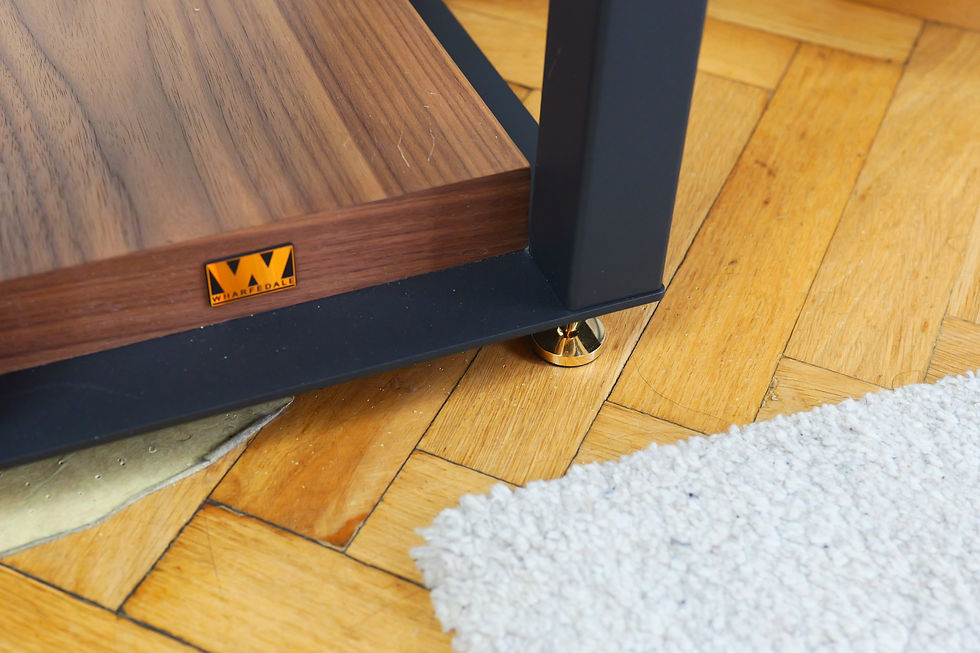
The companion stands deserve more than a passing mention. They are beautifully constructed, in a matching aesthetic, with a rigid steel and wood structure, vibration-damped platforms, and — in a wonderfully practical touch — integrated space to store vinyl records between the legs. They arrive fully assembled, which is a meaningful convenience, and in many online and dealer configurations the stands are bundled with the speakers at a reduced combined price. These are not afterthoughts; they are genuinely good stands that look and function as intended components of a complete system.

Massively upgraded inner Architecture
The three drivers are notable individually. The 8-inch (200mm) bass driver uses a black woven Kevlar cone — a material chosen for its combination of stiffness and self-damping. The cone is mounted on a die-cast chassis for rigidity, and in the Super Linton's version it is paired with an upgraded motor system featuring significantly stronger magnets. This enhanced magnetic force increases control over the cone's movement — resulting in lower distortion, faster transient response, and more deeply extended bass.
The 5-inch (135mm) midrange driver is also a woven Kevlar cone, but it lives in its own dedicated sealed cylindrical enclosure within the cabinet, packed with long-pile acoustic fibre to absorb back-wave energy. Isolating the midrange driver acoustically from the bass cavity is a significant engineering step that prevents low-frequency pressure waves from muddying the midrange unit's operation.
The tweeter is a 25mm soft dome design, borrowing architecture from Wharfedale's flagship Dovedale loudspeaker. It uses a ceramic magnet motor system — chosen for its linearity — with a damped rear chamber that absorbs the tweeter's rearward output, reducing distortion and improving upper-frequency smoothness. The front plate has been redesigned to optimize dispersion.
The crossover is arguably the most significant single upgrade over the standard Linton. Where the original used a single-board network, the Super Linton's crossover occupies two separate circuit boards, physically segregating the high-frequency and low-frequency sections to prevent electromagnetic interference. The bass inductor uses a proprietary "Super-Power" laminated silicon-iron core for improved energy storage and reduced insertion loss, while the midrange and treble inductors are air-core designs for maximum transparency. Capacitor selection has been optimized throughout. This is the kind of crossover work that typically costs far more than the Super Linton's asking price.
Every decision Wharfedale made was to create a better Linton, but what they made is actually a different speaker altogether — while it of course shares a lot of sonic similarity. The Linton is just a warmer speaker, softer and more laid back. What the Super Linton has done is to add more linearity, a more open treble, and just more detail, making it while being musical also dynamically very rich.

Measurements and Power Recommendations
The 90dB sensitivity specification is meaningful: these speakers will play at satisfying levels with modest power, yet can absorb everything a 200-watt amplifier can provide without complaint. The 32Hz bass extension is genuinely exceptional for a standmount speaker at any price — most comparably priced compact speakers struggle to reach 45Hz with authority. If you want more authority you can get a subwoofer, but the bass that this speaker provides is so great that, in most cases, it is not needed.
They are 6-ohm speakers, and just to be safe I do recommend around 100W in 8 ohms for an amp to drive them without issue. But if you want to calculate the sound, or you have a Rega amp, you are also good if your amp can reach 100W in 6 ohms. I usually try to find the middle between 8 ohms and 4 ohms as a very layman way to understand the 6-ohm load of my amp. But if that sounds confusing, just go with 8 ohms and 100W.
Now these are big speakers, as I mentioned earlier, so proper placement is definitely needed for them to sound their best. The space between them and the walls should be at least 50cm, and 2m between them. I do not recommend them for small rooms, but they are so big that it would be a downright strange decision anyway. Keep the grilles on, and toe them in if you want more focus and imaging. I personally prefer them straight, as it feels the most true-to-life with the Linton as possible. But I can see some people just enjoying the toe-in more. Experiment and find what works for you.
Also, I burned these speakers in for 100 hours plus, but I did not see any significant changes in sound, even though many people say that their Lintons opened far more after 50 hours, with better soundstage and bass definition. It could be because I change so much gear — amps and speakers for reviews — and I do not listen continuously enough to see changes happening in front of my eyes. But I did not have that burn-in feeling with mine.

Sound Quality
But let's go from the bottom up, as I love to do to paint the sound with words.
Bass
Bass — oh, that sweet, gorgeous bass. The bass is where the Super Linton immediately announces itself as something special. The 32Hz specified extension is not a paper fantasy — these speakers produce low-frequency information with a weight, control, and authority that is almost shocking given their standmount designation. Bass guitar has real body and bloom. Kick drums land with physical presence. Double bass has the resonant, chest-filling quality that smaller speakers simply cannot deliver.
What distinguishes the Super Linton's bass beyond mere extension is its quality. The upgraded motor system and isolated midrange enclosure combine to produce low frequencies that are well-defined and tonally natural rather than bloated or one-note. There is texture and articulation in the bottom end — plucked bass strings have differentiated note shapes, not just a general low-frequency haze. On densely arranged recordings, the bass remains organised even when challenged by complex musical content.
Now this is super important: if you guys want the Super Linton for more bass over the Linton, I have to disappoint you a little bit. They certainly have more authority and attack, but I never felt that the bass was larger in scope and mass than the regular Linton. I think the Super Linton bass couples with the rest of the instruments far better, creating more insight among instruments. But if you like the warm, encompassing bass of the Linton, you will not get that much more with the Super Linton — it is not the area that the Super Linton has massively improved.
Midrange
And that is midrange coupling and articulation. The Super Linton is a warm speaker, so the presentation of the midrange is going to be smooth. But it is incredible how much space it actually allows on the soundstage for me to gather what is going on, to follow instruments around me.
This is the Super Linton's crowning achievement, and what most listeners remember long after the audition is over. The dedicated midrange chamber — a cylindrical sub-enclosure stuffed with long-pile acoustic fibre — isolates the 5-inch Kevlar driver from the acoustic tumult of the main cabinet, and the results are clearly audible. Voices have a purity and presence that is deeply engaging. Guitars, pianos, horns, and strings all occupy their positions in a mix with a sense of correct tonal weight and texture that many speakers costing twice or three times the price fail to achieve.
The Wharfedale midrange has a character that can be described as rich but not coloured, warm but not woolly, detailed but not analytic. This is very much in the British hi-fi tradition — the school of thought that prioritises musical naturalness and long-term listenability over hyper-resolution that can fatigue on difficult recordings. Singers step forward with that particular intimacy that emotionally connects listeners to music; the phrasing, the breath, the slight roughness in a voice — all of this is communicated with impressive fidelity.

Treble
I cannot say how much this surprised me, including with the treble. But this is where your money goes if you want to spend the additional amount to go from Linton to Super.
What is particularly notable is the midrange's coherence with the adjacent frequency bands. The transition from bass to midrange and from midrange to tweeter is exceptionally smooth — the crossover work shows in how seamlessly the three drivers present a unified sonic picture. There is no discernible "seam" where one driver ends and another begins, which is a meaningful achievement in a three-way design at this price point.
The Super Linton's tweeter, drawing directly on technology developed for the flagship Dovedale, is one of its most intelligently voiced components. Many speaker designers in this price range walk a difficult line: too little treble energy and the speaker sounds veiled and closed-in; too much and it sounds fatiguing on extended listening or with challenging recordings. The Super Linton's tweeter finds an admirable path between these failure modes.
High frequencies are extended — measurements confirm essentially flat response to 20kHz — but they are delivered with a smoothness and ease that never crosses into aggressiveness. Cymbals shimmer naturally. Acoustic guitars have a clear, articulate transient attack. High-pitched female vocals retain their air and presence without steeling into edginess. The damped rear chamber technology contributes meaningfully here: distortion products from the tweeter's own rearward output are absorbed rather than re-radiated, which reduces the harshness that can plague cheaper dome tweeters.

The greatest thing about this speaker THE SOUNDSTAGE
I love soundstage. However, what the Super Linton does with soundstage depth is remarkable. Music hangs behind the plane of the speakers with convincing three-dimensionality; there is a clear sense of near and far, of acoustic environments being reproduced rather than simply sound being emitted. Well-recorded chamber music, acoustic jazz, and classical orchestral recordings benefit enormously from this characteristic — instruments occupy specific, stable positions in space rather than blurring together.
The soundstage is, in one word, spectacular. Because the bass is sprawling, it gives a feeling of openness on the soundstage, making instruments feel almost spatial and all over the space. With great detail in the treble making instruments palpable and real all over the soundstage, it makes this an amazing experience. This is not diffuse or vague; it is more that bass energy fills the room in a convincingly even way that contributes to the sense of being physically inside the music rather than listening from outside it. This is easily my favourite thing about this speaker.
The Tonal Signature
The Super Linton has a tonal signature that is warm, full-bodied, and deeply musical — but not at the expense of accuracy. It is voiced in the best British tradition: it flatters recordings without lying about them, it resolves detail without weaponising it, and it creates an emotional connection with music that keeps you listening well past the point where a more neutral or forensic speaker might have sent you to bed. Long listening sessions are comfortable and satisfying rather than fatiguing, and the hallmark sign of a great speaker — that you find yourself reaching for more and more albums — applies very much here.
Some bad things
But we also have to talk about things that are not particularly bad, as I think there are no bad points to these speakers — but more about how, in this price range, some other speakers do better overall.
Firstly, this is not a speaker for very analytical audiophiles. While the Super Linton is much better than the Linton in the mid section, it still is not as clear and transparent as some other speakers. It is noticeable how much energy and passion there is in the instrumentation, but sometimes I just wish that vocals were more free and had their own room on the soundstage. It is not that vocals are muddied or buried, but they are not the best in class.
And resolving power — while again this is where the Super is better than the regular — it still does not resolve, extend, or detail the instrumentation like the best in class. If you want clinical, rhythmic perfection, clear backgrounds, and just the ability for every instrument to be very rounded and open, this might not be the best choice in this class.
Amazing Experience in a Real world Scenario
Oh, I want to tell you about an amazing experience I had. If you follow more modern classical music, there is one name that has been mostly praised these days, and that is Henryk Górecki. When Górecki switched to a more minimalistic approach in large orchestral pieces in the 70s, he created two masterpieces. One is Symphony Number 2, Copernican, and the other is Symphony Number 3, Symphony of Sorrowful Songs. Now we will talk about Symphony Number 3, the masterpiece of Górecki. I think the most famous rendition of this piece was done in 1992. It was performed by the London Sinfonietta, with soprano Dawn Upshaw. They are the ones who I think popularised it, even though there have been many, many renditions of this symphony.
But the most amazing rendition was done in 2019, performed by the Polish National Symphony Orchestra, with soprano by none other than Beth Gibbons of Portishead. There is also an amazing 2020 rendition with Lisa Gerrard, but that is for some other time — we will focus on the 2019 version.
Everything from the first notes of the cello, setting the tone to this sombre, apocalyptic rendition of a Polish lament for Mary, mother of Jesus, needs authority to sound correctly. And the bass response of these speakers in the lower end works fabulously. It is an introduction rooted in low notes that slowly accumulate, one instrument over another, until it bursts into the rest of the orchestration like a big wave of pent-up emotions coming alive in a stream of consciousness in this lament.
At that moment, the Linton needs to hold the grand scope of sound, but also to hold the treble-rich instrumentation of high violins, and remain composed in the clash of big orchestration. And it does it so wonderfully — it is such an otherworldly experience, emotional, heartbreaking. It touches you on an emotional plane that the story it tries to convey.
And even when soprano Beth Gibbons arrives on the scene — oh my god. You are showered with sonics, singing about pain and beauty. It is a slow, brooding song that takes some time to truly open, but when it reaches its climax with Beth singing — well, you understand why this one specifically is one of the most praised modern compositions. The climax is a hammer; it holds you firmly to your seat, entranced in everything that is going on.
And the Linton, my god, just managed to remain large, with a scope and amazing soundstage that is everywhere. And yet the emotional core of this song did not get lost in haze and muddy sound. It manages to tell tales with its details and textures while remaining large and clear enough to make me always on the edge of tears.
When the first of three pieces of the symphony finishes it is like a catharsis — you have lived that event, survived that event, lamented and learned something. But you have in the end felt something that moves you, and that is rare these days. And the Linton was the main conductor to that in my room. I cannot even imagine what it was like hearing this live. I love the Super Lintons so much.

Synergy and Pairing
Regarding synergy and pairing: this is a large, warmish speaker, so consider power and sonic character accordingly. I think everything goes here, except maybe overly warm amplifiers. But there are two which I enjoyed to no end with these speakers and I am going to recommend here.
The first is Rega amplifiers. If you have the money to buy the Aethos — but the Elicit also works perfectly — you will get probably my favourite combination. Rega pushes the treble and details to reach even more out of the haze, while still remaining a strong foundation in mids and bass. The sound is large and detailed. It might lose a bit of its warmth, bass, and scope, but it gains so much more in other areas.
This might not be a combination for everyone, but I liked it. The other is the Musical Fidelity M5si. As we know, Musical Fidelity is a neutral amplifier, but tuned towards more muscularity with hints of warmth and attack. And that works almost really well with the Super Lintons. The scope, smoothness, and loveliness remain, and yet the details in the lower end and lower mids become more pronounced. There is also great cohesion between the two manufacturers.
The other option is something neutral — something like the Primare i25 or Hegel H190 would work wonders as well. Probably the Primare i25 is the better choice, as the analogue amp is much cheaper than the Hegel one.
Alteratives
Now, during my journey — same as yours — I have listened to many speakers, some at home, some at others', some in listening booths of audio stores. But I have gathered enough knowledge and information to share with you guys.
Kef R3
I think in this price range many people look at the KEF R3 Meta. They are very popular speakers, and they are a bit more expensive — about 200 euros more. KEF uses the company's Uni-Q coaxial driver, which places the tweeter at the acoustic centre of the midrange driver, creating genuinely exceptional point-source imaging. The R3 Meta offers more precise lateral imaging than the Super Linton, a notably more modern aesthetic, and excellent measurements. Where it gives ground is in the warmth and body of the midrange, the depth and scale of the bass, and the overall musical flow that the Wharfedale achieves. They represent fundamentally different philosophies.
Quad Revela 1
Another interesting alternative is from the same designer but at another company: the Quad Revela 1, which also comes with stands when you buy it. And it costs the same. Quad's offering uses a true ribbon tweeter, which provides a quality of high-frequency detail and resolution that soft domes find difficult to match. The Revela 1 is the more forensically precise speaker. But it lacks the Wharfedale's mid-band warmth and bass authority, and at its price it is a more demanding and less forgiving listen with lesser recordings.
Bowers and Wilkins 705 s3
Another interesting alternative is the Bowers & Wilkins 705 S3. They are a bit more expensive — around 200–300 euros more. But they are the pinnacle of what Bowers can offer before going into stratospheric prices. This is perhaps the most instructive comparison in this entire document, because the two speakers represent diametrically opposed philosophies delivered at a similar price.
The Super Linton is warmer, fuller-bodied, more forgiving, and more immediately involving on a broader range of music and equipment. It has dramatically more bass weight and extension. It is kinder to lesser recordings, easier to match to equipment, and emotionally connects with music in a way that encourages marathon listening sessions. It is also considerably more characterful visually, and if retro aesthetics are not your thing, the 705 S3's clean modernism will appeal more strongly.
The 705 S3 wins on outright detail retrieval, imaging precision, and the sheer quality of its high-frequency presentation. If forensic accuracy and surgical midrange transparency are the metrics that matter to you, and you have the electronics to support it, the 705 S3 has an argument. But it costs more all-in (stands are not cheap), is more demanding of its partnering equipment, and can feel somewhat clinical compared to the Wharfedale's.
Wharfedale Evo 5.4
How about the Wharfedale EVO 5.4 — they are cheaper than the Super Linton. The Super Linton vs. EVO 5.4 is essentially a debate between two different Wharfedale philosophies: Heritage warmth and the iconic retro character, versus modern technical excellence at a lower price in a floorstander format.
The EVO 5.4 extends deeper in bass (42Hz vs the Super Linton's 32Hz... wait — actually the Super Linton goes deeper to 32Hz), fills more room volume as a tower, and costs significantly less. Its AMT tweeter is arguably more technically sophisticated than the Super Linton's soft dome. In terms of raw technical specification and value for money, it is extraordinary.
But the Super Linton wins on emotional involvement, midrange richness, bass quality (the Super Linton's 32Hz extension actually beats the EVO 5.4's 42Hz specification), the unique character of its wide-baffle presentation, and the simple joy of its musicality. The Super Linton's more intimate three-way standmount design — with its dedicated midrange enclosure, wide baffle philosophy, and careful crossover voicing — creates a coherence and involvement that the EVO 5.4, for all its technical virtues, doesn't quite replicate. The Heritage range also carries an aesthetic and cultural weight that the EVO, attractive as it is in a modern way, cannot match.
Monitor Audio Studio 89
How about the close British competitor, the Monitor Audio, which is in the same price range? This comparison crystallises the Monitor Audio–Wharfedale divide in the British standmount landscape. Monitor Audio's studio-monitor ethos produces a speaker with exceptional neutrality, a remarkable tweeter, and extraordinary precision. The Super Linton's Heritage ethos produces a speaker with warmth, body, involvement, and a far more forgiving nature.
The Super Linton wins on ease of drive (90dB vs 86dB), amplifier compatibility, bass extension (32Hz vs 48Hz), and the fundamental warmth and fullness that makes it a pleasure to listen to across the widest possible range of amplifiers, recordings, and genres. It does not demand the most expensive electronics to show its character, and it will sound good connected to a tube integrated, a solid-state unit, or a streaming amplifier without extensive system-matching anxiety.
The Studio 89 wins on neutrality, treble sophistication, and the particular pleasure of hearing music through a speaker that simply gets out of the way. For the serious listener who owns or is willing to invest in genuinely high-quality electronics, the Studio 89's transparency is extraordinary. For the music lover who wants to plug in and enjoy, the Super Linton is considerably more accommodating.
Sonus Faber Sonetto I G2
Now the design fashionista option — the Sonus Faber Sonetto I G2. They are a bit more expensive than the Linton. This comparison is, in many ways, the most philosophically interesting in the entire list. The Super Linton and the Sonetto I G2 are both speakers that prioritise musical engagement and tonal richness over clinical accuracy — both have a "listen to music, not equipment" character. Yet they arrive at that character through very different roads and with very different resources.
The Super Linton has everything the Sonetto I G2 has in terms of tonal warmth and musical engagement — and then it adds three-way architecture, an 8-inch woofer, bass extension to 32Hz (versus the Sonetto's 52Hz), higher sensitivity, and a dedicated midrange enclosure. Its midrange, while arguably not quite as pure and refined as the Sonus Faber's famously exceptional two-way quality, is bolstered by a scale and body that the smaller Italian speaker simply cannot match. On large-scale orchestral music, full-band rock recordings, and anything with bass fundamentals below 50Hz, the difference in low-frequency presence is dramatic.
The Sonetto I G2 wins on visual beauty (it is genuinely one of the most handsome speakers at the price), the particular purity of a well-implemented two-way design, and the Sonus Faber house sound — which has an organic, emotionally liquid quality that is completely its own. Its more modest sensitivity makes it compatible with a wide range of amplifiers (including quality valves), and its downward-firing port makes it more placement-flexible than the Super Linton's rear port.
For listeners who primarily enjoy chamber music, jazz, singer-songwriter, and classical — where the purity of voice and the delicacy of acoustic instruments is paramount — the Sonetto I G2 is a deeply satisfying choice. For those who need a speaker to work across the full musical spectrum, handle bass-heavy genres with authority, and operate as a genuinely full-range proposition, the Super Linton's scale and architecture give it a decisive advantage.
Dali Rubikore 2
I want to talk about a speaker that is my favourite, or among my favourites, in the price range above the Lintons. It is the DALI Rubikore 2, but the Opticon 6 Mk2 is also a great alternative with amazing low-end and sub-bass properties. The bass has attack, gravitas, and proportions far bigger than the Super Linton. But we will talk about the Rubikore. I think it is an emotional speaker but on the other spectrum — while the Linton gives a big, smooth, warm hug, the Rubikore is more analytical and detailed, while holding all the cards in an expressive mid section, allowing vocals to take centre stage. With details and textures, just an amazing presentation full of energy and precision. It is a very complete speaker in that regard — detailed, open, with amazing mid-section clarity and expressiveness, and good enough bass for its size.
The Rubikore 2 is the more technically advanced and more neutrally balanced speaker. Its SMC-equipped drivers and crossover, Kore-derived engineering, and ferrofluid-free dome tweeter represent a genuine step forward in standmount design. Detail retrieval is excellent — it communicates fine nuance, recording subtleties, and the texture of individual instruments with a precision that the Super Linton, warmer and more full-bodied in character, does not replicate with quite the same granularity.
The Super Linton counters with architecture and low-frequency authority that the Rubikore 2 simply cannot match at any volume. The Super Linton's 8-inch woofer, three-way design with dedicated isolated midrange chamber, wide-baffle presentation, and 32Hz bass extension give it a fundamental physical completeness that the two-way Rubikore 2 — impressive as it is for its size — cannot replicate. Bass texture, body, and low-frequency extension are all in the Super Linton's favour. The wide-baffle design also creates an enveloping, room-filling presentation that gives music a sense of scale and physical presence that the Rubikore 2, despite its impressive bass for a standmount, does not fully match.

Conclusion - among the greatest ever, certainly best at 2500$
The Super Linton — yes, the best speaker at the price point of 2,500 euros. At least to me. What the Super Linton does in this price range, offering sound that is genuinely easy to listen to and appreciate while being clear and detailed, is just amazing. Not many speakers do so in this price range; it almost does everything excellently, to the point that it is incredible how it offers everything on a dynamic scale. And pair that with bass size and an encompassing soundstage — so beautiful and wide that it will completely trap you in your seat while you listen to music, spending hours in its sonic hug.
The Wharfedale Super Linton is a triumph of considered engineering and clear-eyed philosophy. It takes the fundamental formula that made the 2019 Linton Heritage one of the most beloved loudspeakers of the past decade — wide baffle, three-way design, real wood veneer, musical voicing, companion stands — and refines every element of it with upgraded drivers, a sophisticated dual-board crossover, constrained layer cabinet damping, premium internal cabling, and a tweeter drawn from Wharfedale's flagship range.
The result is a speaker that improves meaningfully on its already-excellent predecessor in bass extension and control, midrange clarity and isolation, treble smoothness and extension, dynamic energy, and overall coherence. It is not the most forensically precise speaker at its price. It will not give you the pinpoint lateral imaging of a narrow-baffled two-way, nor the analytical treble resolution of a ribbon tweeter. What it will give you is something that many audiophiles chase for years and never quite find: music that sounds like music, presented with warmth and body and life, in a beautiful cabinet that looks as though it was made to sit in a home rather than a laboratory.
For listeners who approach hi-fi as a means to emotional engagement with music — who want to disappear into an album, feel the weight of a bass line, be moved by a voice, and spend long evenings in the company of their record collection without fatigue — the Super Linton is not just worthy of audition. It may be exactly what they have been looking for.
The "Super" designation, in Wharfedale's historical tradition, implies superiority over the standard model. In this case, the tradition holds. The Super Linton earns its name, earns its price, and earns a place in the conversation about the finest standmount loudspeakers money can buy at this level. It is, unambiguously, a special speaker.
Pros
1. Exceptional bass for a standmount
Deep extension down to 32Hz, which is rare at this price.
Bass has weight, authority, texture, and articulation.
Handles complex recordings without turning muddy.
2. Beautiful, rich midrange
Natural, warm, and engaging vocal presentation.
Excellent tonal weight for instruments like piano, horns, and strings.
Dedicated sealed midrange chamber improves clarity and separation.
3. Smooth and refined treble
Extended and airy without harshness or fatigue.
Well-voiced tweeter derived from the flagship Wharfedale Dovedale.
Cymbals, guitars, and female vocals sound clean and natural.
4. Excellent soundstage depth and scale
Creates a large, room-filling presentation.
Strong sense of depth and layering.
Instruments occupy believable spaces in the mix.
5. Very musical and emotionally engaging
Warm, full-bodied signature encourages long listening sessions.
Connects emotionally with music rather than sounding clinical.
6. High sensitivity and easy to drive
90dB sensitivity works with many amplifiers.
Performs well even with moderately powered amps.
7. High build quality
Furniture-grade real wood veneers.
Large, solid cabinets with a premium feel.
Companion stands are high quality and include vinyl storage.
8. Thoughtful engineering upgrades
Dual-board crossover reduces interference.
Upgraded magnets in bass driver improve control.
Dedicated midrange enclosure improves clarity.
9. Strong value at the price
Around £2000 / $2499 per pair, often with stands included.
Competes strongly with speakers costing significantly more.
10. Forgiving and system-friendly
Works well with many amps and recordings.
Not overly picky about system matching.

Cons
1. Not the most analytical speaker
Lacks the clinical precision and transparency of some competitors.
Analytical listeners may prefer more neutral speakers.
2. Resolution is not class-leading
Detail retrieval and micro-resolution are slightly behind the best in class.
3. Vocals could be more separated
Vocals sometimes lack ultimate openness or isolation on the soundstage.
4. Bass improvement over original Linton is modest
Bass is tighter and more controlled, but not dramatically bigger than the standard Linton.
5. Large cabinet size
Requires larger rooms and careful placement.
Not ideal for small listening spaces.
6. Needs decent amplification
Although sensitive, the reviewer still recommends around 100W for optimal performance.
7. Retro aesthetic may not appeal to everyone
The large vintage-style cabinet is polarizing compared to modern slim speakers.


Comments