

This is what your first DAP should look like Fiio M21 review
- ducurguz
- Jan 21
- 8 min read
Updated: Jan 21
*Lot more images and videos of product in the video review above.
What Fiio did with M21 is should be understand as company providing no corners cut, to give DAP that gives outmost value at this price range. This is something that money you gives, does not have that big diminishing value. In that I can see many, many audiophiles be completely satisfied with this device for long time.
And that is why I think this should in perfect world be a first device for anyone wanting, not as this is utmost best budget device. Something like that might be more find in J21, but this is just without much cut corners shows audiophiles all great perks of owning a DAP and all that for 300 dollars.
Technical specs, build quality and software
In a segment where precision meets passion, the FiiO M21 stakes a claim not merely as a capable portable audio player, but as a device that re-defines expectations in its price tier. Retailing around USD 329, the M21 enters a crowded arena of dedicated digital audio players (DAPs) — many priced higher — and distinguishes itself with sound quality, power delivery, and architectural ambition.
he M21 runs Android 13 on a Qualcomm Snapdragon 680 octa-core processor — a chip built on an efficient 6 nm process that balances performance and power with low thermal draw. It’s the same generation of silicon you might find in mid-range smartphones, and this choice brings with it smooth navigation, quick app loading, and broad streaming support without taxing the battery.
Now as if you watched my previous reviews, you know while I think Android system is very versatile, and you can use it to how every need you have. I still have an issue that it feels that it is build for mobile, and readapted for DAPs. It does not feel like hit hearth is full into music reproduction, rather than just one more tool in arsenal. But if you are someone who loves to customize and manipulate the OS. Than of course Andoird is or you.

Paired with 4 GB of RAM and 64 GB of internal storage, expandable to up to 2 TB via microSD, the platform supports nearly any Android music app while maintaining responsiveness even with large libraries and system-wide parametric EQ engaged.
From a clock-to-audio perspective, this isn’t just a DAP with Android bolted on — FiiO implements software layers that prioritize low-latency audio paths and support direct file access via special modes like Pure Music or UAPP (Universal Audio Player) that can bypass Android’s normal resampling to preserve native rates when possible.
This is where the M21 most visibly diverges from typical handheld audio gear: instead of a single DAC chip, it uses four Cirrus Logic CS43198 DAC chips arranged in a matrix configuration.
Each chip handles two channels of conversion, summing to eight simultaneous channels that are then recombined into the final left/right feed — this significantly reduces crosstalk and lowers effective noise.
Fully differential conversion — where positive/negative mirror outputs are preserved — improves common-mode noise rejection and preserves dynamic range
Accompanying the DACs is another layer of engineering: two-stage amplification, where the first stage provides voltage gain and the second provides current gain. This separation lets the M21 maintain clean signal integrity even under demanding loads, preserving both detail and dynamic control.
The result is an analog chain that isn’t just technically capable on paper, but audibly transparent and emotionally connective — resolving micro-detail without blunting the rhythmic grip of bass or the nuance of overtones in complex arrangements.
The M21’s amplifier isn’t an afterthought — it’s central to its design ethos. With multiple gain stages and selectable high/super-high gain modes, the player delivers:

Up to 950 mW per channel into 32 Ω in balanced mode when externally powered.
Strong output even in battery-powered portable mode, with more than 400 mW per channel on 32 Ω single-ended and ample power into 300-Ω loads.
This level of drive means the M21 can confidently power both sensitive IEMs and demanding full-size headphones without distortion or tonal compression — a capability usually found in dedicated headphone amps or much more expensive DAPs.
A defining feature here is “Desktop Mode”: a unique implementation where the M21 will bypass its internal battery entirely when connected to external USB power via its secondary Type-C POWER IN port. In this mode the device acts much like a standalone DAC/amp component in a full hi-fi system, delivering its maximum voltage swing (≈21 Vpp) with low distortion and dramatically enhanced headroom.
The M21 isn’t just architected for power — it’s designed for wide compatibility:
High-resolution PCM up to 32-bit/768 kHz and DSD512 support.
Full MQA decoding (rare at this price), meaning it can unfold hi-res tracks from streaming services and local files alike.
Bluetooth 5.0 with extensive codec support — including LDAC, LHDC, aptX HD, SBC, and AAC — for high-quality wireless listening.
This flexibility means the M21 is equally comfortable as a portable streaming device and as a central player in a larger hi-fi ecosystem.
At the core of the M21’s performance is its quad-DAC architecture: four Cirrus Logic CS43198 DAC chips arranged in a matrix that significantly reduces crosstalk and lowers noise. This is a configuration usually found in far more expensive devices and is rarely seen at this price point. The result is a sound that marries technical execution with musical engagement — not simply loud or colored, but incisive and expressive.

Sound Quality
The bass on the M21 is remarkably well-controlled and extended. Sub-bass lines have weight without boom, and mid-bass punch propels rhythms clearly and with definition. In contrast to “V-shaped” tunings found on some competitors, where bass can be overemphasized for effect, the M21’s low end stays integrated with the rest of the spectrum, preserving clarity without sacrificing impact.
The midrange is the heart of the M21’s sonic identity. Vocals, whether male or female, come through natural and engaging, with a warmth that invites long listening sessions without veering into thick or congested territory. Acoustic instruments have textural richness and clear definition, with a transparency that tracks micro-details without sounding etched or artificial.
The upper frequencies on the M21 are extended and lively yet controlled, offering air and sparkle without harshness. On tracks with complex cymbal work or bright string instruments, the M21 reveals detail without veering into sibilance — although pairing with extremely bright headphones can tip the balance toward a sharper treble presentation.
Thanks to its advanced DAC layout and balanced signal path, the M21 creates a wide, three-dimensional soundstage that belies its compact dimensions. Instruments and vocals are precisely placed within that field, giving complex mixes the space to breathe. This engraving of space and depth is uncommon in mid-range DAPs and a hallmark of players that aim beyond modest expectations.
One of the most lauded strengths of the M21 is its extremely low noise floor, especially evident with sensitive in-ear monitors. Barely perceptible hiss means even quiet passages emerge clean and immersive. Dynamic response — the player’s ability to handle shifts from whisper-quiet subtleties to bold crescendos — is consistent and engaging, not compressed or smoothed over.
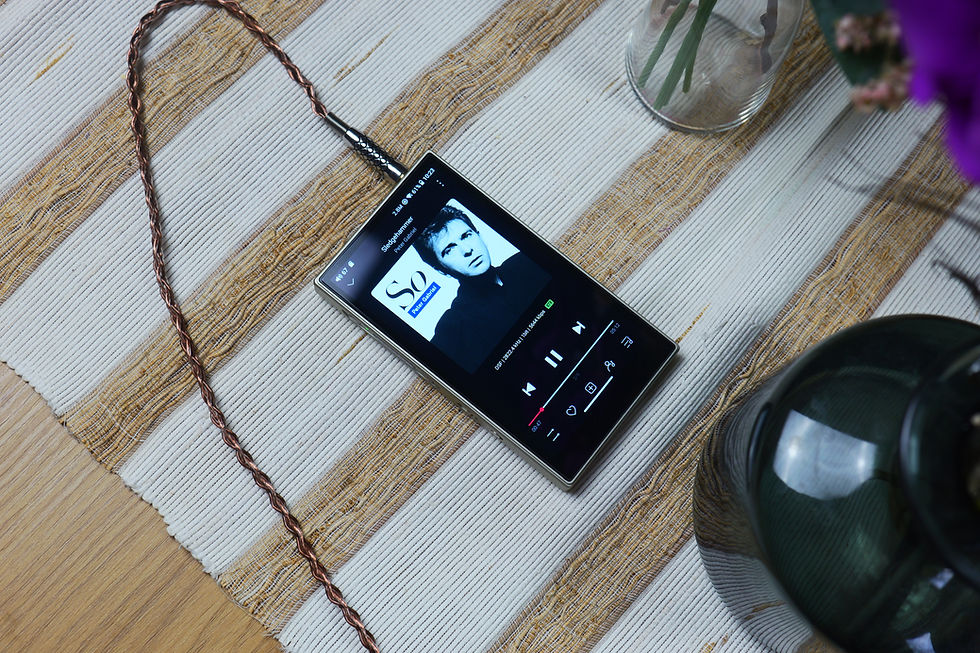
Fiio M21 vs HiBy R4
Perhaps the most common comparison users make is between the M21 and the HiBy R4, another prominent Android-based DAP in a similar price segment. While both are capable performers, the tonal profiles and tuning philosophies differ:
HiBy R4 tends to favor a slightly warmer and fuller signature, with bass that feels more lush and a slightly V-shaped emphasis that can make musical enjoyment more immediate. It also offers deeper customization via plugins and MSEB EQ.
M21 delivers a more dynamic, neutral-leaning and detailed presentation, with a lower noise floor and higher output power when paired with balanced headphones. Many users find the M21’s sound more engaging and punchy with a broader sense of control across the frequency range.
That said, some listeners still prefer the R4’s warmth and plugin ecosystem — demonstrating that subjective taste and pairing synergies (headphone type and source material) can influence preference significantly.
FiiO M21 vs Shanling M3 Plus
Shanling’s M3 Plus, positioned at a slightly higher price, has its own sonic identity — typically more colored and warm, with enhanced bass and smoother treble. In contrast, the M21 emphasizes natural neutrality and detail retrieval, which makes it more revealing, albeit occasionally perceived as leaner. The M3 Plus might be easier for relaxed or genre-specific listening, while the M21 suits those chasing accuracy and resolution.
Synergy and Pairing Notes
Like all audio components, the M21’s ultimate performance depends on headphone or IEM pairing:
With bright or analytical headphones, the M21’s neutrality can accentuate treble detail but sometimes veer into what some describe as thin or grainy if the headphone itself lacks warmth.
Pairing with balanced-tuned headphones or warmer signatures often yields a more satisfying blend — the M21 reveals micro-detail while preserving musicality.
In other words, enthusiastic audiophiles often recommend trying the M21 with both neutral and warm headphones to find the pairing that best suits your personal preference and music library.

Conclusion/Conquering the price range
I can not stress enough how much technology and handwear Fiio put in M21, for rather realistic price. This is maximizing the audiophile experience for cheap. And in that way I see this is best DAP to get as your first one if you can afford it. It certainly can not hold best value or best budget as obviously there are cheaper devices that maximize what you get for that money.
But this is a very capable sonic device, with internal storage, flexible Android software, lot of power and capabilities. It’s wait and size are also decent. Also its warm signature, lush and smooth vocals will fit many headphones, and will help with poorer production of music. But as always 24bit or DSD is a must to truly experience greatness of one player. It shows why DAPs are special, why we need them in 21st century, and why many people just love them.
Technically, the FiiO M21 is a tour de force of pragmatic engineering: it pulls advanced mobile processing, sophisticated digital-to-analog conversion, and robust power circuitry into a single package that competes with much more expensive components. Its quad-DAC matrix, two-stage amplification, and optional desktop-mode operation put it in a rare category where portable convenience meets desktop performance — a compelling proposition for audiophiles who refuse to compromise on either front.
I know in every audiophile lies a person who will appreciate DAP, just needs to have leap of faith and give them a chance.
✅ Pros
Outstanding value for money Delivers near–flagship-level architecture and performance around the $300–330 price point with very few compromises.
Quad-DAC architecture (4× Cirrus Logic CS43198)Rare at this price; significantly reduces crosstalk and noise while improving dynamic range and channel separation.
Powerful amplification
Up to 950 mW @ 32 Ω (balanced, desktop mode)
Strong battery-powered output
Drives sensitive IEMs and demanding full-size headphones confidently.
Two-stage amplification design Separate voltage and current gain stages preserve clarity, control, and dynamics even under load.
Desktop Mode with battery bypass Unique feature allowing the M21 to function as a true desktop DAC/amp with higher voltage swing and improved headroom.
Low noise floor Excellent performance with sensitive IEMs; minimal hiss and clean background.
Neutral yet engaging sound signature
Controlled, extended bass
Natural, warm, and transparent mids
Extended, airy treble without harshness (with proper pairing).
Wide and well-defined soundstage Impressive spatial depth and imaging for a mid-range DAP.
Android 13 with Snapdragon 680Smooth operation, fast app loading, and full streaming support.
Flexible software ecosystem Supports Pure Music mode, UAPP, and bypassing Android resampling for better audio integrity.
Excellent format and connectivity support
PCM up to 32-bit/768 kHz
DSD512
Full MQA decoding
Bluetooth with LDAC, LHDC, aptX HD, AAC, SBC.
Expandable storage microSD support up to 2 TB.
Strong first-time DAP recommendation Shows newcomers the full appeal of dedicated audio players without feeling compromised.
❌ Cons
Android still feels “adapted,” not purpose-built Despite flexibility, the OS can feel like a mobile system repurposed for audio rather than a music-first experience.
Not the cheapest “best budget” option Lower-priced DAPs may offer better price-to-performance if cost is the sole priority.
Neutral tuning can be system-dependent With bright or analytical headphones, treble can lean toward sharpness or thinness.
Less customization than some competitor s Compared to HiBy R4, it lacks deep sound-shaping tools like extensive plugin ecosystems or MSEB-style tuning.
Revealing nature exposes poor recordings Lower-quality masters sound less forgiving; high-resolution files benefit the M21 far more.
Some may prefer warmer, more colored alternatives Listeners seeking lush or heavily colored sound may favor Shanling M3 Plus or HiBy R4.


Slope Game is a simple, contemporary graphic style with geometric terrain and vivid neon surrounds. Because of the straightforward visual design and the fluid animations that create a constant sense of motion, the action is clearly apparent even at very high speeds. When combined with energetic sound effects, every successful dodge and daring escape feels strong, transporting players to a world where precision and speed are the only considerations.