

Best Speakers you can Buy now in 2026
Updated: Jun 30
These are the list of my favourite speakers. Awards are just awards and it does not mean that you should only look at gold award. Maybe that silver or bronze fit better your needs and budget and is therefore a perfect pair for you. I will give 5 awards and additional 10 more speakers that I really love. Somewhere here is certainly a perfect speaker for you.
Best Budget Speaker -Dali Kupid


Don't let the price fool you, and don't let the size fool you either. The Kupid is the smallest, cheapest thing here, and it is also the speaker most likely to make a newcomer fall in love with this hobby on the first track.
There is a particular Dali magic that usually starts further up the range, and somehow it survives all the way down to this tiny box: the same low-loss paper-and-wood-fibre mid/bass driver, the same soft dome tweeter, the same dual-flare reflex port philosophy that keeps the bass honest instead of inflating it for showroom effect. This is not a budget speaker pretending to be hi-fi. It is real hi-fi that happens to be cheap.
Sonically, the Kupid leans warm, and it wears that warmth beautifully. The bass is tight and quick, with no overhang and no one-note thump, sitting underneath the music as a foundation rather than barging to the front of the mix. But the midrange is where this speaker earns its place at the top of the budget pile. Voices arrive with a presence and an emotional directness that genuinely startles people who have only ever heard a soundbar: a singer's chest and breath, the rasp at the edge of a note, the small human details that make you stop scrolling and actually listen.
Acoustic guitar has body and bloom, synths have texture and grain, and the whole thing swings with a rhythmic confidence that pulls you into the track. Treble is smooth and unforced, never rolled off but never sharpened to fake detail, so it tracks cymbal shimmer and room reverb without a hint of glare even after hours. The soundstage spreads well beyond the cabinets, though depth stays modest, which is the one obvious reminder of the price. The catch is sensitivity: at 83dB the Kupid wants a proper integrated with some current behind it, not a flea-powered class-D toy.
Feed it well and it gives back warmth, rhythm, and pure musical joy out of all proportion to what you paid. This is the speaker I would put in front of anyone who says good sound costs a fortune, and I would happily watch them change their mind in real time.
Best Floorstander Gold - Spendor A7.2


Some speakers impress you. The A7.2 seduces you, slowly and completely, and then refuses to let you go back. It carries one of the most respected lineages in British hi-fi: the original A7 spent years as the floorstander I measured everything else in its class against, and was almost impossible to fault.
The revision keeps the slim, room-friendly proportions, builds around Spendor's own 18cm EP77 polymer mid/bass driver and 22mm Sonomex tweeter, and adds the Linear Flow port system that kills port chuffing when you push the volume. It looks understated to the point of invisibility. That is the whole point.
Sonically, this is Spendor doing the thing almost nobody else does as well: making music sound real without ever sounding like it is trying. The midrange is the heart of it, and it is genuinely one of the finest mid ranges in British hi-fi at any price. Voices are reproduced with a tonal honesty and a sense of a real human in real space that makes most rivals sound like they are reciting the notes rather than singing them.
Piano is the acid test and the A7.2 passes it without blinking: left-hand weight and right-hand sparkle arrive together, with the proper sense of a large wooden instrument resonating in a room rather than a flat recording of one. Strings have rosin and air, brass has body without bite. Treble is smooth, extended, and quietly detailed, the kind of top end that reveals everything yet never once makes you reach for the volume to turn it down.
Bass trades slam for warmth and tunefulness, full and well-judged rather than thunderous, which is the deliberate Spendor bargain: if you want a speaker that punches you in the chest, the Triangle or the Fyne further down this list will oblige, but they will not disappear the way this one does. The soundstage is wide, deep, and beautifully layered, and the speakers themselves simply vanish, leaving the music hanging in the room.
Whether the A7.2 genuinely improves on the legendary A7 is a debate that will rumble on in forums for years. What is not up for debate is the result in the room: effortless, natural, non-fatiguing, and quietly addictive. This is the floorstander you buy when you have stopped chasing fireworks and started wanting the truth. It is my gold pick because, months from now, it is the one you will still be listening to at 2am, telling yourself one more album.
Best Floorstander Silver - Wharfedale Diamond 12.3


If the Spendor is the speaker you grow into, the Diamond 12.3 is the speaker that proves you never needed to spend Spendor money to be genuinely happy. This is the textbook definition of what a budget floorstander should be: balanced, honest, unflustered, and built to a standard that quietly shames the price tag. Twin 6.5-inch woven Kevlar mid/bass drivers, a 25mm fabric dome tweeter, a slim cabinet wrapped in a real wood veneer that looks like it costs three times as much. Nothing here is exotic. Everything here is right.
Sonically, the 12.3's superpower is restraint, and restraint is rarer and harder than flash. It does not goose the bass to wow you on a demo, it does not sharpen the treble to fake detail, it does not push the vocals forward to seem exciting. It just plays the music straight, and that honesty is exactly why it never gets tiring. Bass reaches down to around 38Hz with real weight and proper control, taut and tuneful where cheaper towers go boomy and loose, so basslines actually walk and kick drums actually start and stop.
The midrange is clean, open, and credible: voices sound like voices, acoustic instruments keep their natural tone and timing, and you genuinely forget you are listening to something this affordable. Treble is airy and extended, with enough sparkle to keep the top end alive but none of the brittle edge that makes budget metal domes fatiguing after an album.
Imaging is tidy and well-focused, the soundstage is neatly organised between and a little beyond the speakers, and the whole presentation hangs together with a coherence that punches way above the asking price. It will not throw the cavernous, holographic stage of speakers many times its cost, but it never embarrasses itself, and it never sounds cheap. If someone wants to understand what real hi-fi actually sounds like without taking out a loan, this is where I send them. Silver here is not a consolation prize. It is a genuine giant-killer that just happened to run into a legend in the same category.
Best Bookshelf Speaker Gold - Dali Rubikore 2


This is the speaker that made me late for things. The Rubikore 2 takes Dali's flagship Kore engineering and pours it into a two-way standmount you can actually afford: SMC (Soft Magnetic Compound) motor systems and inductors that strangle the non-linear magnetic distortion most drivers quietly add, and an unusually large 29mm ferrofluid-free, low-loss soft dome tweeter derived from the Kore programme. Worth being clear here, because it trips people up: the Rubikore 2 is the one model in the range that skips Dali's hybrid dome-plus-planar tweeter array (that lives on the 6, 8 and Cinema). It runs the soft dome alone, and Dali removed the ferrofluid to cut mechanical damping and free up the dome's speed and air. It is handcrafted in Denmark, and the veneer and lacquer work feels like furniture rather than audio gear. But none of that is why it wins gold. It wins because of what happens when the music starts.
Sonically, the Rubikore 2 is the warmest, most human, most flat-out enjoyable standmount on this entire list, and it gets there without sounding soft or rolled off. It does not chase the last decimal point of transparency. It chases the feeling, and it nails it. The midrange is glorious: voices arrive with body, weight, and a three-dimensional solidity that puts the singer in the room with you rather than trapped between the speakers, every breath and chest resonance intact. Cellos have wood and bow, saxophones have reed and air, and there is a richness to instrumental texture that makes leaner rivals sound like they are showing you a diagram of the music instead of the thing itself. Bass is the quiet shock of this speaker: for a compact two-way it goes genuinely deep and lands with real authority and warmth, never bloated, always adding rather than smearing. And that big soft dome is the jewel on top, one of the best dome tweeters at any sane price. Stripping the ferrofluid out gives the top end a delicacy and an airiness that stiffer, heavier domes simply cannot fake, with cymbals and string overtones decaying naturally into silence instead of being chopped off.
The soundstage is wide, deep, and properly layered, with instruments placed in believable space front to back. What you trade for all this soul is a sliver of outright resolution and clinical bite at the very top compared to something like the KEF. That trade is not a weakness, it is a philosophy, and it is the right one for anyone whose listening leans toward jazz, acoustic, vocal, and classical, or toward those long late-night sessions where you want the music to feel alive and warm-blooded rather than dissected on a lab bench. The Rubikore 2 does not just reproduce music. It makes you want to keep listening to it. That is the whole game, and this is the speaker that wins it.
Best Bookshelf Speaker Silver - Acoustic Energy AE300 Mk2


The AE300 Mk2 is the quiet professional in a room full of show-offs, and it is the one I would not bet against. It will not seduce you in the first thirty seconds of a demo, because it is not built to win demos. It is built to win the long argument, the one that plays out over hours and weeks, where every flashier rival slowly reveals the corners it cut and this one just keeps being right. Behind the modest cabinet sits real engineering: a 29mm fabric dome tweeter crossed over at an unusually high 3.5kHz to a 12cm paper-and-coconut-fibre mid/bass driver lifted from Acoustic Energy's far pricier Corinium range, with the kind of grown-up cabinet damping the price has no business including.
Sonically, the defining word is composure, and it runs through everything this speaker does. The bass is lean and linear rather than warm and woolly, and that is a deliberate, confident choice: notes start and stop with a precision and an articulation you simply do not expect down here, so a bassline has shape and a kick drum has actual attack instead of dissolving into generic low-end mush.
The midrange is open, clean, and ruthlessly honest to the recording. Feed it a great master and it sounds glorious, layered and effortless. Feed it a bad one and it tells you, politely but plainly, with none of the cosy euphonic smearing some rivals use to flatter everything into the same pleasant blur. That honesty is the whole appeal: this is a speaker that respects you enough to play the truth. Treble is smooth, extended, and clean, free of grain and glassy edge at any normal volume, so long sessions never tire the ears. Imaging is tight and precisely focused, with surprisingly good front-to-back depth for the money, and the overall presentation is so even and unforced that you stop thinking about the speaker entirely and start thinking about the music.
It is restrained, mature, and slow-burn addictive in a way that loud, sculpted rivals never manage. This is the standmount for the listener who has been through the flashy phase, stopped being impressed by loudness, and started caring about what is actually on the record. Silver, and thoroughly deserved, because it is one of the most genuinely honest speakers you can buy at this price.
The Rest - Ascending by Price
Wharfedale Diamond 12.1

The Diamond 12.1 is the compact standmount that sits near the bottom of Wharfedale's most famous range, and it carries far more engineering than its size or price suggests. It is a small two-way, just over 30cm tall, built around a 25mm woven polyester dome tweeter and a Klarity mica-infused polypropylene mid/bass cone, loaded by a rear port and a multi-layer sandwich cabinet with internal spot bracing that you can hear the benefit of the moment you knuckle-rap the side panel: a dead, inert thud rather than a hollow knock. The crossover is the giveaway that someone cared, using a steep Linkwitz-Riley topology with air-core inductors of the kind you normally only meet much further up the price ladder.
Sonically, the 12.1 punches with a confidence and a body that genuinely surprises people the first time they hear it. This is not a thin, tinny budget box. It sounds bold and full-bodied, with a composure under pressure that most rivals at the price simply cannot match. Bass is taut, tuneful, and impactful for such a compact cabinet, and unlike the older Diamonds it does not demand to be jammed against a wall to find its weight: it stays balanced even out in the room.
The midrange is smooth and forgiving without going soft, so vocals carry real presence and texture and busy passages stay organised instead of collapsing into a muddle. There is enough bite up top to keep things lively, but never the brittle edge that makes cheap tweeters fatiguing. It will happily tell you when a recording is poor, yet it never over-eggs the problem, and that even-handedness is rare and valuable down here. Driver integration is seamless, dynamics land with more scale and authority than the size promises, and the whole thing swings with a surefooted sense of rhythm. For a small system, a desktop, or a second room, this is one of the most musically complete things you can buy for the money.
Full review here:
Q Acoustics 3050i

The 3050i borrows cabinet engineering directly from Q Acoustics' flagship Concept 500 Point-to-Point internal bracing that stiffens the enclosure where it needs it most, Helmholtz Pressure Equalizer tubes that kill standing wave resonances common in tall cabinets, and a decoupled tweeter suspension that isolates the 22mm soft dome from vibration fed back by the twin 6.5-inch coated-paper woofers.
For $799 a pair, the engineering pedigree is absurd.
Sonically, the 3050i is big, spacious, and room-filling in a way that no standmount at twice the price can match. The presentation is full-bodied and smooth, warm and enveloping, with a natural transition from bass through the midrange that makes large-scale music feel genuinely large. Bass has real weight and authority, though low-frequency control depends on room placement and amplification, loose positioning with a weak amp can produce a slightly woolly low end. Tighten up the placement and give it decent power and it firms up considerably. Dynamics are excellent for the price, with a sense of punch and energy on rock and orchestral music that more delicate bookshelf speakers simply can't replicate.
Q Acoustics 3020i reivew:
Buchardt S400 Mk2

The S400 Mk2 is one of the most quietly influential standmounts of the last few years, built by a Danish family company that sells direct to your door and skips the dealer margin entirely, which is exactly how a compact two-way ends up with this much engineering inside it for the money. The design is unmistakable: the tweeter sits below the mid/bass driver in an aluminium CDC waveguide, fed by a 6-inch paper-cone woofer designed by Ulrik Schmidt, with a large rear passive radiator loading the sealed-style cabinet instead of a conventional port. The real story is the crossover. Buchardt poured the budget into parts you will never see, mixing Jantzen Audio components with a single ultra-high-end Miflex KPCU-1 capacitor, and it pays off in the most important way: the sound. Note that it is a genuine 4-ohm load that dips toward 2.6 ohms, so give it a proper integrated with current to spare and keep the tube amps and lightweight receivers away from it.
Sonically, the Mk2 does the trick that made this speaker famous: it sounds far bigger than its physical size has any right to. The defining quality is the soundstage. Where most speakers at this price throw a flat wall of sound up in front of you, the Mk2 sets the stage back and lets it unfold in depth, putting you a few rows into the hall rather than pinned to the front of the stage. The background is genuinely dark, and against that silence the instrument separation becomes almost addictive, with each voice and instrument carved out in its own pocket of space. Bass is the party trick everyone talks about and it deserves the praise: deep, controlled, and physical in a way that embarrasses far larger boxes, reaching down near 33Hz without ever turning flabby. The midrange leans a touch warm but stays open and transparent, with a sweetness on vocals and acoustic instruments that pulls you into a record and keeps you there long past bedtime. The treble is refined and slightly polite, with one quirk worth knowing: the tweeter lets go of reverb tails a fraction early, so the very last shimmer of a cymbal or a piano's decay fades sooner than on some rivals. It is not a beefy, in-your-face speaker. It is an intimate, musical, deeply engaging one, and at this price, bought direct, it remains one of the most genuinely satisfying standmounts you can own.
KEF R3 Meta

Three-way standmounts that borrow the same Uni-Q driver array as KEF's flagship R11 a 1-inch vented aluminium dome tweeter mounted coaxially inside a 5-inch aluminium midrange, all treated through KEF's MAT metamaterial disc that absorbs 99% of the tweeter's rear-wave distortion. A separate 6.5-inch hybrid aluminium woofer handles the low end.
Sonically, the R3 Meta is the most technically accomplished standmount at anywhere close to this price. The Uni-Q array produces an astonishingly holographic, three-dimensional soundstage width, depth, and height all genuinely extended with a sweet spot that's wider and more forgiving than most competing designs. Treble is fast, extended, and highly resolved, occasionally showing some forward presence in the upper registers that benefits from careful amp matching. Midrange has a cleanness and transparency that sounds more expensive than it is. Bass goes deeper than the cabinet suggests, with good control and a punchy character. The overall signature is precise, clear, and slightly analytical a speaker that reveals more as the quality of the source and amplification improves.
Sonus Faber Sonetto II

Sonus Faber doesn't make practical speakers. It makes beautiful ones. The Sonetto II is built in Vicenza, Italy with a lute-shaped cabinet, hand-stitched leather top panel, and a silk DAD dome tweeter paired with a natural fibre mid/bass cone borrowed from the brand's higher Olympica and Homage collections. The design language is furniture-grade — there is nothing else at this price that comes close on aesthetics.
Sonically, the Sonetto II is warm, full, and unabashedly romantic. The midrange has body and flesh instruments and voices feel three-dimensional and present in a way that more clinically tuned rivals don't replicate. Bass is surprisingly full for the cabinet size, with a forward-firing slot port that makes placement easier than most standmounts and reduces boundary loading issues. Treble is the one area requiring care: the silk dome has energy and sparkle, but pointed straight at the listener it can tip toward brightness on harder recordings. Toe them slightly outward around 20 to 30 degrees and the top end becomes smooth and sweet. Soundstage depth is a genuine strength, with layering and dimensionality that comfortably exceeds the price bracket. Amp matching matters: something warm and musical works best here; lean or forward electronics will expose the treble's tendency to sharpen. For anyone who values tone, beauty, and musical engagement over clinical neutrality, the Sonetto II is genuinely hard to resist.
Wharfedale Super Linton

The Super Linton is what the standard Linton would be if Peter Comeau had been given more budget and more time. Bigger cabinet using a dual-layer MDF-and-latex-glue sandwich construction, a more powerful bass motor, a new ceramic magnet tweeter borrowed from the flagship Dovedale, and woven Kevlar drivers throughout. Bass extends to 32Hz.
Sonically, the Super Linton is everything the Linton was and more with better bass extension and impact, more treble detail, and a wider dynamic envelope. The core character remains warm, organic, and deeply musical: the midrange is full and natural, vocals sit in the centre of the stage with real presence, and the top end is smooth and sweet rather than analytical. Where the standard Linton could feel slightly polite at loud volumes, the Super Linton has real dynamic authority. Bass is extended, warm, and well-textured, with enough definition to track bass lines cleanly while maintaining the full-bodied warmth that defines the Linton family sound. Deeply, infectiously musical and it makes almost every genre more enjoyable than it has any right to at this price.
Unofficial Bronze award!
Wharfedale Super Linton full review:
Monitor Audio Studio 89

Monitor Audio took lessons from the flagship Hyphn program and distilled them into the Studio 89 — a two-and-a-half-way standmount with through-bolt cabinet construction, RDT III cones on both mid/bass drivers, and a C-CAM gold dome tweeter in a carefully designed flared waveguide. Cabinet rigidity is exceptional for the price.
Sonically, the Studio 89 is detailed, agile, and polished. High-frequency presentation is clean and precise without the harshness cheaper metal-dome tweeters can produce there's air and shimmer in the treble but no etch or grain. Midrange has excellent resolution and organisation with each instrument in its own defined space. Bass is tight, fast, and well-controlled rather than expansive and warm it reveals rather than flatters. Imaging is pinpoint, with a stereo stage that has real precision on both lateral placement and front-to-back depth. Against the KEF R3 Meta: where the KEF has a larger and more holographic soundstage, the Studio 89 has a more polished, ordered presentation with arguably better driver integration through the upper midrange.
Unofficial Bronze award!
Bowers & Wilkins 705 S3

The 705 S3 is the most technically impressive two-way standmount on this list. The Carbon Dome tweeter sits in a Solid Body Tweeter-on-Top housing evolved directly from the 800 Series Diamond, mechanically decoupled from the main cabinet. A Continuum Cone mid/bass driver sits in a new curved baffle with a dedicated pod housing that reduces diffraction and cabinet colouration.
Sonically, the 705 S3 is immediate, forward, and cinematic. Treble detail and extension are exceptional one of the clearest, most resolved high-frequency presentations at any price near this level. Cymbals, string overtones, and breath all register with speed and precision. Midrange is clean and well-defined with excellent voice reproduction. Bass is controlled and articulate rather than warm or expansive precise definition of what's already there rather than added weight. The character overall is high-resolution and slightly analytical, which means amp matching genuinely matters. A warm, musical amplifier unlocks the 705 S3 completely. Pair it with something bright or thin and the upper-frequency emphasis will let you know.
Bowers and Wilkins 706 S3 review:
Fyne Audio F502S
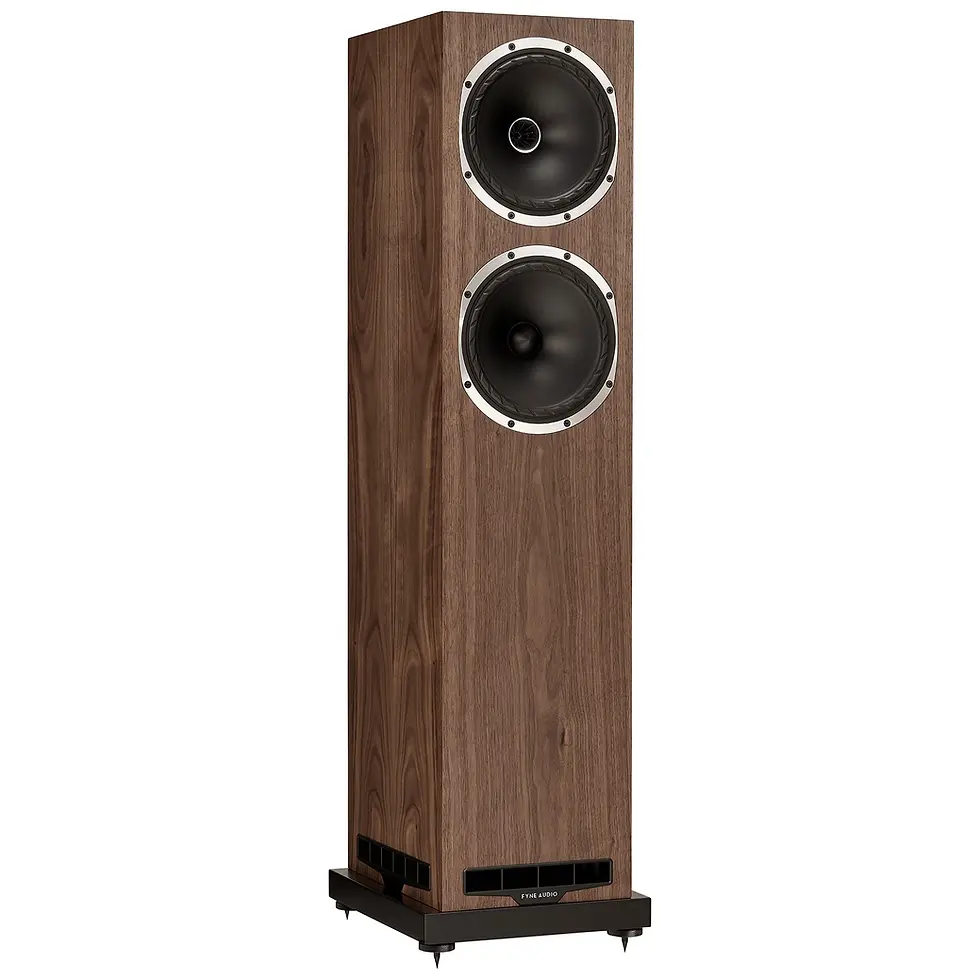
Scottish engineering at a price that makes far more expensive speakers uncomfortable. The F502S uses Fyne's IsoFlare point-source technology a 25mm magnesium dome compression tweeter mounted at the geometric centre of an 8-inch mid/bass cone plus a second 8-inch dedicated bass driver and Fyne's BassTrax downward-firing Tractrix diffuser port. Sensitivity 91dB, nominal impedance 8 ohms.
Sonically, the F502S has genuine scale and authority. Bass is deep, controlled, and physical without ever becoming loose or overblown the BassTrax system distributes bass energy evenly around the base of the cabinet, reducing the room-loading peaks that front- and rear-firing ports create. Midrange is open, natural, and cohesive thanks to the IsoFlare point-source configuration voices, strings, and brass integrate seamlessly across the transition region that trips up most multi-driver designs. Treble is refined and detailed without brightness, faster and more extended than a conventional dome without any etch. Imaging is rock solid, dynamic contrast is exceptional, and it doesn't specialise it's genuinely good at everything, across every genre.
Triangle Antal 40th Anniversary

Triangle has built the Antal since 1994, and the 40th Anniversary edition is the most comprehensively upgraded version yet. Cabinet uses the same high-density MDF as Triangle's Signature and Magellan series, 20–23mm thick with full internal bracing. The tweeter is a rose-gold anodised magnesium dome horn-loaded compression driver lighter than the previous titanium, faster, lower in distortion. Two bass drivers use a composite cone of wood pulp, flax, and carbon fibre with oversized voice coils. Signature-series internal wiring throughout.
Sonically, the Antal 40th is the most effortlessly big-sounding speaker on this list short of the F502S. The horn-loaded magnesium tweeter is its most distinctive element high frequencies land with exceptional speed and dynamic accuracy: cymbals crack rather than shimmer, strings have immediacy and presence. The midrange is Triangle's historic strength: natural cellulose paper drivers that communicate musical emotion with warmth and clarity in equal measure. Bass is satisfying and well-defined rather than thunderous, gaining authority and weight at moderate-to-loud volumes. The soundstage is wide and well-organised, and the sense of dynamic scale on orchestral and large-ensemble music is genuinely impressive. The verdict is simple: astonishing value, and a speaker that challenges rivals at two to three times the price.


The speaker comparisons are really interesting, especially the point about finding something that fits your needs and budget rather than just chasing awards. When it’s time to take a break from audio gear, Rocket Goal is a fun little game to jump into and relax with for a while.