

I have never seen DAC like this Ampapa Q1 review
I have already reviewed the first two products from Ampapa, the A1 preamp and D1 amp. Both solid and great products, that had distinguished style and regarding the D1 amp, great sonics that can rival all the best products in that price range. In the description of this video, I will link to my reviews of these products.
Ampapa D1 review: https://www.hifidaydreaming.com/post/finally-stylish-cheap-and-good-amp-douk-audio-x-ampapa-d1-review-vs-fosi-and-ayima
Ampapa A1 review: https://www.hifidaydreaming.com/post/douk-audio-x-ampapa-a1-brings-outstanding-versatility-and-quality-at-129-preamp-review-vs-fosi-and
A Surprise like no other
But what about the brand new product from Ampapa, the Q1 DAC. A DAC that I received from the company to review, and as I loved the first two products, I never bothered until it arrived to observe it and analyse it. And so I connected that DAC with the rest of its siblings. To start listening, there is a long road of listening sessions and it is a good time to start, review will as always wait a little bit.
And before going into sound, I dabbled a little bit with the menu of this device, and there is HP DAC and Line DAC. I was like what? Inside that menu, you can choose ESS, AKM, or that ESS and AKM are firing through two different channels. Again what?
I looked closely and I saw something that I never saw before. What Ampapa Q1 did, is actually having two different DACs under one roof, sharing the same architecture. Oh my god, that is amazing. I am so sorry for everyone who is watching this review, who cannot experience that surprise like I did, accidentally by serendipity. It was like unpacking the gift box, without knowing what you will get.

And you might ask me now, well my dear friend, we already have a bunch of DACs with two DAC chips inside, some even have four. So what is special here? Well until now, we always had 2 or 4 DAC chips working together in a DAC chain to produce sound. They usually are responsible for different elements of dynamic scale, and how to conduct them.
But here we have two separate individual DACs that can work individually how listeners please, and shape the sound how listener please. It is like an extreme filter shaping inside the DAC, but instead slow and fast rolloffs etc. You get completely different chipset from different companies that produce sounds differently. Really unique and amazing idea, and if that is not correct, please write in the comment about other DACs that do the same thing.
Tech Specs, Features, Inputs and Outputs...
But let’s first go through a quick summary of what is Q1. The Ampapa Q1 is a Hi-Fi USB DAC, Bluetooth 5.2 receiver, and headphone amplifier designed for desktop audio systems. It uses dual DAC chips (ESS9039 + AK4493) and supports high-resolution digital audio formats up to PCM 768 kHz/32-bit and DSD512.
From digital inputs you have USB-C, Bluetooth 5.2, coaxial and optical. And from analog inputs RCA unbalanced, and XLR unbalanced outputs. But also you get headphone amplification inside, with 1000 mW in 32 ohms, and 3.5 mm headphone jack.
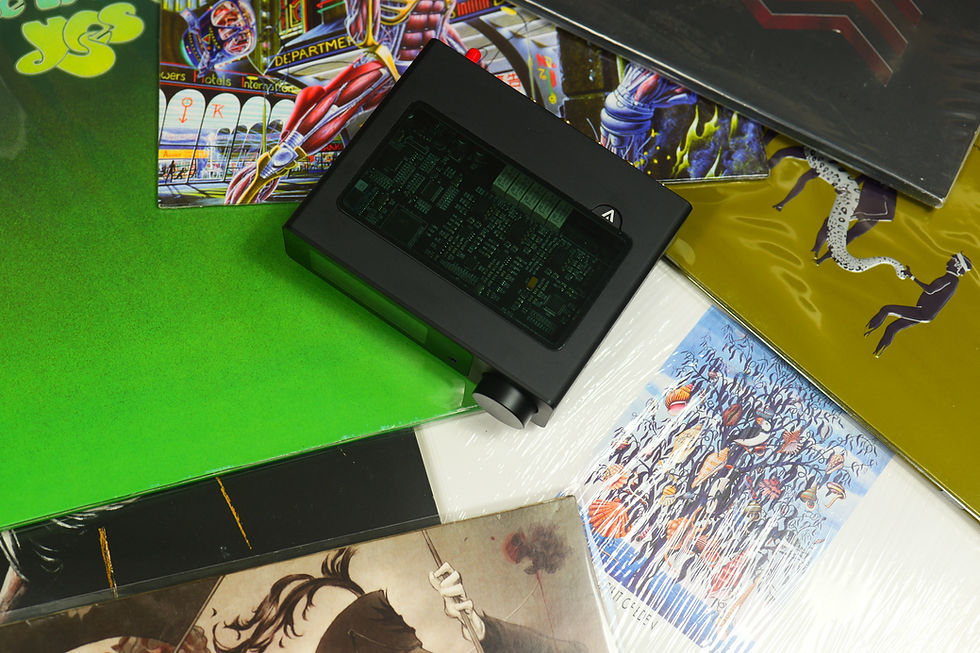
From perspective of inputs and outputs this is not something groundbreaking, and certainly not a selling point of this DAC. But what was spectacular from previous devices, and it certainly Q1 inheritance here is the great looks, open top to see the innards of device and the lights that illuminate the whole device.

I might say something here, even though there is not a long period between A1 and Q1. Ampapa learned a lot about user interface and user experience. Now the menu is far better organised. The remote control has a better layout and back button is more prominent and you can therefore more easily traverse the menus. But something which I really really liked is that now you do not have to lift the glass top to reach the small buttons to change the lights on the device. No, now you can change the lights, I think 6 or 8 of them, with a remote control. Oh how much I wanted this on previous devices and now it is here.
This is all such a positive sign for Ampapa as a company that is ready to learn and adapt to become a better product in future.
Sound Quality ESS + AKM
But I know why you are here, you want to know about the sounds, you want to know is having two DACs under one roof a gimmick or something that will all the companies follow in future.
And the verdict is... I don’t know really. I find it good to have enough of flexibility to change, add and manipulate the sound. But as these are mid tier DACs, working under the same architecture, same clocks, same I/V, the sonic difference is not that big.
ESS
What I noticed is that ESS is a baseline DAC, it is more neutral with less colorations, while the AKM DAC is pushing for that more colorations in bass and treble.
Now I will explain the baseline sound, and add what I feel like it sounded with AKM.
As this is a very neutral DAC, it tends to be clear and analytical. I mean it does what every good DAC is supposed to do. It helps your music to be more organised and decluttered.
Now that does not mean that the DAC itself is a straight line, but don’t expect much of colorations. Which is in my opinion great, the transients in midsection and treble become more clear. Which means that there will not be a large decay here, but rather quick and snappy.

And that will help your speakers to be more organised and informative at top. More information, more details, and insight. I think what it does with sound in this mode is what every great ESS 9038Q2M DAC does. It is a bit bright, detailed, and clear. With a bass which is lean and has an attack, while not giving boost in decibels in sub bass and lower bass.
It is not much dynamic sound, as much as it is precise, open and detailed. Without going much into details here, it is on par with the best DACs that use this chip. And noise floor, distortion, and everything else is great enough that is inaudible.
Voices have space, and are pretty much neutral and present. And you can say that all across the soundstage which is generally airy with space and room around instruments.
AKM
But let’s switch to other side what happens when you use the AKM chip. While maybe you might expect some big changes to happen here, they do exist but they are a bit more subtle how they change the overall sonic character. It almost feels like someone uses an EQ but without loss of information or artificial sounding. Which is great.
The AKM most certainly becomes more V-shaped. It becomes more dynamic, with a slight loss in clarity and quickness.
The bass becomes more tight, with more mass compared to ESS counterpart.
I think what can be said is that sound becomes more warmer, with more body around mids and bass. But not overall like really warm sound, but definitely it has a bit more body and weight to it.
And that is the major difference, that you have little bit less clear, while having a bit more warmth and “musicality” to it. And musicality in sense that it is more laid back, compared to more open and airy presentation of ESS.
It makes vocals a bit more smoother, the instruments a bit more smoother, just something that is easier to listen as it is not something that is open and shows textures and details without veil.
But this is not like night and day, it is a bit more smoother, more emphasis on lower mids, and upper bass. Bit less clarity while everything else pretty much remains the same.

Two really great things
So the great thing about this DAC is how it allows depending on music you listen, and preferable sonic qualities. It remediates an endless question in Hi-Fi which is this which DAC should I get to what speakers and what music I listen. Now you can choose, and it will give you more options and flexibility.
Will that be rock, classical, pop, jazz, you can switch DAC chips with a click of a button. Big thing.
The other big big thing is price, this is 270 dollars. And as far as I know not even single DAC on market does this. It does not give you this flexibility and this great looks and design.
It is almost like buying two DACs for 270 dollars, which is unheard of. Which in itself should make you think twice about getting this DAC.
vs. SMSL D200 and Topping D 50 III
Two closest alternatives are Topping D50 III and SMSL D200. Topping is 240 dollars which is a bit less than Ampapa Q1. But it uses dual ESS chip which is in Q1. Its precision and sonics are similar to ESS side of Q1, while retaining even more clarity and transparency. It is really easy to see that, when you sit and listen and you can just hear instruments more rounded, more detailed, more open. I don’t know how to say it best. It is very clear and transparent DAC. Now this is a bit better than Q1, we all know that Q1 offers better design, flexibility and two different DAC chips. So what you like more you can purchase.
SMSL D200 is an interesting choice, it is 60 dollars more. But you get an amazing DAC that is maybe even the best value DAC in its price range. It is V-shaped but better than AKM portion of Q1. It just has a bit more details, and bass definition that AKM part of this DAC does not provide. It is also a smooth sounding, and it is clearer DAC as well. In reality it is more superior choice.
But I have to mention everything I said with previous comparisons, this gives you flexibility. This gives you if you want ESS chip that sounds more brighter and clean. While overall sonic quality is in D200 direction I think Q1 offers more fun in experimentation and design synergy with other devices in Ampapa catalog.
Conclusion/Giving you a choice
I think what Ampapa tried to do with Q1 is super interesting, and something that I think will catch up among other companies. And I wish that two DACs we have are better implemented, with their own personal architecture. And maybe in future even flagship DACs, that we can have a big difference when we switch between DACs. Like major difference in sonic signature.
But disregarding that, for 270 dollars you get an experiment which is not just something slapped together for sake of experiment, but rather one great looking, and great sounding product. Which is more than enough for you to look in this direction. It looks modern, the LED lights are great, open top is great, and it is not big so it fits everywhere. Its price is right, maybe not best value, or best in class but not far from it. So I think there is a lot of audiophiles that this DAC might really be interesting. So check it out, be the pioneer in these technology.
Thanks for watching this video, if you enjoyed this content, please like and subscribe.
Keep daydreaming, and see you on a next video.
Bye
Buy Ampapa Q1 here: https://doukaudio.com/products/ampapa-q1
Pros
Unique dual-DAC concept (ESS + AKM) – Two completely different DAC chips in one device, allowing you to switch between neutral/analytical and warmer/more musical sound signatures.
Great flexibility in sound tuning – You can adapt the DAC to different genres (rock, classical, jazz, pop) with a simple switch.
Strong value for money – At $270, it’s like getting two DACs in one, which is unheard of in this price range.
Very good sound quality overall – ESS side is clear, detailed and airy; AKM side is warmer, smoother and more dynamic.
Good technical performance – Low noise floor, low distortion, clean and transparent output.
Attractive and distinctive design – Open-top chassis, visible internals and LED lighting make it visually striking.
Improved UI/UX over previous models – Better menu structure, more usable remote, easier navigation.
Remote-controlled lighting – You can change LED modes without opening the device.
Solid feature set – USB-C, Bluetooth 5.2, optical, coaxial, RCA/XLR outputs, and built-in headphone amp.
Fun and educational product – Great for experimentation and learning how different DAC chips affect sound.
Cons
Sonic differences are subtle – The ESS vs AKM switch is not “night and day”; changes are more nuanced.
Not the best in class sonically – Competing DACs (SMSL D200, Topping D50 III) can sound more refined or detailed.
AKM mode loses some clarity – Warmer and smoother, but slightly less precise and less detailed.
More about concept than pure performance – It’s more exciting as an idea and experience than as a reference-grade DAC.


Comments